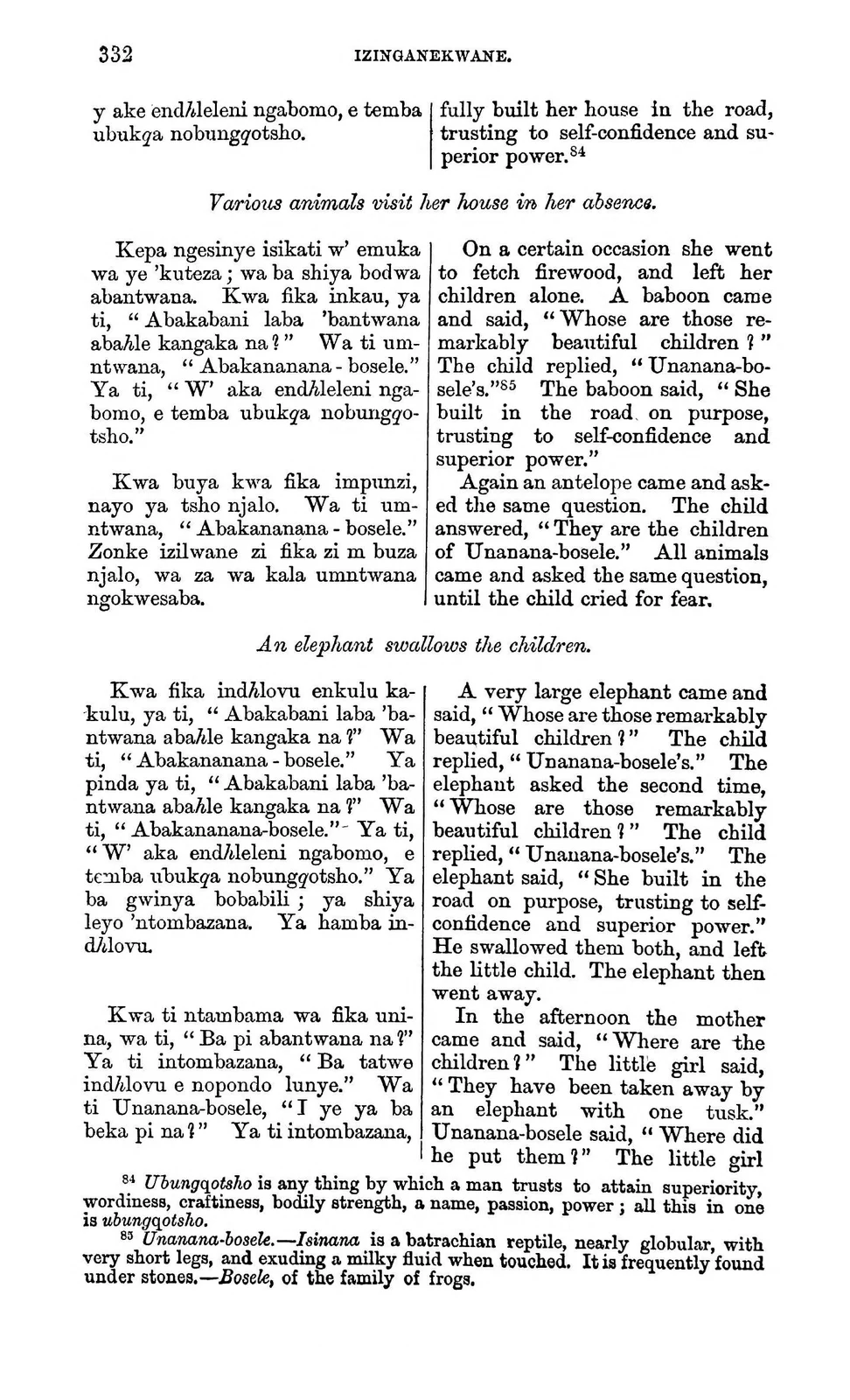
One-Tusked Elephant of Unanana-bosele: documentary text witness, Callaway 1868, printed page 332; documentary source-page facsimile
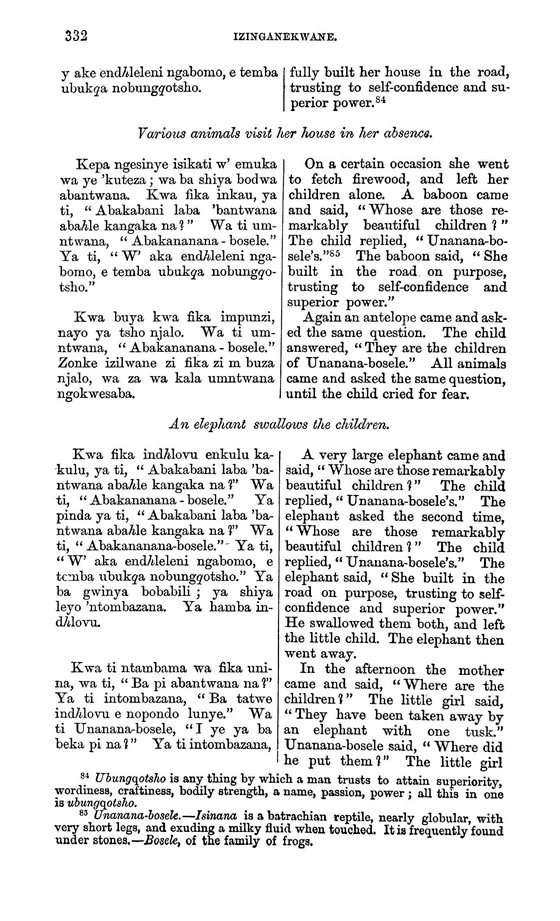
Explicitly one-tusked elephant swallowing Unanana-bosele’s children; exact episode text. Individually inspected original bilingual Zulu/English scanned page; documentary text, no creature illustration claimed. Physical edition 1868; translator/editor distinguished from traditional narrators. Public-domain publication and expired Callaway lifetime.
Overview
Unanana-bosele’s house stands directly in the road. While she gathers firewood, a baboon, an antelope and other visiting animals question the child minding her two children, repeating a complaint about their mother’s confidence in building there. The young companion becomes frightened. A very large elephant repeats the question twice, swallows the two children and leaves her behind. She later identifies the offender by its single tusk, but cannot tell their mother whether the swallowed children are dead.
The mother follows directions from an antelope, a leopard and the other animals toward high trees and white stones. She finds the elephant lying beneath the trees. It repeats their directions as though she must continue elsewhere. Recognizing it, she stands her ground and asks again rather than following the deception. The elephant seizes and swallows her. Its stomach contains large forests, great rivers, high ground and rocks, together with established villages, people, dogs and cattle. Her own children are sitting there alive but have eaten nothing.
She gives the children amasi and answers their fear that cutting the beast will kill them: it is the elephant itself that will die. She lights a large fire, cuts and roasts its liver, and eats with them; they also cut and roast flesh. Other captives, astonished that eating is possible, follow her example. Outside, the elephant tells other beasts that swallowing the woman has brought pain in its stomach. They suggest the many people inside may be responsible. It eventually dies.
Unanana-bosele opens the body with a blade and cuts through a rib with an axe. A cow, a goat, a dog and laughing people emerge, celebrating their return to the open country. The freed captives give her cattle, goats and sheep, and she returns home with her children. Callaway’s note 86 separately records a narration in which prolonged liver-cutting groans draw feeding animals to the elephant. That variant is distinguished from the main account’s spoken complaint and reply.
Origins & earliest records
The selected bilingual account credits Lydia (Umkasetemba). Henry Callaway translates and annotates it; contributor, translation and comparative commentary are distinct layers.
Records & interpretation
Complete selected narrative read, including its ending and contributor credit: Unanana-bosele, pp. 331–335; variant groans in note 86, p. 335.
In the literature
“all was there inside the elephant”
Unanana-bosele, printed p.334 · Henry Callaway
Narrated villages, animals and landscape inside this supernatural elephant.
Selected bibliography
Documented works and useful reading. This is not a list of every appearance.
- 01
Nursery Tales, Traditions, and Histories of the Zulus, in Their Own Words, volume I
Unanana-bosele, pp. 331–335; variant groans in note 86, p. 335
- 02
Nursery Tales, Traditions, and Histories of the Zulus, Volume I — Unanana-bosele
Henry Callaway, Nursery Tales, Traditions, and Histories of the Zulus, Volume I, Springvale, Natal: John A. Blair,1868; bilingual edition, selected Princeton scan. Complete Umamba321–331 and Unanana-bosele331–335 read; both end with Lydia(Umkasetemba).
Family & connections
A source-supported family tree or inspiration record has not yet been compiled for this profile. Related reading below indicates a connection in subject matter, not a proven lineage or creative influence.
Located primary passages
Specific passages supporting details in this entry, grouped by their published witness.
Nursery Tales, Traditions, and Histories of the Zulus, in Their Own Words, volume I
Henry Callaway, Nursery Tales, Traditions, and Histories of the Zulus, Volume I, Springvale, Natal: John A. Blair,1868; bilingual edition, selected Princeton scan. Complete Umamba321–331 and Unanana-bosele331–335 read; both end with Lydia(Umkasetemba).
- Several animals question the child guarding Unanana-bosele’s house. A very large elephant with one tusk swallows her two children but leaves their young minder. It later tries to redirect the searching mother and swallows her when she persists. Its stomach contains forests, rivers, rocky uplands, inhabited villages, dogs, cattle and her living children.
Unanana-bosele, printed pp.331–334; visitation, swallowing and interior
- The mother begins roasting the elephant’s liver and flesh inside it, encouraging other captives to eat too. The elephant reports stomach pain, dies after an interval and is cut open; animals and people emerge alive. The editor separately records an alternative narration in which its groans draw surrounding animals before death.
Unanana-bosele, printed pp.334–335; communal eating, elephant death and note86
Speaking animal and inhabited inner landscape belong to this particular narrated creature. No real elephant species or literal anatomical claim is inferred; the translation varies gendered pronouns. The groaning detail is explicitly a separately noted version, not silently inserted into the main narration. The beast is actually killed, contrasting with a simple release or escape ending.
References
Sources supporting this profile. Linked pages have their own scope and editorial standards.
- Attributed primary narrative with translation; digitized bilingual editionCallaway bilingual edition — Unanana-bosele, pp. 331–335; variant groans in note 86, p. 335Research access: 2026-10-05
Image credits
Historical text facsimileOne-Tusked Elephant of Unanana-bosele: documentary text witness, Callaway 1868, printed page 332; documentary source-page facsimile
Explicitly one-tusked elephant swallowing Unanana-bosele’s children; exact episode text. Individually inspected original bilingual Zulu/English scanned page; documentary text, no creature illustration claimed. Physical edition 1868; translator/editor distinguished from traditional narrators. Public-domain publication and expired Callaway lifetime.