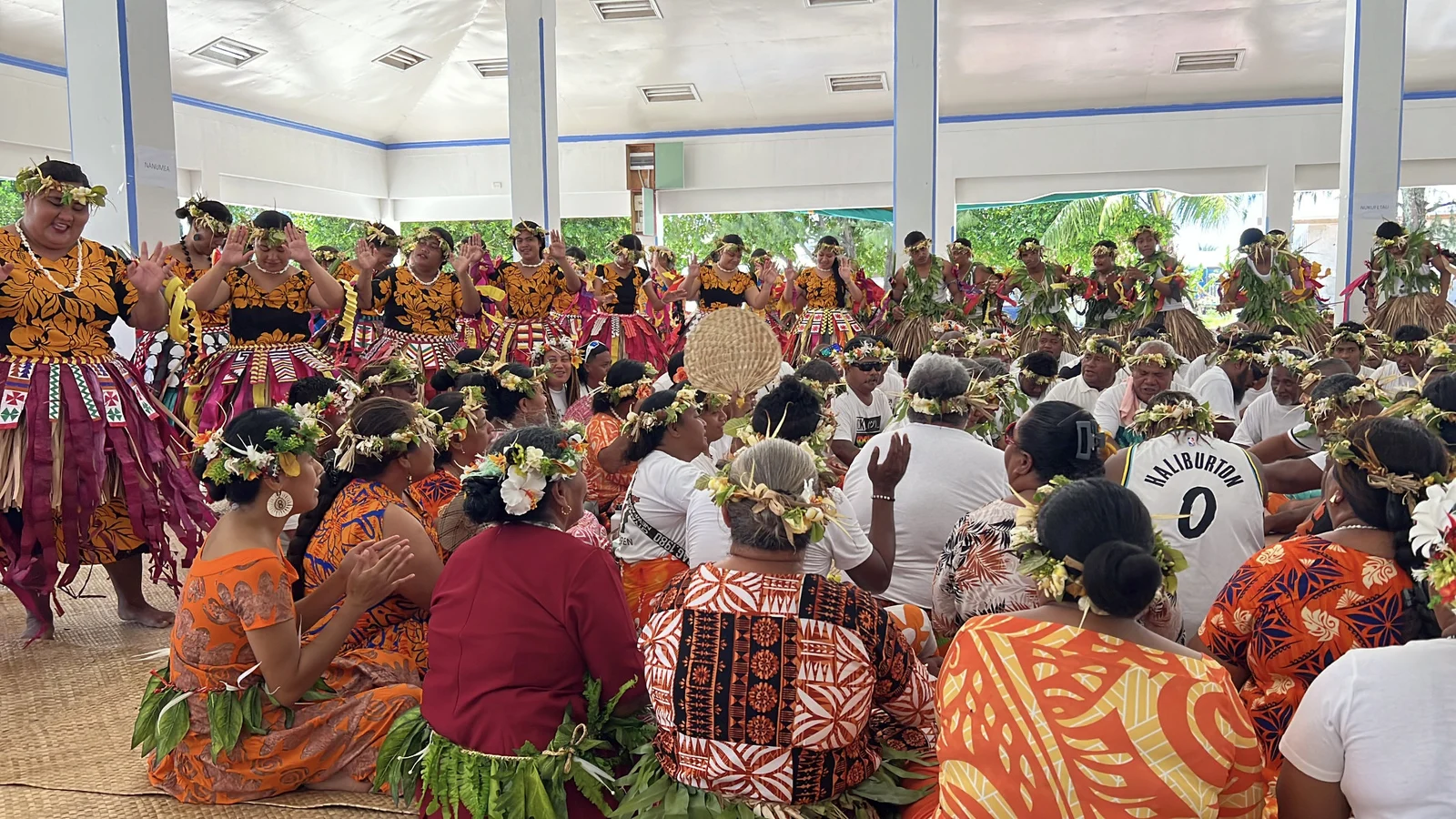
Standing and seated performers in an open hall, wearing colourful patterned clothing and leaf garlands; the photographer identifies this as a Nanumea group performing fatele in Funafuti.
A Nanumea group performing fatele in Funafuti for Tuvalu Independence Day, 1 October 2025, as identified by photographer JialiangGao. This particular performance does not represent every island community or disclose the performance’s lyrics or procedures.
Overview
Tuvaluans have a homeland across Tuvalu’s atolls and reef islands and communities overseas. The country’s 2024 cultural-landscape submission describes shared cultural connections alongside home-island identities, differing dialects and local practices. It discusses villages, meeting halls, houses, gardens and marine environments as places shaped by social life. This is Tuvalu’s own submission to UNESCO’s Tentative List, not a World Heritage inscription or an independent endorsement of every historical statement in it. The account explicitly recognises that Tuvaluan society changes. Its combination of local differences and shared relationships is more informative than treating all island communities as one uniform way of living.
A community gift provides a different kind of evidence. Te Papa records a woven pandanus mat, FE012623, given by Siale Glover on behalf of the Wellington Tuvalu Community for the opening of Tangata o le Moana in 2007. The museum leaves its maker and production date unknown. Those gaps should be preserved: the date of the gift cannot be substituted for the date the mat was made. This object places community participation within a museum collection without assigning a biography to an unnamed maker. Alongside it, a 2024 language-week report credits Kaiga Tuvalu Otago with developing that year’s theme, which emphasised language and dialect as part of identity.
In September 2026, a ministry account describes Sapeta Manaia and the Tuvalu Oamaru Community Group bringing elders and younger participants together in workshops. The programme began with language basics and continued with crafts and adornments. Sapeta describes these sessions as learning opportunities for herself as well as for children, connecting families living abroad with island knowledge. This is evidence of a particular funded project and its participants’ aims, rather than proof of universal proficiency or uninterrupted transmission. The report links workshop learning with public performances and language-week activities, showing how a community can make space for teaching and recognition beyond home and school.
Another September 2026 report follows researcher Lisepa Paeniu and student Sinirewa Agaifo’s work with elders and knowledge holders in Tuvalu. Their planned language book shifts attention from merely describing how objects are made to asking who taught the skills and to whom they will be passed. The report identifies Lisepa’s connections with Nukulaelae and Funafuti and her doctoral study at Otago. It gives publication at the end of 2026 as a plan, not a completed book available for inspection. These named accounts show people choosing how to document and transmit knowledge. They also retain the distinction between reading a project report and having read the underlying oral accounts or the future publication.
History & identity
A living community overview distinguishing home-island affiliations, diaspora participation and the Tuvaluan state. The 2024 Tentative List submission and dated projects are documentary milestones, not origin dates for identity.
Sources & representation
A scoped Tuvalu-submitted landscape account, an exact museum object record and complete dated reports with named community participants are used. The exposed-code Home Affairs homepage is excluded as unreliable. No ritual instructions or unpublished book contents are supplied.
Selected bibliography
Documented works and useful reading. This is not a list of every appearance.
- 01
The Pacific atoll-island cultural landscape of Tuvalu
Complete general Description read; home-island differences and changing landscapes retained. Tentative submission, not inscription.
- 02
Mat FE012623
Complete item record read; Wellington community gift in 2007, unknown maker and production date retained.
- 03
Upholding Tuvaluan Language and Identity in New Zealand
Complete report read; Kaiga Tuvalu Otago theme authorship used, old census figures omitted.
- 04
Passing on Tuvalu traditions to the next generation
Complete 28 September 2026 report read; Sapeta Manaia and Oamaru workshops scoped. No craft procedure reproduced.
- 05
Ensuring Tuvalu knowledge and stories live on
Complete 28 September 2026 report read; Paeniu/Agaifo research and planned publication distinguished. No unpublished book reading claimed.
Language & cultural connections
Source-supported language and cultural connections have not yet been compiled for this profile.
References
Sources supporting this profile. Linked pages have their own scope and editorial standards.
- State-submitted heritage documentationThe Pacific atoll-island cultural landscape of TuvaluResearch access: 2026-10-05
- Museum object recordMat FE012623Research access: 2026-10-05
- Community programme reportUpholding Tuvaluan Language and Identity in New ZealandResearch access: 2026-10-05
- Named community programme reportPassing on Tuvalu traditions to the next generationResearch access: 2026-10-05
- Named community research reportEnsuring Tuvalu knowledge and stories live onResearch access: 2026-10-05
Image credits
Contextual community performance photographStanding and seated performers in an open hall, wearing colourful patterned clothing and leaf garlands; the photographer identifies this as a Nanumea group performing fatele in Funafuti.
A Nanumea group performing fatele in Funafuti for Tuvalu Independence Day, 1 October 2025, as identified by photographer JialiangGao. This particular performance does not represent every island community or disclose the performance’s lyrics or procedures.