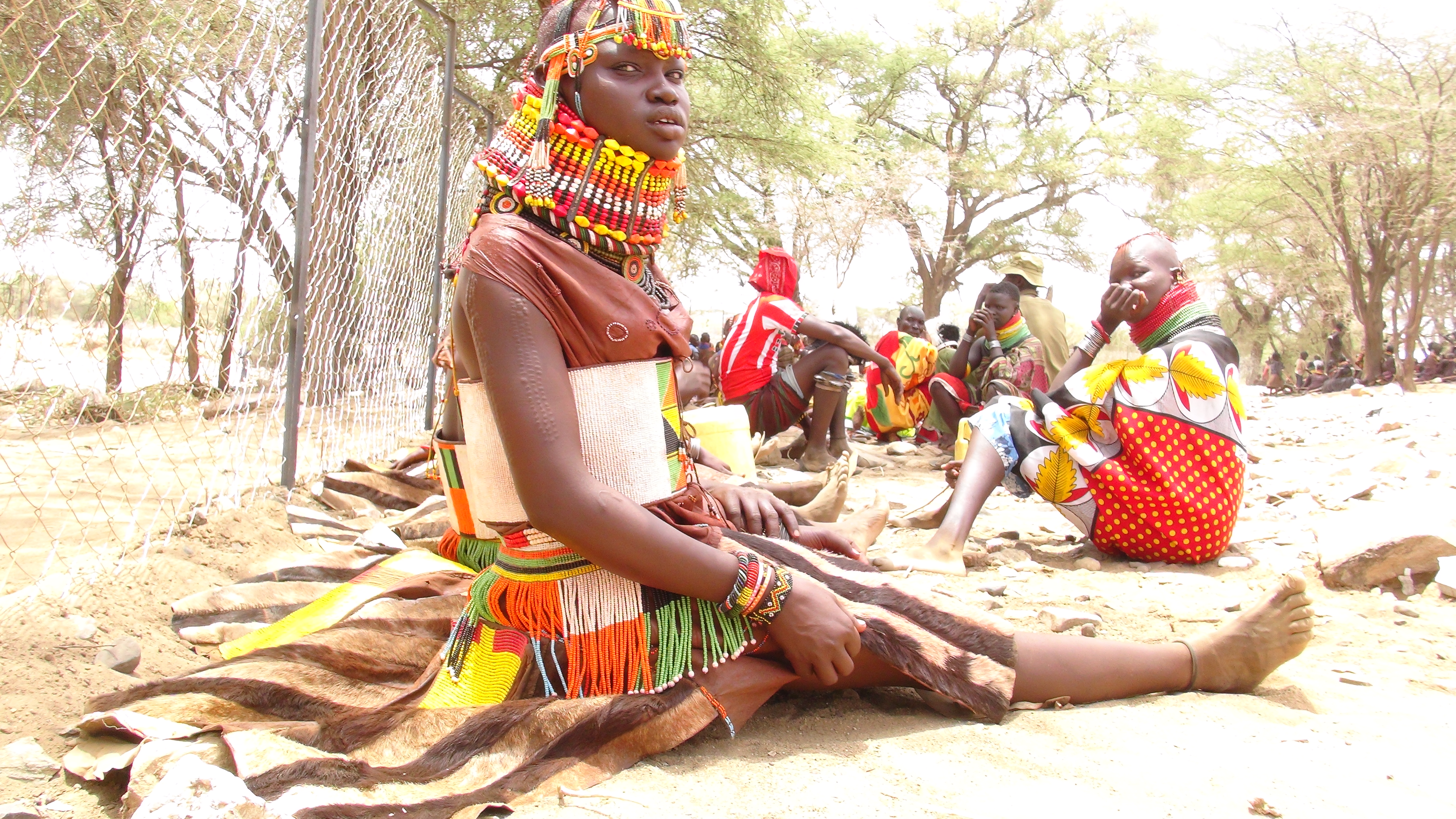
Women sit outdoors beneath trees, wearing colourful bead adornments and cloth or hide garments; the photographer identifies them as Turkana women attending a cross-border event in Uganda.
A cross-border event in Uganda photographed by Hannahlongole on 21 September 2015. The author identifies the pictured women as Turkana, but supplies no personal names or event title. Their clothing is shown in this particular event context.
Overview
Turkana communities in Kenya are represented here through museum documentation, cultural events and contemporary local education work. The National Museums of Kenya’s exhibition connects the community with Turkana and Marsabit counties and describes livestock keeping alongside fishing and farming near Lake Turkana and the Turkwel River. Its collection examples include beaded clothing, ornaments, dance bells and metal objects. Philemon Nyamanga is credited as exhibit curator. The Desert Museum at Loiyangalani presents Turkana heritage alongside other regional communities. These examples keep different local livelihoods visible, rather than assigning one occupation or museum object to every Turkana person.
The Tobong’u Lore festival offers another public setting for cultural relationships. A December 2025 ministry report locates its ninth edition in Lodwar and describes participation by neighbouring Ateker communities, including Iteso, Karamojong, Jie, Nyang’atom and Toposa participants. The ministry frames the event as promoting cultural preservation, cross-border relationships and tourism. The museum exhibition separately distinguishes the Lake Turkana Cultural Festival at Loiyangalani from Tobong’u Lore in Turkana County. Their locations and organisers should not be collapsed into one event. Shared participation supports a documented cultural connection, without requiring identical languages, citizenship or customs among all attending communities.
Contemporary education is also part of community organising. BITE describes its beginnings among university students from Turkana and its efforts to involve local youth, parents, elders and leaders. Its education account identifies literacy classes in Ngaturkana and Kiswahili, teacher training and mentorship, and culturally relevant learning materials. Community resource centres and mobile libraries are described as work being developed. These activities bring language and educational access into the same account as local leadership. The organisation’s stated approach is retained without adopting its undated headline literacy figures or treating proposed facilities as already completed.
The Turkana Community Foundation provides a further local organisational account. Its website identifies Samuel Litunya as founder in 2015 and describes a board, programme staff and volunteers with different responsibilities. Education work includes the Wings of Hope early-childhood centre and support for children returning to school. Its wider programme includes vocational training in tailoring, computing and entrepreneurship, alongside community protection and household livelihood work. These are the foundation’s descriptions of its activities and aims, rather than independently audited measures of reach. The two organisations illustrate selected contemporary initiatives; neither is treated as the sole representative of Turkana identity or county residents.
History & identity
Living regional identity; festival editions and organisation founding dates concern particular institutions and events.
Sources & representation
A credited museum exhibition, dated official festival report and local organisational accounts; source claims remain scoped to their contexts and programme reporting.
Selected bibliography
Documented works and useful reading. This is not a list of every appearance.
- 01
The Turkana Community of Kenya
Complete exhibit text and credits read; local livelihoods, objects and distinct festival locations.
- 02
A Celebration of Culture and Heritage at the 9th Turkana Tourism and Cultural Festival
Complete December 2025 report read; cross-border participants, without identical-language or biological-descent claims.
- 03
Education
Complete approach section read; named languages and plans. Undated headline rates excluded.
- 04
Our story and programmes
Complete governance, programme and founder sections read; activities attributed, numerical impact not independently verified.
Language & cultural connections
Source-supported language and cultural connections have not yet been compiled for this profile.
References
Sources supporting this profile. Linked pages have their own scope and editorial standards.
- Museum cultural exhibitionThe Turkana Community of KenyaResearch access: 2026-10-05
- Dated government festival accountA Celebration of Culture and Heritage at the 9th Turkana Tourism and Cultural FestivalResearch access: 2026-10-05
- Local organisation self-descriptionEducationResearch access: 2026-10-05
- Local organisation self-descriptionOur story and programmesResearch access: 2026-10-05
Image credits
Contextual community activity photographWomen sit outdoors beneath trees, wearing colourful bead adornments and cloth or hide garments; the photographer identifies them as Turkana women attending a cross-border event in Uganda.
A cross-border event in Uganda photographed by Hannahlongole on 21 September 2015. The author identifies the pictured women as Turkana, but supplies no personal names or event title. Their clothing is shown in this particular event context.