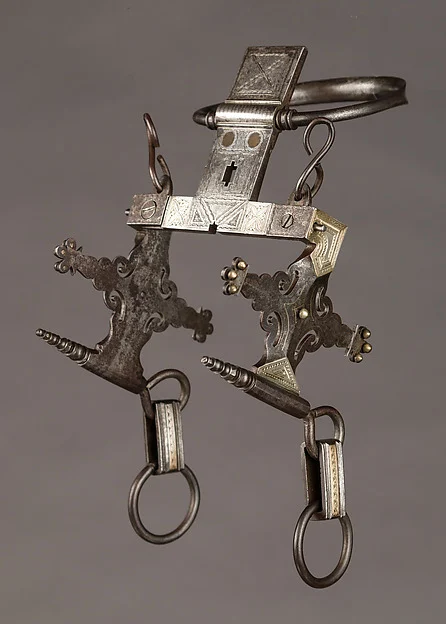
Nineteenth-century Tuareg ring bit of iron, silver and copper alloy, with decorated cheek pieces and hanging rings, Met 36.25.557
This nineteenth-century ring bit is catalogued as Tuareg and combines iron, silver and copper alloy. It illustrates one historical piece of decorated riding equipment, rather than the appearance or practices of every member of today’s Tuareg communities.
Overview
Tuareg cultural communities are documented here through selected musical, educational and urban heritage witnesses. UNESCO’s 2013 Imzad inscription explicitly concerns communities in Algeria, Mali and Niger. Its account identifies women playing a single-stringed bowed instrument and describes music accompanying poetry and songs, including compositions associated with remembered heroic deeds. Both women and men participate in the surrounding performance. Knowledge is transmitted orally through observation and learning from practitioners. The inscription recognises a particular body of practice across national borders; it does not establish identical citizenship, one institution representing everyone, or a complete account of the many communities described as Tuareg.
Association Sauver l’Imzad’s published values connect cultural work with education, economic concerns and exchanges involving younger generations. The association calls for debates, meetings and cooperation with people in Algeria and elsewhere, while stating that changes should involve consultation with Tuareg populations. Transparency and collective responsibility form part of its declared approach. These are organisational principles and aspirations expressed by the association, rather than a survey of every community’s preferences. The site’s dated account is retained as a cultural actor’s self-description; its publication does not demonstrate that all the proposed development benefits have occurred.
The association’s programme describes cooperation with cultural and vocational authorities, local organisations, research centres and media. Proposed work includes inventorying heritage, recording and conserving it with contemporary methods, and exchanges with related artistic settings in neighbouring countries. It also identifies artist training, musical and poetry events, and Dar El-Imzad, an intended artists’ centre, as programme components. This documentation makes institutional planning and practical support visible alongside performance itself. The programme page is evidence of planned structures and partnerships; it is not used to establish when a centre was completed or whether every proposed activity remains operational.
Agadez provides a different regional witness. UNESCO’s account relates the Niger city’s historic growth to the Sultanate of Aïr, Tuareg settlement and trans-Saharan exchanges. It describes a street pattern associated with former encampments, earthen housing, the Grand Mosque and the Sultan’s Palace. The historic centre remains a living urban place, with cultural, commercial and craft traditions discussed together. Its architecture is interpreted as specific to the Aïr region, rather than a template for every Tuareg dwelling. The city’s fifteenth- and sixteenth-century development dates concern this urban history; they are not an origin date for all Tuareg people. Together these witnesses document music, advocacy and an inhabited heritage landscape without reducing identity to one occupation or settlement form.
History & identity
Cross-border musical designation, association planning and Agadez urban history document distinct settings; institutional and city dates do not define the origin of Tuareg communities.
Sources & representation
Complete indexed music and association accounts plus a full English urban heritage statement preserve their different geographical and institutional scopes.
Selected bibliography
Documented works and useful reading. This is not a list of every appearance.
- 01
Practices and knowledge linked to the Imzad of the Tuareg communities of Algeria, Mali and Niger
Complete indexed English description read; three-country scope, music/poetry and oral learning retained; craft recipe and therapeutic claims excluded.
- 02
Our values
Complete indexed values body read; consultation and educational aims attributed. Native certificate expired; no bypass, dated site not assumed current.
- 03
Notre programme: specific objectives and components
Complete indexed programme page3 read; inventory, partnerships and proposed centre distinguished from achieved results. Native certificate failure retained.
- 04
Historic Centre of Agadez
Complete English description and value statement read; regional architecture and living urban setting retained; old population/current prosperity claims excluded.
Language & cultural connections
Source-supported language and cultural connections have not yet been compiled for this profile.
References
Sources supporting this profile. Linked pages have their own scope and editorial standards.
- Official heritage element accountPractices and knowledge linked to the Imzad of the Tuareg communities of Algeria, Mali and NigerResearch access: 2026-10-05
- Cultural association self-descriptionOur valuesResearch access: 2026-10-05
- Cultural association programmeNotre programme: specific objectives and componentsResearch access: 2026-10-05
- Official urban heritage descriptionHistoric Centre of AgadezResearch access: 2026-10-05
Image credits
Contextual cultural object photographNineteenth-century Tuareg ring bit of iron, silver and copper alloy, with decorated cheek pieces and hanging rings, Met 36.25.557
This nineteenth-century ring bit is catalogued as Tuareg and combines iron, silver and copper alloy. It illustrates one historical piece of decorated riding equipment, rather than the appearance or practices of every member of today’s Tuareg communities.