A sourced illustration has not yet been added. This gap is included in the coverage record.
Overview
An old woman lives deep in the forest with nine daughters. Nine youths visit them, but the youngest refuses food and stays awake. He exchanges the boys’ and girls’ clothing. When the woman feels for garments in the darkness to identify her intended victims, she kills her daughters instead. The boys escape through a tunnel. At dawn she discovers the deception and resolves to take revenge.
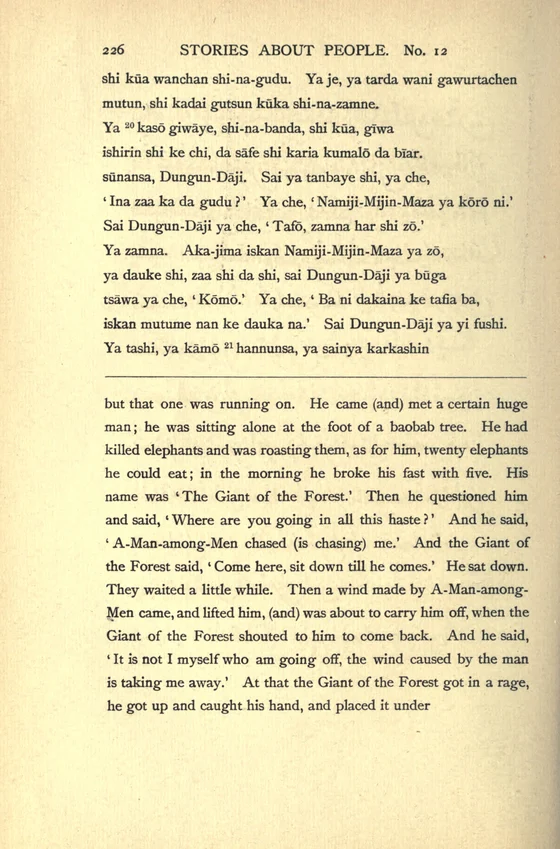
She enters their town as a magaria tree. Fifteen boys climb into its branches; she uproots it and carries them to her house. The youngest of the original brothers follows, enters her cow’s belly and emerges as a female calf. By breaking the woman’s calabashes he provokes her into sending the captured boys to catch and kill it. He leads them home and becomes human again. Her next disguise is a Fulani woman bringing milk into the town, with a prohibition against looking into it. An older brother looks and loses his eyes; she becomes a whirlwind and carries them away. The youngest recovers the eyes by dressing as her youngest daughter and gaining her confidence.
Later she captures him while he hunts and confines him in a pit. He pulls her daughter into the pit and takes her clothing, so the mother kills and eats her own child while believing the victim is the boy. He reveals himself and warns the town to flee. Returning for a brother’s dropped slipper, he is trapped once more. He blinds her temporarily with pepper, tricks her into releasing his foot for a post, escapes and burns the closed house. The town returns after her death. The ending awards the youngest wealth and half the town, then credits him with constructing its protective wall.
Origins & earliest records
Malam Shaihu supplies the written Hausa material translated and transliterated by R. Sutherland Rattray. The compiler’s Author’s Note describes a mixed written and Arabic-manuscript mediation process; this tale is not labeled a verbatim oral field transcription by a separately named narrator.
Records & interpretation
Shaihu/Rattray, Hausa Folk-Lore, Customs, Proverbs, etc., Volume I (1913), tale 8, complete pp. 162–184; compiler methodology p. xii.
Selected bibliography
Documented works and useful reading. This is not a list of every appearance.
- 01
Hausa Folk-Lore, Customs, Proverbs, etc., Volume I
Shaihu/Rattray, Hausa Folk-Lore, Customs, Proverbs, etc., Volume I (1913), tale 8, complete pp. 162–184; compiler methodology p. xii.
Family & connections
A source-supported family tree or inspiration record has not yet been compiled for this profile. Related reading below indicates a connection in subject matter, not a proven lineage or creative influence.
References
Sources supporting this profile. Linked pages have their own scope and editorial standards.
- Bilingual manuscript tale; digitized primary OCRShaihu/Rattray 1913 — Tree-and-Whirlwind Witch of Shaihu’s TaleResearch access: 2026-10-05
- Compiler methodologyAuthor’s NoteResearch access: 2026-10-05
Image credits
A sourced illustration has not yet been added. This gap is included in the coverage record.