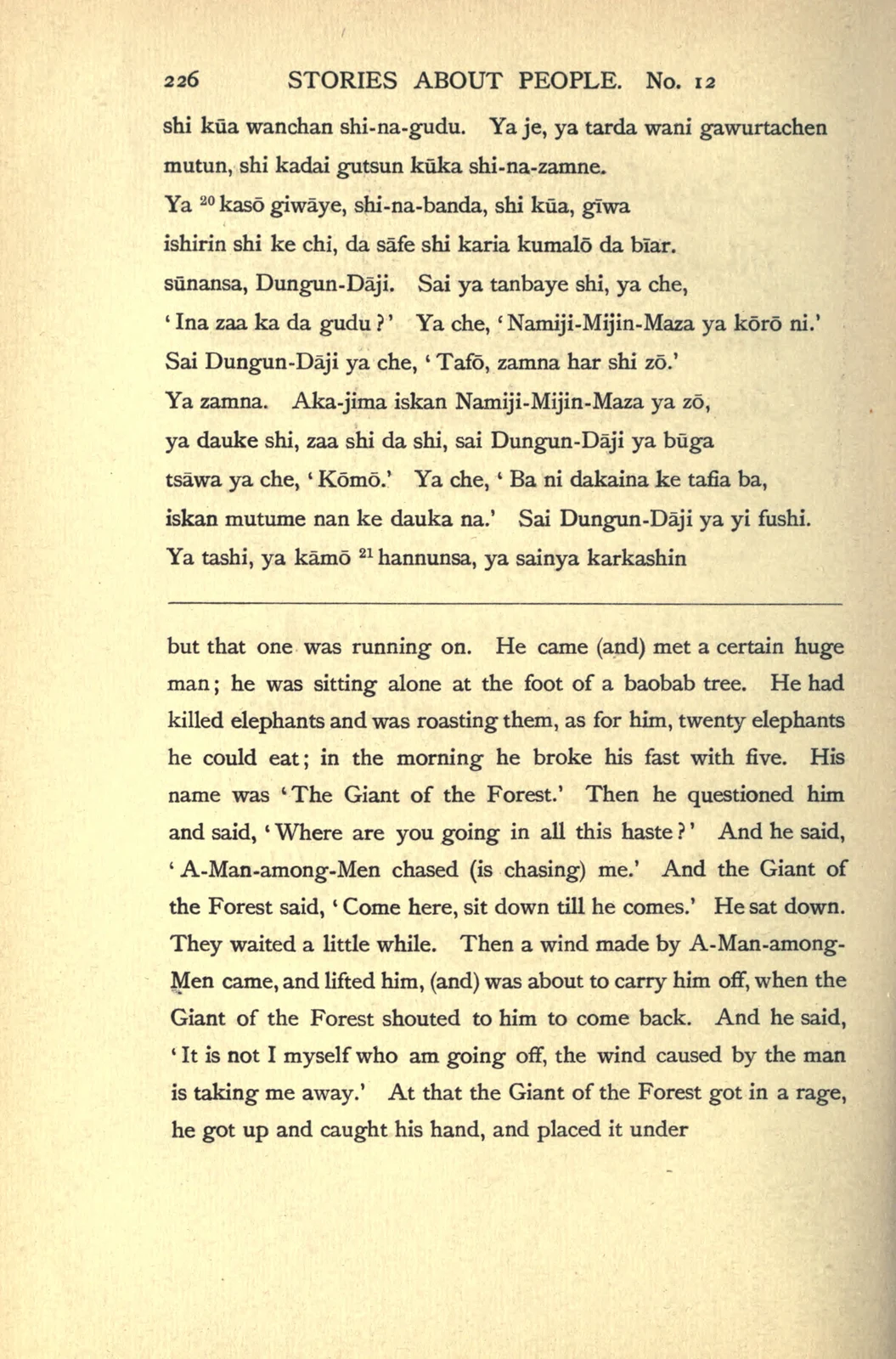
Dungun-Daji, historical printed text witness, page226; documentary source-page facsimile
Documentary text facsimile of the named Hausa tale, with transliteration and English translation; not creature artwork. Original publication page226.
Overview
Dungun-Daji appears near the end of a contest over the boast A-Man-among-Men. A wood-carrying man uses that title for himself, despite his wife’s warning that a stronger person may exist. He visits a forest household whose huge master uses the same title. The visitor hides, escapes at the sign of the master’s sleep and is pursued. Groups clearing land, hoeing and sowing first offer protection, but the wind produced by the pursuer knocks them about before he himself arrives. They send the fugitive onward.
The fugitive finally finds Dungun-Daji alone beneath a baobab tree, roasting elephants. The text credits him with eating twenty and taking five for breakfast, compared with the pursuing master’s ten-elephant appetite and one-elephant morning meal. These stated quantities distinguish the two large figures without assigning exact heights. Dungun-Daji asks about the flight and invites him to stay. When the pursuer’s wind lifts him, the protector at first orders him back; after hearing that the departure is involuntary, he takes his hand and holds it under his thigh.
The pursuing A-Man-among-Men challenges the seated protector as living or dead and demands the person he is sheltering. Dungun-Daji refuses and invites him to take the fugitive himself. The two seize each other, intertwine their legs and leap into the heavens. They remain there, resting when exhausted and renewing their struggle; the sound of thunder is explained as their wrestling. The released fugitive returns home, where his wife applies the experience to his earlier boasting. The ending leaves both wrestlers in the sky, without making one the victor or giving either a separate lightning weapon.
Origins & earliest records
Malam Shaihu supplied written Hausa material, sometimes translated from Arabic manuscripts; Rattray transliterated and translated it into English. The author note dates the manuscript collection to 1907–1911.
Records & interpretation
Complete tale 12 pp. 210–230 reread: two similarly titled men distinguished; three failed farm-worker refuges pp. 222–224, Dungun-Daji pp. 226–230.
In the literature
“Till this day they are wrestling there”
Tale 12, p. 228; English translation beneath Hausa text · R. Sutherland Rattray
The sky-wrestling of the two powerful beings explains thunder.
Selected bibliography
Documented works and useful reading. This is not a list of every appearance.
- 01
Hausa Folk-Lore, Customs, Proverbs, etc., Volume I
Complete tale 12 pp. 210–230 reread: two similarly titled men distinguished; three failed farm-worker refuges pp. 222–224, Dungun-Daji pp. 226–230.
- 02
Hausa Folk-Lore, Customs, Proverbs, etc., Volume I — Tale 12, printed pp. 226–230
Oxford: Clarendon Press, 1913, volume I. Malam Shaihu supplied written Hausa material during 1907–1911; Rattray transliterated, translated and annotated. The author note includes material translated from Arabic manuscripts, so oral collection is not assumed for every tale.
Family & connections
A source-supported family tree or inspiration record has not yet been compiled for this profile. Related reading below indicates a connection in subject matter, not a proven lineage or creative influence.
Located primary passages
Specific passages supporting details in this entry, grouped by their published witness.
Hausa Folk-Lore, Customs, Proverbs, etc., Volume I
Oxford: Clarendon Press, 1913, volume I. Malam Shaihu supplied written Hausa material during 1907–1911; Rattray transliterated, translated and annotated. The author note includes material translated from Arabic manuscripts, so oral collection is not assumed for every tale.
- The fugitive encounters Dungun-Daji roasting elephants beneath a baobab; the giant shelters him from the pursuing wind and holds him beneath his thigh.
Tale 12, printed pp. 226–230; p. 226, encounter beneath the baobab
- Dungun-Daji grapples with A-Man-among-Men; they rise into the heavens and continue wrestling, with thunder explained as the sound of their struggle.
Tale 12, printed pp. 226–230; p. 228, wrestling in the heavens
The historical translation and manuscript collection are mediated witnesses; the entire selected episode was read. Narrative labels are not zoological identification.
References
Sources supporting this profile. Linked pages have their own scope and editorial standards.
- Bilingual manuscript tale; digitized primary OCRHausa Folk-Lore I — tale 12Research access: 2026-10-05
- Compiler methodologyAuthor’s NoteResearch access: 2026-10-05
Image credits
Historical text facsimileDungun-Daji, historical printed text witness, page226; documentary source-page facsimile
Documentary text facsimile of the named Hausa tale, with transliteration and English translation; not creature artwork. Original publication page226.