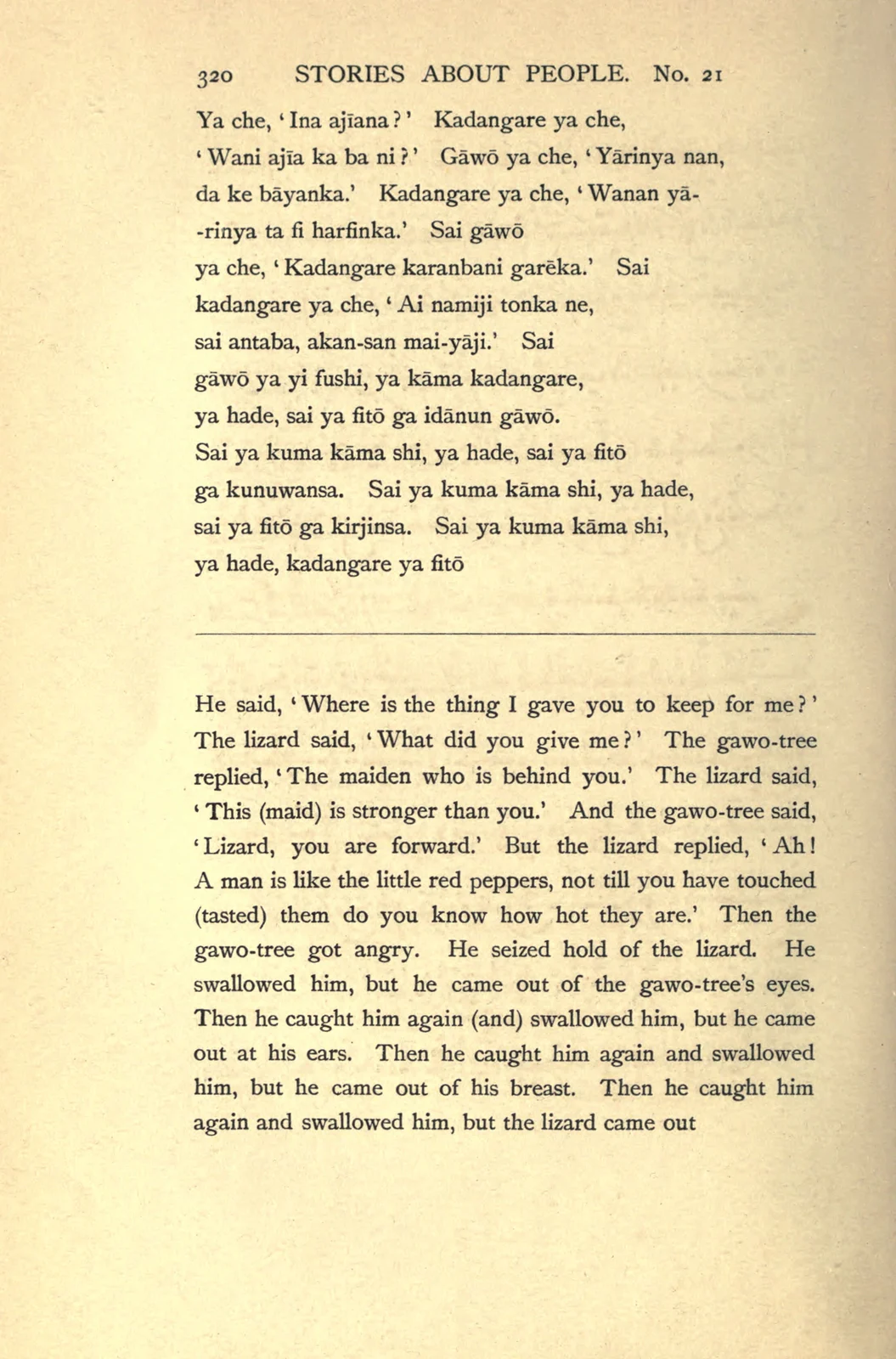
Gawo tree, historical printed text witness, page320; documentary source-page facsimile
Documentary text facsimile of the named Hausa tale, with transliteration and English translation; not creature artwork. Original publication page320.
Overview
The daughter of Mowa repeatedly takes household sweepings to a gawo tree, touches a growth resembling a human navel and mocks that feature. One day the tree pulls itself out of the ground and pursues her, speaking a refrain that repeats the insult she has used morning and evening. She first appeals to sowers, then to people hoeing and finally to ploughmen. Each group confidently promises to kill the approaching pursuer with its agricultural implements. Each changes its mind when the walking tree actually arrives and sends the girl further on. The repetition makes the tree's visible arrival defeat successive promised defenses before any tool is used.
A weaving lizard is the first protector who holds his ground. The girl shelters close to him while he continues his weaving rhythm, and he asks whether she will marry him if he separates her from the pursuer. She agrees. When the tree demands the girl as something supposedly left in the lizard's keeping, the defender rejects that claim. A verbal exchange about courage provokes the tree into grabbing and swallowing him. The lizard escapes through its eyes, is caught and swallowed again, then emerges through the ears. Further captures lead to an exit through the breast and finally the navel, at which the tree falls dead. The marked growth that occasioned the pursuit therefore becomes the point of its defeat.
The lizard escorts the girl home, but she refuses the promised marriage. The father instead offers Baura's daughter, who accepts; the defender is revealed as a chief's son and brings wedding gifts from his own household. The closing contrast follows the first girl's mistaken belief that another suitor must also be a disguised royal. That social ending is part of the same full tale, after the monster has already died. The walking, speaking, repeatedly swallowing tree belongs to this specific manuscript narrative, whose ending continues through printed p. 326 rather than stopping at the navel encounter.
Origins & earliest records
Malam Shaihu supplied written Hausa material, sometimes translated from Arabic manuscripts; Rattray transliterated and translated it into English. The author note dates the manuscript collection to 1907–1911.
Records & interpretation
Complete VolumeI tale 21 pp. 312-326 independently read, including main tree defeat, lizard-prince marriage and second-daughter contrast. Bilingual Hausa/English text preserves the selected manuscript witness.
In the literature
“Then the gawo-tree got angry.”
Tale 21, p. 320; English translation beneath Hausa text · R. Sutherland Rattray
The pursuing tree begins its confrontation with the rescuing lizard.
“And the gawo-tree fell down and died.”
Tale 21, p. 322; English translation beneath Hausa text · R. Sutherland Rattray
The tree dies after the lizard repeatedly escapes from its body.
Selected bibliography
Documented works and useful reading. This is not a list of every appearance.
- 01
Hausa Folk-Lore, Customs, Proverbs, etc., Volume I
Tale 21, complete printed pp. 312-326 now independently inspected, including the closing marriage and second-daughter contrast.
- 02
Hausa Folk-Lore, Customs, Proverbs, etc., Volume I — Tale 21, printed pp. 312–326
Oxford: Clarendon Press, 1913, volume I. Malam Shaihu supplied written Hausa material during 1907–1911; Rattray transliterated, translated and annotated. The author note includes material translated from Arabic manuscripts, so oral collection is not assumed for every tale.
Family & connections
A source-supported family tree or inspiration record has not yet been compiled for this profile. Related reading below indicates a connection in subject matter, not a proven lineage or creative influence.
Located primary passages
Specific passages supporting details in this entry, grouped by their published witness.
Hausa Folk-Lore, Customs, Proverbs, etc., Volume I
Oxford: Clarendon Press, 1913, volume I. Malam Shaihu supplied written Hausa material during 1907–1911; Rattray transliterated, translated and annotated. The author note includes material translated from Arabic manuscripts, so oral collection is not assumed for every tale.
- A girl repeatedly touches a navel-like growth on the gawo tree while dumping sweepings; the tree uproots itself and follows her, frightening away would-be protectors until a weaving lizard offers rescue.
Tale 21, printed pp. 312–326; pp. 312–318, uprooting and pursuit
- The tree repeatedly swallows the lizard, which emerges from its eyes, ears, breast and navel; the tree falls dead and the lizard takes the girl home.
Tale 21, printed pp. 312–326; pp. 320–322, the lizard’s repeated escapes
- The rescued girl initially rejects marriage to a lizard; a second daughter accepts him and discovers he is a chief’s son, while the first mistakenly takes a slave for another disguised prince and suffers the tale’s contrasting ending.
Tale 21, printed pp. 312–326; pp. 322–326, marriages and contrasting outcomes
The historical translation and manuscript collection are mediated witnesses; the entire selected episode was read. Narrative labels are not zoological identification.
References
Sources supporting this profile. Linked pages have their own scope and editorial standards.
- Bilingual manuscript tale; digitized primary OCRHausa Folk-Lore I — tale 21Research access: 2026-10-05
- Compiler methodologyAuthor’s NoteResearch access: 2026-10-05
Image credits
Historical text facsimileGawo tree, historical printed text witness, page320; documentary source-page facsimile
Documentary text facsimile of the named Hausa tale, with transliteration and English translation; not creature artwork. Original publication page320.