Baby Pumpkin, historical printed text witness, page310; documentary source-page facsimile
Documentary text facsimile of the named Hausa tale, with transliteration and English translation; not creature artwork. Original publication page310.
Overview
Furaira is the cherished daughter of the wealthy Alabarma. When her mother takes her into the bush, she sees one young pumpkin and wants it plucked as a toy. Her mother resists because it is the plant's only young fruit, but the child cries on returning home and her father orders that she be given it. Once taken, the baby pumpkin follows Furaira, speaking a repeated demand for meat. Her father tries to satisfy it by putting it among his goats. It consumes flock after flock and returns to the child with the same demand. The domestic gift has become a moving pursuer whose appetite makes the household's wealth a sequence of inadequate defenses.
The pumpkin is next sent among sheep, then cattle and camels. Each new provision is consumed and followed by another return to Furaira. It is directed to the servants' quarters and then to the grazing ground, where people too are eaten. The narrative expands the devouring to people and livestock throughout the establishment, explicitly including horses and domestic birds. Finally only the master of the household remains. When Furaira runs to her father, he says there is nothing else left and offers himself if that is what the pursuer wants. The pumpkin takes and swallows him, then continues after the girl rather than being satisfied by the surrender.
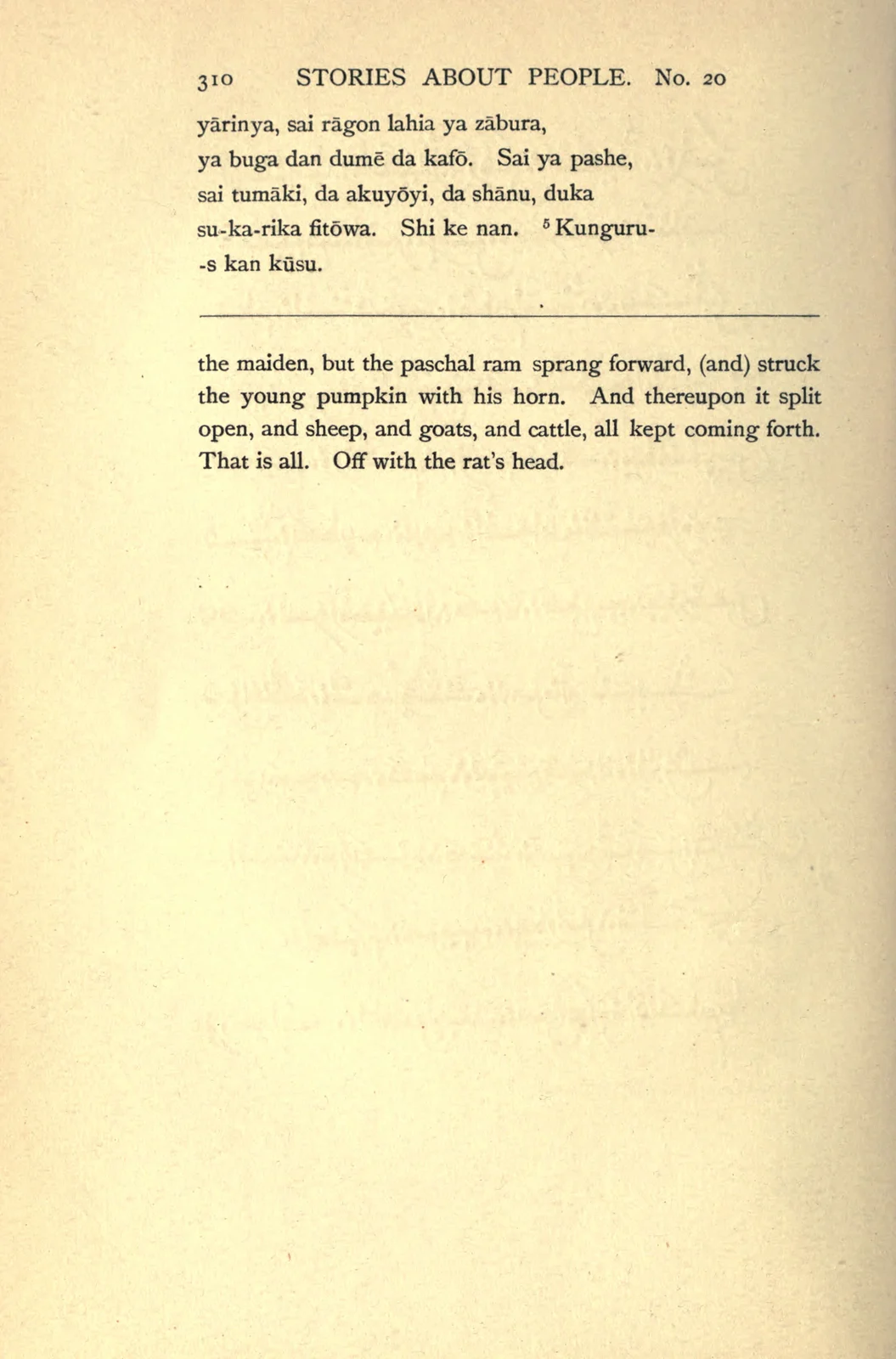
Furaira reaches her father's ceremonial ram. As the pumpkin is about to seize her, the ram springs forward and strikes with its horn. The fruit-body splits open and sheep, goats and cattle keep emerging. The ending names those released animals rather than separately restoring the father, servants and every other victim. The contrast between the initially solitary desired fruit and its enormous swallowing capacity remains central, but the tale does not give a measured giant size or a different animal body to the pumpkin.
Origins & earliest records
Malam Shaihu supplied written Hausa material, sometimes translated from Arabic manuscripts; Rattray transliterated and translated it into English. The author note dates the manuscript collection to 1907–1911.
Records & interpretation
Volume I, tale 20, printed pp. 300–310 directly attests this episode. Primary OCR includes Hausa and English; handwritten manuscript facsimiles form part of the edition. No first oral date is inferred.
In the literature
“the paschal ram sprang forward, (and) struck the young pumpkin with his horn.”
Tale 20, p. 310; English translation beneath Hausa text · R. Sutherland Rattray
The ram interrupts the pumpkin’s pursuit and splits it open.
Selected bibliography
Documented works and useful reading. This is not a list of every appearance.
- 01
Hausa Folk-Lore, Customs, Proverbs, etc., Volume I
Tale 20, printed pp. 300–310
- 02
Hausa Folk-Lore, Customs, Proverbs, etc., Volume I — Tale 20, printed pp. 300–310
Oxford: Clarendon Press, 1913, volume I. Malam Shaihu supplied written Hausa material during 1907–1911; Rattray transliterated, translated and annotated. The author note includes material translated from Arabic manuscripts, so oral collection is not assumed for every tale.
Family & connections
A source-supported family tree or inspiration record has not yet been compiled for this profile. Related reading below indicates a connection in subject matter, not a proven lineage or creative influence.
Located primary passages
Specific passages supporting details in this entry, grouped by their published witness.
Hausa Folk-Lore, Customs, Proverbs, etc., Volume I
Oxford: Clarendon Press, 1913, volume I. Malam Shaihu supplied written Hausa material during 1907–1911; Rattray transliterated, translated and annotated. The author note includes material translated from Arabic manuscripts, so oral collection is not assumed for every tale.
- Furaira insists on a solitary young pumpkin for a toy; after her father overrules her mother’s reluctance, the pumpkin is plucked and begins following the girl demanding meat.
Tale 20, printed pp. 300–310; pp. 300–302, the only young pumpkin is plucked
- Attempts to satisfy the pumpkin with successive flocks and herds fail; it devours animals and people, including Furaira’s father, and continues pursuing her.
Tale 20, printed pp. 300–310; pp. 304–308, escalating consumption
- Furaira flees to her father’s paschal ram, which strikes the pumpkin with its horn; it splits open and swallowed livestock emerge.
Tale 20, printed pp. 300–310; p. 310, the paschal ram’s intervention
The historical translation and manuscript collection are mediated witnesses; the entire selected episode was read. Narrative labels are not zoological identification.
References
Sources supporting this profile. Linked pages have their own scope and editorial standards.
- Bilingual manuscript tale; digitized primary OCRHausa Folk-Lore I — tale 20Research access: 2026-10-05
- Compiler methodologyAuthor’s NoteResearch access: 2026-10-05
Image credits
Historical text facsimileBaby Pumpkin, historical printed text witness, page310; documentary source-page facsimile
Documentary text facsimile of the named Hausa tale, with transliteration and English translation; not creature artwork. Original publication page310.