A sourced illustration has not yet been added. This gap is included in the coverage record.
Overview
In Werner’s selected Khodumodumo account, a shapeless monster passes through villages, swallowing people and domestic animals. A woman escapes and bears the boy who eventually defeats it, allowing the consumed population to return. Werner explicitly presents Kammapa as an alternative name, so the two labels remain in one profile. The hero Ditaolane has a separate profile.
Werner’s account follows the swallower through mountain pass, valley and successive villages, gathering people, cattle, goats, dogs and fowls into one lost population. A woman on an ash-heap remains outside that consumption. Her later child makes the rescue possible. Those particular landscape and animal details belong to this witness, alongside the separately located Casalis version.
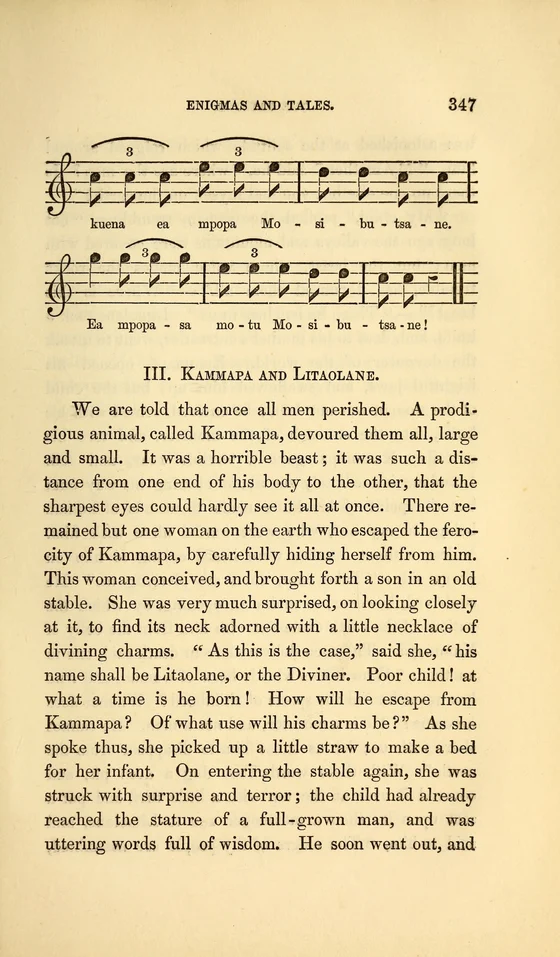
Casalis’s earlier Kammapa version begins with an immense animal that has devoured the people, large and small. Its body stretches so far that even very sharp eyes can scarcely take in both ends at once, and its voice makes rocks tremble. One woman survives by hiding and gives birth in an old stable. The baby’s neck already carries divining charms, prompting the name Litaolane. While the mother gathers straw for a bed, he grows to full stature and speaks words of wisdom.
Litaolane takes a knife and confronts the creature despite his mother’s fear. Kammapa opens its jaws and swallows him, but he remains alive and tears the entrails from within. A terrible roar precedes the monster’s fall. As the hero cuts an exit, the people inside cry out that his blade is piercing them; he succeeds in opening a safe way, and the nations emerge alive with him. The rescue therefore releases already living captives rather than creating an unmentioned resurrection.
The later persecution is directed at the rescuer, not another attack by Kammapa. People fear Litaolane because he never experienced childhood and call him a monster. Their pit, hidden-warrior and fire plots fail, and he finally changes into a stone at a river; an enemy throws it across, where it becomes the hero again. These actions belong to Litaolane’s continuation. Casalis’s subsequent Christian comparison is missionary interpretation and is kept outside the creature’s narrated origin.
Origins & earliest records
The selected witness is Alice Werner’s 1933 comparative collection, section Khodumodumo, or Kammapa. Its stated source context is Sotho swallowing-monster account presented by Werner. Publication and collection dates do not establish the beginning of the oral tradition. Casalis’s 1861 English edition supplies an earlier located Kammapa narrative; individual narrator is not named in that episode.
Records & interpretation
Khodumodumo, or Kammapa explicitly supplies the features and narrative actions summarized here. The account is mediated through named collectors or reported narrators, not a current community statement or independently verified encounter. Broad colonial interpretations are not adopted as facts. Casalis III. Kammapa and Litaolane, pp. 347–349, independently read through the final stone escape.
Selected bibliography
Documented works and useful reading. This is not a list of every appearance.
- 01
Myths and Legends of the Bantu
Khodumodumo, or Kammapa; cited source context: Sotho swallowing-monster account presented by Werner. Selected historical witness, not exhaustive.
- 02
The Basutos; or, Twenty-three Years in South Africa
III. Kammapa and Litaolane, complete pp. 347–349; monster description, living-captive release and hero continuation.
Family & connections
A source-supported family tree or inspiration record has not yet been compiled for this profile. Related reading below indicates a connection in subject matter, not a proven lineage or creative influence.
References
Sources supporting this profile. Linked pages have their own scope and editorial standards.
- Historical collection and comparative commentaryMyths and Legends of the Bantu — Khodumodumo, or KammapaResearch access: 2026-10-05
- Digitized historical collected narrativeCasalis — Kammapa and LitaolaneResearch access: 2026-10-05
Image credits
A sourced illustration has not yet been added. This gap is included in the coverage record.