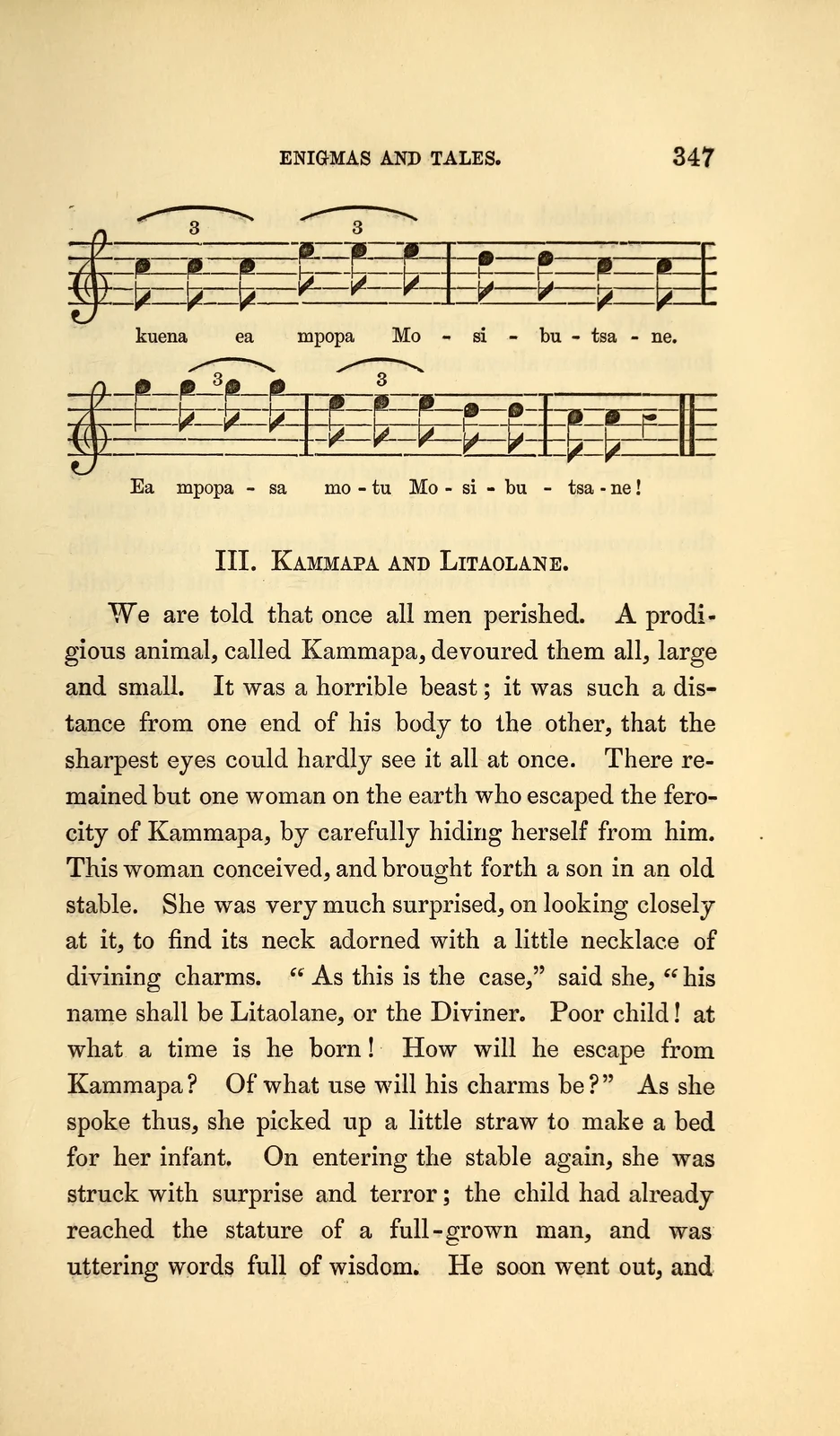
Litaolane and Kammapa, historical printed chapter opening; documentary source-page facsimile
Primary text witness to Litaolane and Kammapa in the 1861 edition. Documentary text facsimile, not creature artwork; historical terminology and collector interpretations belong to the original publication.
Overview
The tale begins with a monstrous threat that leaves a mother isolated and produces an extraordinary child. Ditaolane develops rapidly into a hero capable of confronting the swallowing being. By defeating it, he releases those held inside, turning the monster’s body into a dramatic container for a lost community.
The rescue does not end every problem: the delivered people fear the hero’s extraordinary development and plot against him. Casalis’s Litaolane defeats their traps and changes into a stone to escape across a river. This shifts the story from strength to fear and ingratitude. His resemblance to other swallowed-people tales does not erase the Sotho setting. Casalis’s subsequent Christian comparison is editorial speculation, and is not adopted as the story’s origin.
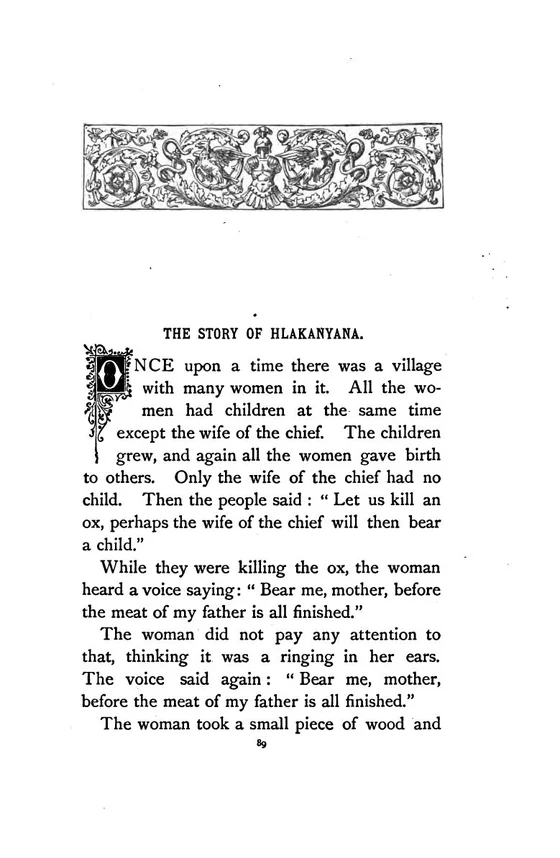
Werner connects the name Ditaolane with ditaola, divining bones, which the rapidly grown child wears around his neck; she also records Moshanyana, little boy, as an alternative name in some versions. The swallowing monster becomes too swollen to leave the valley through its narrow pass. After killing it, the hero must cut carefully because living people and domestic animals remain inside; one injured survivor later helps turn the community against him. The chapter preserves different conclusions, including a guardian ox that warns him and a version in which he accepts death after repeated attacks. These incompatible outcomes are evidence of narrative variation, rather than missing pieces of one fixed biography.
Casalis’s complete 1861 telling makes the speed of the child’s growth concrete. His mother, the sole person to avoid being swallowed by hiding from Kammapa, gives birth in an old stable. The infant already wears divining charms around his neck, prompting her to name him Litaolane, which this English witness explains as the Diviner. During the short time she gathers straw for his bed, he reaches adult stature and begins speaking wisely. The episode supplies a mother but names no father; it does not provide a longer hereditary line.
After asking why the landscape is empty, Litaolane approaches Kammapa with a knife despite his mother’s fears. The monster swallows him alive. He kills it from inside, then must make an exit without cutting the numerous people still alive around him. Their warnings interrupt the escape attempt, but he succeeds in opening a passage and they emerge together. In this witness the recovery is a release of living captives, rather than an explicitly narrated resurrection of people whom digestion had already killed.
The community’s subsequent hostility centers on his unfamiliar origin and lack of an ordinary childhood. They cover a deep pit with turf and place a seat above it, then invite him to join their elders. He pushes an opponent onto the concealed trap instead. A warrior hidden among the rushes where he rests also fails; a later attempt to throw him into a fire ends with several attackers falling into it themselves. The narrative attributes his survival to extraordinary knowledge without explaining a separate magical procedure for each evasion.
The river escape is the final narrated confrontation in Casalis. Litaolane becomes a stone, and the frustrated pursuer throws it across the water while imagining what he would do to the fugitive. On the far bank the stone becomes a man again. Litaolane faces the unreachable enemy, who can only threaten him. Casalis then shifts out of the tale into a Christian comparison, expressly declining to affirm it as an explanation. That editorial passage continues onto page350; it is separate from the episode’s ending and from Werner’s later account of other endings.
Origins & earliest records
Casalis’s 1861 English account names the hero Litaolane and the swallowing being Kammapa; Werner later discusses related Sotho material. These are recorded spellings and selected witnesses, not a complete biography. Publication dates document collecting and translation, rather than the beginning of oral transmission or a secure earliest telling. The inspected title page identifies London, James Nisbet & Co.,1861. No named oral narrator or recording date is supplied in the selected Casalis episode.
Records & interpretation
The recorded tale provides evidence for the extraordinary birth, rescue and troubled aftermath as a narrative sequence. It is cultural testimony mediated by publication, not proof of a historical mass swallowing. This is evidence for cultural expression and recorded interpretation, rather than a zoological specimen or independently verified supernatural event. Complete Casalis tale347–349 and following commentary through350 read in OCR and checked against all four original printed pages; original title page also inspected. The original-language telling, field notes and an entire earlier edition were not collated.
Selected bibliography
Documented works and useful reading. This is not a list of every appearance.
- 01
The Basutos; or, Twenty-three Years in South Africa, III: Kammapa and Litaolane, pp. 347–349
Complete narrative pp347–349, with following collector commentary through350; original title and all four pages visually checked. London: James Nisbet & Co.,1861. No identified oral narrator in this selected witness.
- 02
Myths and Legends of the Bantu
Selected primary witness; not an exhaustive bibliography.
Family, evolution & connections
Litaolane and the surviving mother in Casalis’s 1861 account
The mother–son relation in Casalis’s printed Kammapa and Litaolane episode; Litaolane is this witness’s spelling.
Scroll sideways to see all branches. With a keyboard, focus the tree and use the arrow keys.
- Unnamed surviving woman
The woman gives birth to a son, names him Litaolane and is addressed as mother in the next scene. The mother is unnamed and no father is identified. Rapid maturation is a narrative marvel, not biological descent evidence. Casalis’s subsequent Christian analogy is editorial interpretation and is not adopted as the tale’s origin.
The surviving mother in Casalis’s Kammapa episode
Casalis’s Litaolane is born to the unnamed woman who escaped Kammapa. His rapid maturation and rescue follow that birth; the passage identifies no father.
Encyclopedia background
An additional attributed reference, separate from the editorial profile above.
Read the open encyclopedia overview
Ditaolane, also known as Moshanyana-wa-Senkatana or Senkatana (spelled as Litaolane and Moshanyana oa Senkatana in Lesotho Sesotho) is a hero and deity in the Basotho religion and mythology. Moshanyana-wa-Senkatana means "Senkatana's little boy" and Ditaolane comes from the Sotho-Tswana word for divination bones, ditaola, which he was born with in the legends
Text from Wikipedia contributors, “Ditaolane”. CC BY-SA 4.0. Extracted introduction; formatting changed. Retrieved 5 October 2026. The source article may have changed since retrieval.
References
Sources supporting this profile. Linked pages have their own scope and editorial standards.
- Primary textCasalis, Kammapa and Litaolane, The Basutos, 1861, pp. 347–349Research access: 2026-10-05
- Primary textMyths and Legends of the BantuResearch access: 2026-10-05
- Primary textMyths and Legends of the Bantu, XIV: The Swallowing MonsterResearch access: 2026-10-05
- Historical printed-page facsimileCasalis1861: original Kammapa and Litaolane pages347–350Research access: 2026-10-05
Image credits
Historical text facsimileLitaolane and Kammapa, historical printed chapter opening; documentary source-page facsimile
Primary text witness to Litaolane and Kammapa in the 1861 edition. Documentary text facsimile, not creature artwork; historical terminology and collector interpretations belong to the original publication.