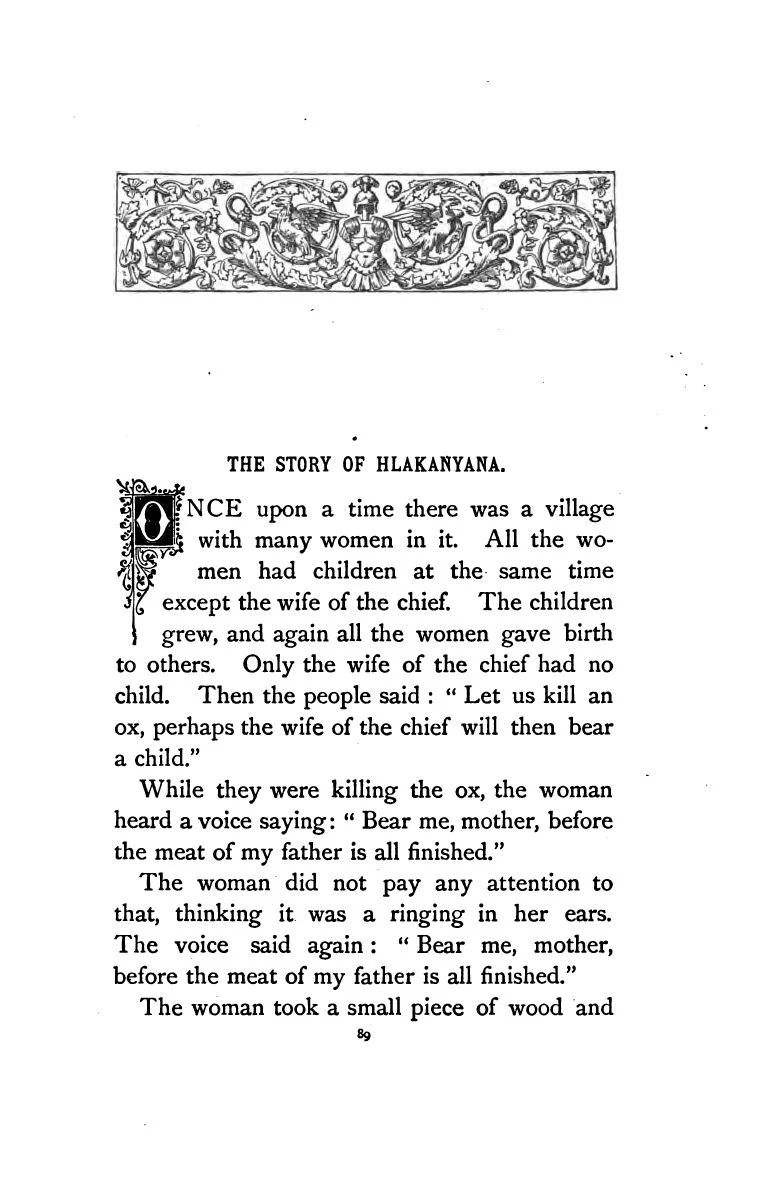
The Story of Hlakanyana, historical printed chapter opening; documentary source-page facsimile
Primary text witness: the named chapter opening in an 1886 folktale collection. Documentary text facsimile, not creature artwork; historical source terminology belongs to the original publication.
Overview
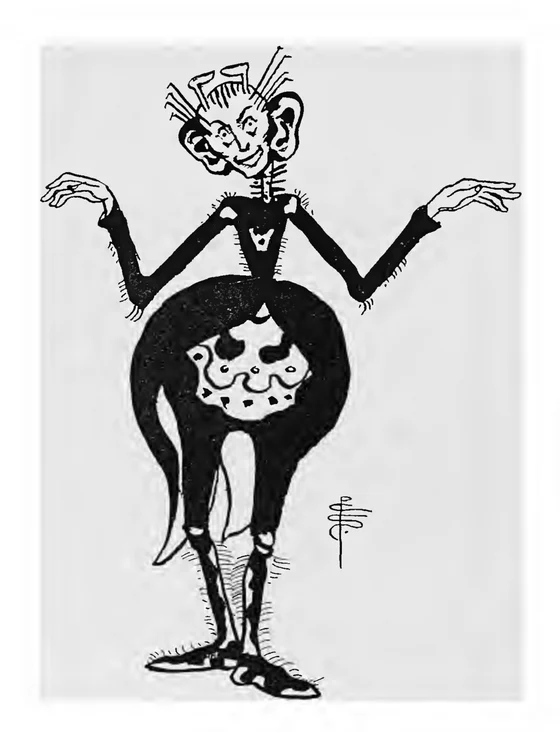
Hlakanyana acts with startling ability from the beginning of his story, speaking and maneuvering in ways that exceed an ordinary infant. His small stature contrasts with his resourcefulness, enabling reversals against larger opponents. Cunning is central, but individual episodes may make his behavior disturbing rather than offer him as an uncomplicated model to imitate.
Werner’s discussion draws especially on earlier Zulu collecting, including Callaway’s translated material. It places the narrative alongside other tricksters, which can help comparison while also risking overgeneralization. The reader should keep the Zulu account in view and follow each episode’s consequences, rather than assume every African clever-child figure represents the same character or moral outlook.
Origins & earliest records
Callaway’s nineteenth-century publications and Werner’s 1933 discussion are selected written witnesses. Their translation and classification choices affect how the figure appears to English readers. A surviving record dates its documentation, not the beginning of an oral tradition; earlier transmission cannot be timed precisely from this witness alone.
Records & interpretation
The recorded narrative documents precocity, trickery and encounters with opponents. It is textual evidence for an extraordinary tale figure; the comparison with animal tricksters does not establish a biological identification. This is evidence for cultural expression and recorded interpretation, rather than a zoological specimen or independently verified supernatural event.
Selected bibliography
Documented works and useful reading. This is not a list of every appearance.
- 01
Myths and Legends of the Bantu
Selected primary witness; not an exhaustive bibliography.
Family, evolution & connections
Hlakanyana’s parents in Theal’s recorded story
The named story’s opening and cattle-kraal scene only.
Scroll sideways to see all branches. With a keyboard, focus the tree and use the arrow keys.
- Unnamed chief and his wife (joint parent pair)
Explicit relationships in the named source witness. This collector’s witness is kept separate from Werner’s synthesis and other tellings; it does not establish ancestry of a real weasel species.
The unnamed chief in Theal’s Hlakanyana story
In this recorded opening, Hlakanyana calls the chief his father and identifies himself as his child. The chief’s wife gives birth to him after the speaking-in-the-womb episode.
The chief’s unnamed wife in Theal’s Hlakanyana story
The chief’s wife explicitly gives birth to Hlakanyana and later cooks for him. The narrative names neither parent; titles are retained without invented names.
References
Sources supporting this profile. Linked pages have their own scope and editorial standards.
- Primary textMyths and Legends of the BantuResearch access: 2026-10-05
Image credits
Historical text facsimileThe Story of Hlakanyana, historical printed chapter opening; documentary source-page facsimile
Primary text witness: the named chapter opening in an 1886 folktale collection. Documentary text facsimile, not creature artwork; historical source terminology belongs to the original publication.