
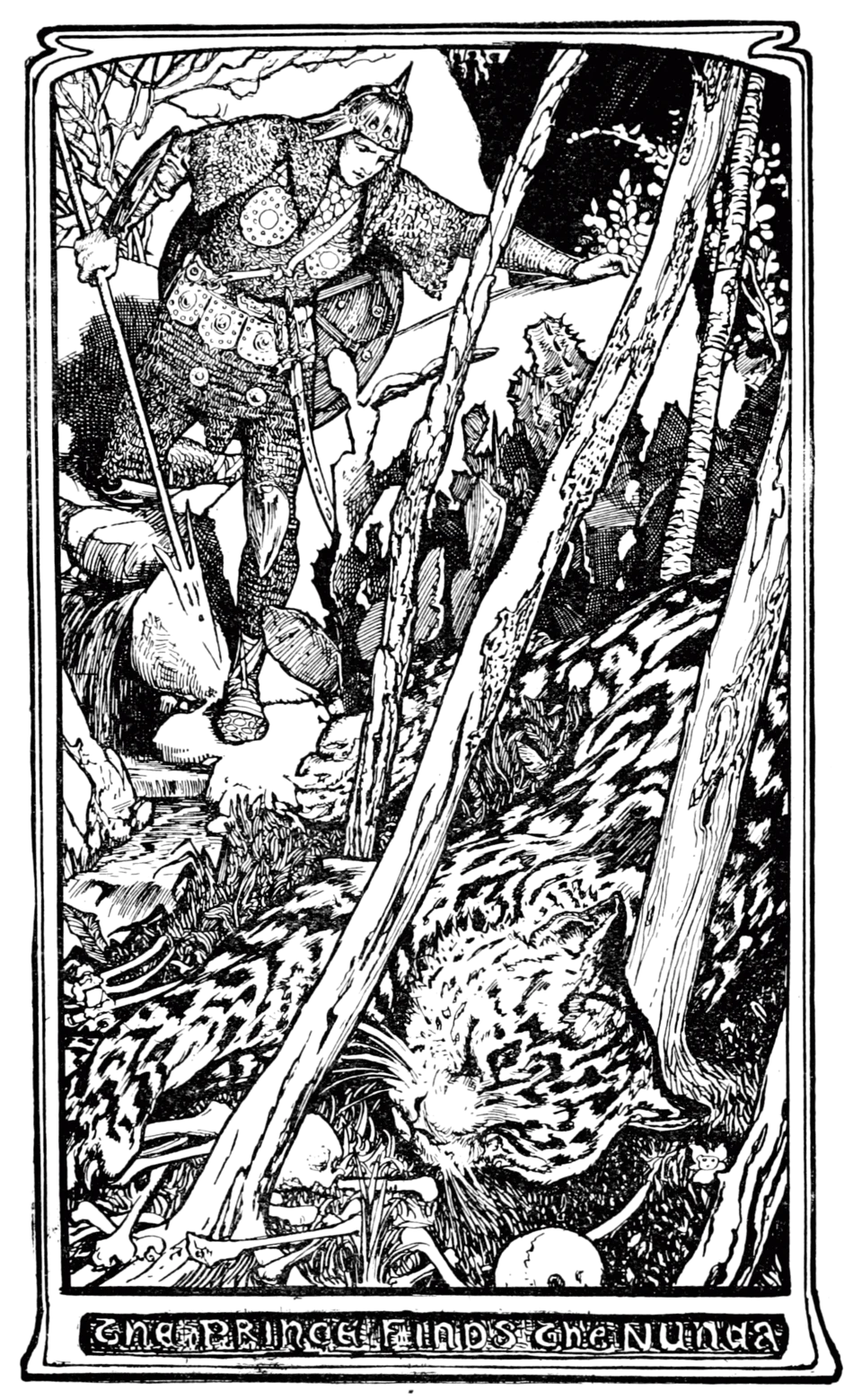
The prince finds the Nunda, Henry Justice Ford illustration
Henry Justice Ford illustration to the Nunda tale in Andrew Lang’s Violet Fairy Book, first published1901; this reproduction is from the1906 edition. Later illustrated adaptation of the Swahili narrative, not an observed animal.
Overview
In Steere’s Sultan Majnun, Nunda begins as the ruler’s own cat. Its predation escalates through calf, goat, cow, donkey, horse and camel, then a child and an adult. The sultan dismisses each complaint by claiming both predator and victim as his property. Moving into roadside undergrowth, the animal takes livestock and people going for water. Avoided roads do not end the danger: it shifts to another route, raids the town at night and hunts farther into the country by day. The ruler finally bars people who come to complain. Only when the cat attacks a royal outing and kills three sons does he authorize its destruction and declare that it is now called Nunda. Soldiers sent against it are killed or flee.
The youngest son undertakes the hunt to avenge his brothers. His mother supplies food, attendants and weapons, but repeatedly rejects the animals he brings back as the supposed monster. A large dog, two differently described civet cats, zebra, giraffe, rhinoceros and elephant all fail her test. Each return is marked by the son’s confident song and his mother’s answering denial; exhaustion and increasingly dangerous journeys accompany the repeated mistakes. His father even offers him the throne if he will abandon the hunt. He refuses. The final recognition depends on the mother’s specific description: small ears, a broad rather than long body, two blotches compared with a civet cat and a thick tail.
From a mountain the hunters locate the matching beast below the trees. They leave food and spare belongings behind, approach on their knees and fire together while it sleeps. Retreating to higher ground, they wait until morning before confirming its death. The son insists on dragging the carcass home even as it begins to decay. This time his mother recognizes it, and the town celebrates; the father transfers royal authority to him. The body is buried in a pit beneath a house where a soldier collects an imposed payment from passers-by. The selected primary ending turns the defeated predator into the center of a coercive royal memorial, rather than opening its body to free swallowed victims.
Bateman’s 1901 Mkaaah Jeechonee, the Boy Hunter gives a later English telling with the same cat-to-Noondah escalation and repeated mistaken quarry. It retains the mother’s small ears, broad short body, paired blotches and thick tail as the identifying features. Two attendants, Keeroboto and Shindaano, help locate or assess the animals; their fears do not become features of the monster. The ending differs from the selected Steere witness: the successful hunter receives honours and a wife, then becomes sultan when his father dies. Bateman does not narrate the carcass memorial and payment-house ending printed by Steere. The shared episodes and separate conclusions are therefore retained as publication witnesses rather than blended into one final sequence.
Origins & earliest records
Selected primary witness is Steere’s 1870 Sultan Majnun, with facing Swahili text and English translation. Werner’s 1933 discussion is retained separately as a comparative witness; its chicken-opening summary is not silently substituted for Steere’s calf-opening sequence. London: Bell & Daldy, 1870. Edward Steere’s English translation. The closing statement explicitly attributes Sultan Majnun’s story to Chuma; this is not a claim that the narrative was invented in 1870. Hosted transcription revision 11512053. Steere's preface p. ix separately identifies Masazo as the teller of Sultan Majnun to him, while the story's closing p. 283 attributes its making to Chuma. These credits are retained at their stated levels without inventing an identity or biographical chain. A later English witness is George W. Bateman’s Zanzibar Tales (1901), VIII, Mkaaah Jeechonee, the Boy Hunter, whole pp. 155–179; its conclusion is kept separately.
Records & interpretation
Actual complete selected cat/Nunda sequence inspected in the consolidated Wikisource chapter. Earlier bird/date-tree episodes in Sultan Majnun are not attributed to Nunda. Morphology comes from the mother’s identifying description, not guesses from mistaken elephant or rhinoceros quarry. Bateman VIII pp. 155–179 separately whole-read: small ears/broad-short body/two blotches/thick tail match the recognition passage, but marriage and succession after the father’s death replace Steere’s memorial ending. No independence or first-origin claim is inferred from Bateman’s publication.
In the literature
“This is no longer a cat, its name is Nunda”
Sultan Majnun; Sultan’s speech after the cat kills three sons · Edward Steere
The sultan names the destructive cat after its attack on his family.
“the nunda is broad and not long”
Sultan Majnun; The seventh son checks his mother’s description below the mountain · Edward Steere
The hunter compares the final target with the description his mother provided.
Selected bibliography
Documented works and useful reading. This is not a list of every appearance.
- 01
Swahili Tales, as Told by Natives of Zanzibar
Sultan Majnun, selected cat/Nunda sequence; facing Swahili and English edition.
- 02
Myths and Legends of the Bantu
The Nunda; cited source context: Edward Steere’s Swahili Tales, pp. 199 and 247, discussed by Werner. Selected historical witness, not exhaustive.
- 03
Zanzibar Tales
VIII, entire pp. 155–179; morphology pp. 175–176, hunt/death pp. 176–178 and separate honours/marriage/succession conclusion p. 179.
- 04
Swahili Tales, as Told by Natives of Zanzibar — Sultan Majnun
London: Bell & Daldy, 1870. Edward Steere’s English translation. The closing statement explicitly attributes Sultan Majnun’s story to Chuma; this is not a claim that the narrative was invented in 1870. Hosted transcription revision 11512053. Independently checked original1870 preface p.ix names Masazo as teller; closing p.283 names Chuma as story maker. Both credits retained at their stated levels.
Family, evolution & connections
Khodumodumo
Werner expressly contrasts the Nunda account with the usual swallowing-monster pattern: Nunda’s victims are not recovered, whereas the selected Khodumodumo tale releases people and animals alive. The connection highlights a difference within a comparable consuming-monster theme. It leaves Werner’s possible historical development as speculation and does not convert these narrative types into biological lineages.
Domestic cat (Felis catus)
In Werner’s discussion of Sultan Majnun, Nunda begins as an ordinary cat and grows beyond ordinary animals as its feeding continues. A domestic cat is therefore a useful living counterpart for the opening motif, not for the monster’s later size or behavior. The story supplies fantastic growth, not evidence that real cats can develop into Nunda.
Located primary passages
Specific passages supporting details in this entry, grouped by their published witness.
Swahili Tales, as Told by Natives of Zanzibar
London: Bell & Daldy, 1870. Edward Steere’s English translation. The closing statement explicitly attributes Sultan Majnun’s story to Chuma; this is not a claim that the narrative was invented in 1870. Hosted transcription revision 11512053.
- The ruler tolerates his cat’s attacks on animals and people until it kills three of his sons; he then names it Nunda and permits attempts to kill it.
Sultan Majnun; Cat’s escalating predation through the death of three princes
- The youngest son kills a succession of animals, including an elephant, but his mother rejects each as the Nunda.
- Small ears, a broad body, two blotches and a thick tail identify the target; coordinated gunfire kills it, the mother confirms it, and the victorious son receives rule.
Sultan Majnun; Final encounter below the mountain, confirmation and burial
No real species identification inferred. Chuma is credited exactly as the text names him; biographical identification is not assumed. Local HTTP returned 403; the accessible read-only web transcription supplied the evidence.
Primary source witness
Edward Steere, Swahili Tales as Told by Natives of Zanzibar, London: Bell & Daldy,1870. Original bilingual edition OCR.
- Steere names Masazo, his cook and house steward, as teller of Sultan Darai, Sultan Majnun and Sell Dear in the preface. The Majnun closing separately says Chuma made the story. These are distinct transmission/credit statements; note81 discusses the name’s meaning but does not establish a biography or identify Chuma with Masazo.
Preface p.ix, Masazo paragraph; Sultan Majnun closing p.283 and note81
Relevant complete preface attribution section, complete closing statement and note81 read. Colonial language judgments are not adopted; no songs reproduced and no biographical identity inferred.
References
Sources supporting this profile. Linked pages have their own scope and editorial standards.
- Primary collected narrative translationSteere — Sultan Majnun, Nunda sequenceResearch access: 2026-10-05
- Historical collection and comparative commentaryMyths and Legends of the Bantu — The NundaResearch access: 2026-10-05
- Digitized primary narrator and story creditSteere 1870 preface and Sultan Majnun closingResearch access: 2026-10-05
- Later historical English collected-tale witnessBateman 1901: Mkaaah Jeechonee, the Boy HunterResearch access: 2026-10-05
Image credits
Historical illustrationThe prince finds the Nunda, Henry Justice Ford illustration
Henry Justice Ford illustration to the Nunda tale in Andrew Lang’s Violet Fairy Book, first published1901; this reproduction is from the1906 edition. Later illustrated adaptation of the Swahili narrative, not an observed animal.