A sourced illustration has not yet been added. This gap is included in the coverage record.
Overview
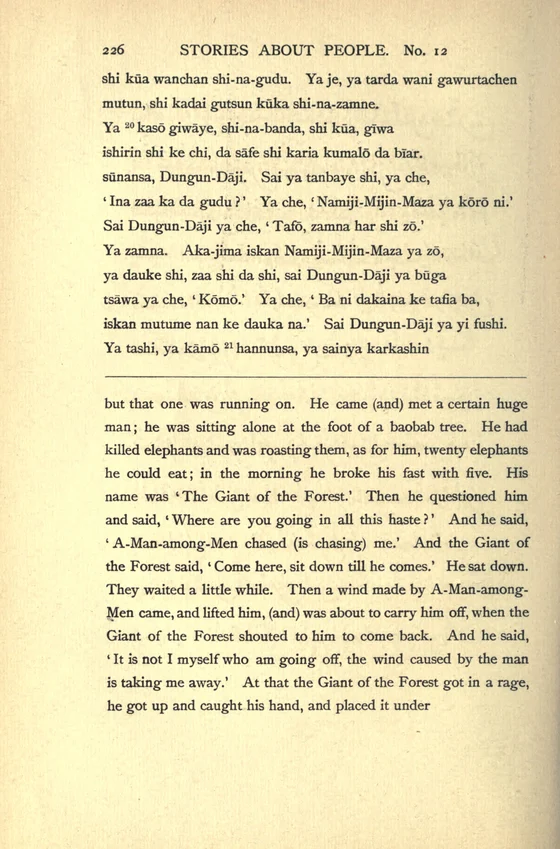
The youngest of nine brothers remains alert in the witch’s household and swaps his companions’ clothing with the nine daughters’ garments. The witch consequently kills her own children, while he digs an escape tunnel and brings his brothers home. When she later kidnaps fifteen boys in tree form, he hides within her cow. The cow produces a female calf which is actually the boy transformed. He deliberately smashes calabashes, prompting the witch to send the captives after him, then runs into their town and resumes human form so their parents can reclaim them.
After she steals his elder brother’s eyes, he dresses as her daughter, pretends to mourn the slain sisters and receives the eyes to play with. He returns them while she fetches water. A later capture places him in a covered pit; he trades places and clothing with its guard, the witch’s younger daughter, and escapes after exposing the mother’s mistaken cannibal meal. On the final return to the abandoned town, he escapes her grip and burns her house. The chief offers a hundred of various goods and half the town, but he insists the assembled people first help build a wall. The text presents that construction as the origin of walled towns. His calf form is explicit; his impersonations through clothing are not additional bodily transformations.
Origins & earliest records
Malam Shaihu supplies the written Hausa material translated and transliterated by R. Sutherland Rattray. The compiler’s Author’s Note describes a mixed written and Arabic-manuscript mediation process; this tale is not labeled a verbatim oral field transcription by a separately named narrator.
Records & interpretation
Shaihu/Rattray, Hausa Folk-Lore, Customs, Proverbs, etc., Volume I (1913), tale 8, complete pp. 162–184; compiler methodology p. xii.
Selected bibliography
Documented works and useful reading. This is not a list of every appearance.
- 01
Hausa Folk-Lore, Customs, Proverbs, etc., Volume I
Shaihu/Rattray, Hausa Folk-Lore, Customs, Proverbs, etc., Volume I (1913), tale 8, complete pp. 162–184; compiler methodology p. xii.
Family & connections
A source-supported family tree or inspiration record has not yet been compiled for this profile. Related reading below indicates a connection in subject matter, not a proven lineage or creative influence.
References
Sources supporting this profile. Linked pages have their own scope and editorial standards.
- Bilingual manuscript tale; digitized primary OCRShaihu/Rattray 1913 — Calf-Form Youngest Brother of Shaihu’s TaleResearch access: 2026-10-05
- Compiler methodologyAuthor’s NoteResearch access: 2026-10-05
Image credits
A sourced illustration has not yet been added. This gap is included in the coverage record.