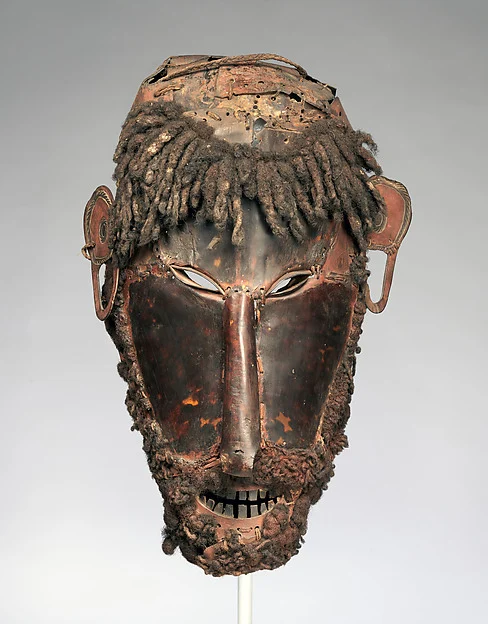
Le op mask from Erub Island in the Torres Strait, mid- to late nineteenth century, photographed in the Met collection, accession 1978.412.729
The museum identifies this le op mask with Erub Island in the eastern Torres Strait and dates it to the nineteenth century. Its shell face is furnished with hair and fibre. It is a specific historical object; the photograph does not depict a living person or imply that every Torres Strait community shares one mask form or ceremonial practice.
Overview
Torres Strait Islander peoples have distinct cultures connected with islands between Cape York and Papua New Guinea. The regional council recognises variation between island communities and describes five geographical clusters. These include the Top Western islands of Boigu, Dauan and Saibai; the Near Western group around Badu, Mabuiag and Moa; Central islands including Warraber and Poruma; Eastern islands including Mer and Erub; and the Inner Islands. These regional groupings provide a framework for locating particular communities, rather than replacing their own identities with a single uniform culture. The council also points to Indigenous Knowledge Centres as local resources for cultural history.
A March 2023 TSRA announcement documents the establishment of the Torres Strait Traditional Languages Association. Acting chairperson Horace Baira described institutional support, while association chairperson Cygnet Repu identified continuing language revitalisation and everyday use as priorities. The initial board included representatives of five language clusters. This structure brought regional partnerships and community language leadership together while recognising different local settings. The announcement also described a goal of operating separately from TSRA later that year. That intention is retained as a dated organisational plan; the source does not by itself confirm the later administrative outcome.
A 2022 community publishing project gives a more specific example. Warraber and Poruma community members, Elders, students and TSRA Rangers launched a plants-and-animals book on Warraber Island. The account names Porumalgal and Warraberalgal Traditional Owners and their representative bodies among the partners. Its stated purpose was to strengthen Kulkalgau Ya and pass knowledge to younger generations. Local artist Tony Harry contributed artwork, and Tagai College students participated in the launch. The evidence here is the published account of collaboration and its contributors; the book’s detailed cultural and ecological contents were not inspected or reproduced.
Gab Titui provides another public setting for contemporary cultural work. Its own history records an April 2004 opening after longstanding community interest in a keeping place for historical and cultural material. Cultural adviser Ephraim Bani recommended a name bringing eastern and western language words together, translated by the centre as Journey of the Stars. The institution was envisaged both as a place to engage with older material and as a venue for living Ailan Kastom and contemporary artistic production. Its governance account places it within TSRA’s cultural programme, supporting regional artists and providing an outlet for their work. This institutional history documents cultural maintenance and creative development together, without treating an exhibition as an exhaustive representation of the surrounding communities.
History & identity
Regional council and cultural institutions document distinct island settings, language leadership and community collaboration; institutional dates do not establish the origins of these peoples.
Sources & representation
Complete scoped regional, language-association, community book-launch and cultural-centre accounts identify institutions, local partners and named contributors.
Selected bibliography
Documented works and useful reading. This is not a list of every appearance.
- 01
Our Region
Complete regional culture, cluster and knowledge-centre sections read; variation retained, ancient settlement theory and duplicated language heading excluded.
- 02
New association established to revitalise languages across the Torres Strait
Complete 17March2023 body read; named leadership and five-cluster initial board retained; planned separate operation not assumed completed.
- 03
Living off the land: Torres Strait book to preserve language, culture and environment
Complete 9August2022 report read; Warraber/Poruma partners and artwork credit retained. Book contents, ecological knowledge and performance media not inspected.
- 04
Our Story
Complete naming, history and governance sections read; Bani contribution and 2004 opening retained; awards, linked collections and protocols not used.
- 05
Behind the Book: A Q&A with author and poet Samantha Faulkner
Black Inc.,14March2024; actual article publication metadata.
- 06
Stop and Stare
State Library of Queensland, 23 May 2019.
- 07
Pop mythology: Old gods and new icons
Public web interview; associated issue listed 2 May 2023.
Language & cultural connections
Source-supported language and cultural connections have not yet been compiled for this profile.
Located primary passages
Specific passages supporting details in this entry, grouped by their published witness.
Behind the Book: A Q&A with author and poet Samantha Faulkner
Black Inc.,14March2024; actual article publication metadata.
- Faulkner describes an anthology bringing island and mainland experiences together while preserving local identities. Historical excerpts accompany contemporary accounts. Her editorial process encouraged first-time writers and sought contributors’ satisfaction with their stories and images. This is a named editor’s account of collaborative publishing, rather than proof of a single experience shared by all Torres Strait Islander people.
Complete three-question written interview, especially selection-process answer.
Anthology contents, cited historical memoirs and recordings unread; interview appointments remain dated.
Stop and Stare
2019
- Mooney identifies Aboriginal, Torres Strait Islander and Australian South Sea Islander heritage. This essay foregrounds South Sea Islander family memory and reclaims archival subjects through portraiture. His collective acknowledgement of ancestors is cultural expression, not proof of biological descent from an unnamed photographed stranger.
Complete signed guest essay, opening identity statement through final continuity statement.
Individual mixed-heritage perspective, not an account of every Torres Strait community. Artwork, exhibition and archival photographs not independently inspected. Native fetch returned403; no local source-cache claim.
Pop mythology: Old gods and new icons
2023 web version
- Robinson connects childhood drawing and family storytelling on Waiben with his artistic practice. He describes drawing as the foundation for work across media and explains how ancestral narratives, Greek stories and popular-culture imagery coexist in his prints. Humour and play are part of his individual creative approach.
Complete public six-exchange interview and introductory editing notice.
Printed issue, artworks and recorded conversation uninspected. Individual recollections are not universal cultural testimony; no ritual procedures, direct quote or historical-origin claim.
References
Sources supporting this profile. Linked pages have their own scope and editorial standards.
- Regional council self-descriptionOur RegionResearch access: 2026-10-05
- Institutional announcement with named language leadersNew association established to revitalise languages across the Torres StraitResearch access: 2026-10-05
- Named community collaboration accountLiving off the land: Torres Strait book to preserve language, culture and environmentResearch access: 2026-10-05
- Cultural centre institutional historyOur StoryResearch access: 2026-10-05
Image credits
Contextual cultural object photographLe op mask from Erub Island in the Torres Strait, mid- to late nineteenth century, photographed in the Met collection, accession 1978.412.729
The museum identifies this le op mask with Erub Island in the eastern Torres Strait and dates it to the nineteenth century. Its shell face is furnished with hair and fibre. It is a specific historical object; the photograph does not depict a living person or imply that every Torres Strait community shares one mask form or ceremonial practice.