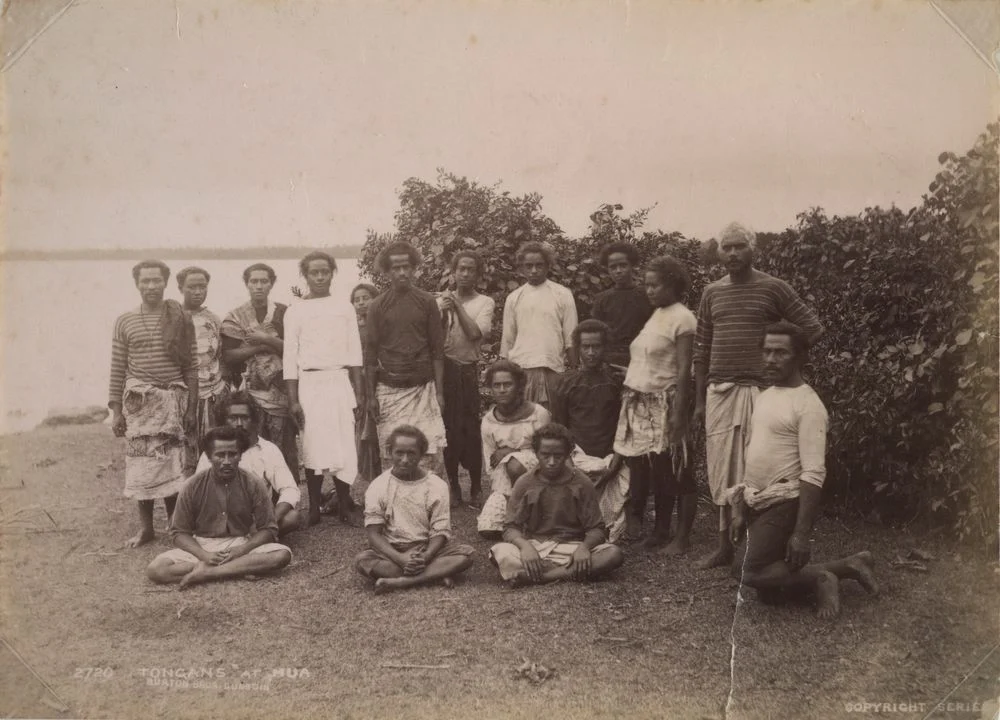
Historical group portrait titled Tongans at Mua, photographed by Burton Brothers in 1884, Te Papa O.002041
Burton Brothers photographed this group at Muʻa in Tonga in 1884. The print retains its original title and studio imprint, but the museum record does not identify the sitters individually. It records one historical gathering rather than the appearance or clothing of all Tongans today.
Overview
Tongans maintain living cultural relationships in the Kingdom of Tonga and in communities abroad. Lea faka-Tonga, family connections and cultural work provide overlapping forms of belonging, while citizenship and residence are separate questions. Tonga Tourism’s cultural overview places extended family at the centre of its public account and describes households including relatives beyond parents and children. It also identifies Tongan language teaching in primary schools alongside English. That account is a national tourism presentation, rather than a survey of every household. Its claims of unchanged village life and numerical religious proportions are not necessary to understand the contemporary examples documented here.
Language activities in Aotearoa New Zealand connect different generations and institutions. The Ministry for Pacific Peoples’ 2026 Tonga Language Week page records an August programme centred on music and lists teaching, women’s, church and local community organisations among funding recipients. The Aotearoa Tongan Teachers Association and Tonga Language Society are examples of participating bodies, not representatives of every Tongan speaker. The published schedule includes library activities and online presentations. It documents planned events and approved support; a funding entry alone does not prove attendance or measure language proficiency. These settings show language use extending across homes, education, community gathering and public cultural programmes.
Contemporary ngatu art supplies a specifically named account of inherited knowledge and creative change. Te Papa’s written introduction to Tui Emma Gillies identifies her as a Tongan artist from Aotearoa, influenced by her grandmother ‘Ema Topeni and mother Sulieti Fieme‘a Burrows. It describes her work bringing older practices into contemporary forms. The museum’s account of the 2023 Tahiti gathering places Tongan makers alongside artists from several other Pacific communities responding to historical cloth samples. This documents collaboration among distinct traditions, rather than treating all barkcloth art as interchangeable. The written account was read; the linked interview film is not claimed as fully viewed.
Museum collecting can also record ordinary work, fashion and youth experience. Te Papa’s 2017 report describes Project 83, involving students from a Year 13 Tongan language class at Sir Edmund Hillary Collegiate. Maya Taufa offered her father’s factory uniform to acknowledge his support for the family. Separate co-collecting work with Kenneth Tuai and Czarina Wilson included contemporary fashion and a Tongan-owned barber. The museum describes families and cultural consultants participating in deciding what the collection should represent. These examples place Tongan people within changing urban and creative settings and retain the participants’ roles, rather than presenting the objects as timeless evidence about everyone’s life.
A separate educational partnership links Te Papa with the Ministry for Pacific Peoples. Their Tongan Language Week introduction describes a resource for Tongan and non-Tongan speakers across ages, connecting language learning with identity, respect and communication. It also introduces recognition of language champions. This documents an institutional learning invitation, rather than observed classroom results; the downloadable kit, pronunciation guidance, activities and pictured textiles were not inspected here.
History & identity
A living people with homeland and diaspora relationships. Dates of language programmes and museum projects describe specific activities, not the origin of Tongan identity.
Sources & representation
National tourism, a current ministry programme and named Te Papa community/artist reports provide scoped examples. Approved funding, scheduled events and linked films are not treated as evidence of outcomes or complete viewing.
Selected bibliography
Documented works and useful reading. This is not a list of every appearance.
- 01
People & Culture
Complete overview read; family and school-language sections scoped. Promotional continuity and numerical claims excluded.
- 02
Tonga Language Week 2026
2026 theme, event schedule and funding section read; support distinguished from measured outcomes.
- 03
Tui Emma Gillies at Ahu: Ngā Wairua o Hina
Complete written introduction and gathering account read; linked video not claimed fully viewed.
- 04
Tongan students showcase the objects they are donating to Te Papa
Complete report read; named student, consultants and distinct contemporary collecting projects retained.
- 05
Tongan Language Week resource
Complete written introduction read; downloadable kit not inspected.
Language & cultural connections
These connections link languages or specific cultural works and institutions; they do not establish biological ancestry or ethnic identity.
Te Papa / Ministry for Pacific Peoples
Te Papa credits the museum and the Ministry for Pacific Peoples with jointly creating its Tongan Language Week education resource. The written introduction describes pronunciation support and activities for Tongan and non-Tongan learners. This is a particular educational collaboration; the downloadable resource itself was not inspected here.
Samoan language
WALS groups Tongan and Samoan within its Oceanic category of the Austronesian language family. This broad linguistic grouping neither asserts that they are the closest relatives nor describes ethnic or biological descent.
References
Sources supporting this profile. Linked pages have their own scope and editorial standards.
- National tourism cultural overviewPeople & CultureResearch access: 2026-10-05
- Government community programme recordTonga Language Week 2026Research access: 2026-10-05
- Museum artist documentationTui Emma Gillies at Ahu: Ngā Wairua o HinaResearch access: 2026-10-05
- Museum community co-collecting reportTongan students showcase the objects they are donating to Te PapaResearch access: 2026-10-05
- Institutional learning introductionTongan Language Week resourceResearch access: 2026-10-05
Image credits
Historical community group photographHistorical group portrait titled Tongans at Mua, photographed by Burton Brothers in 1884, Te Papa O.002041
Burton Brothers photographed this group at Muʻa in Tonga in 1884. The print retains its original title and studio imprint, but the museum record does not identify the sitters individually. It records one historical gathering rather than the appearance or clothing of all Tongans today.