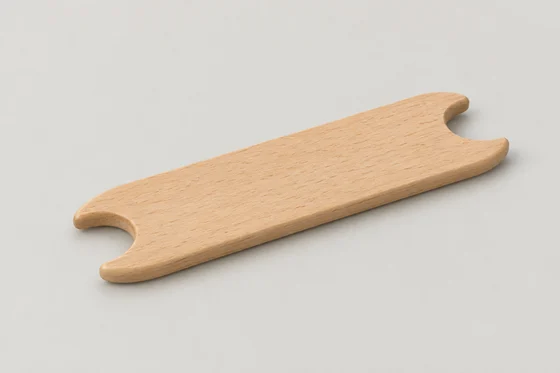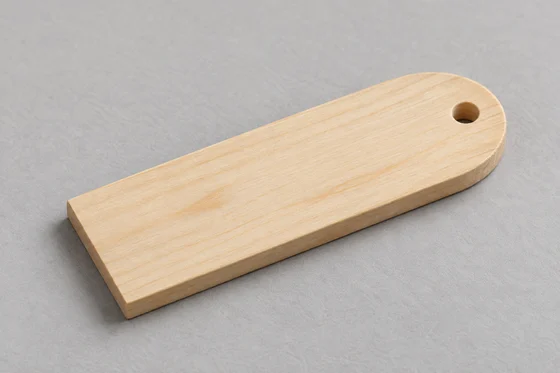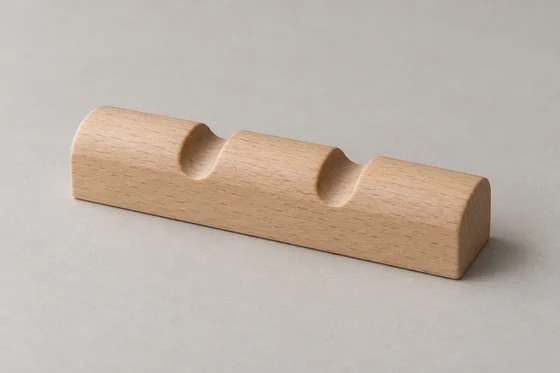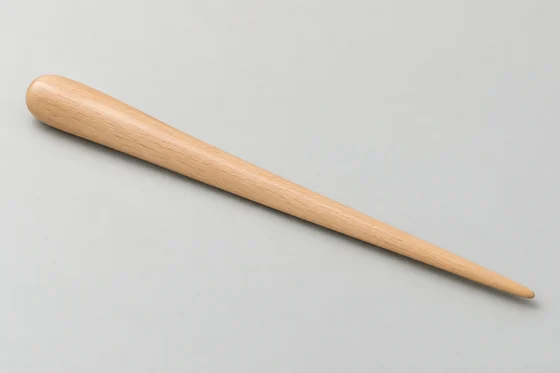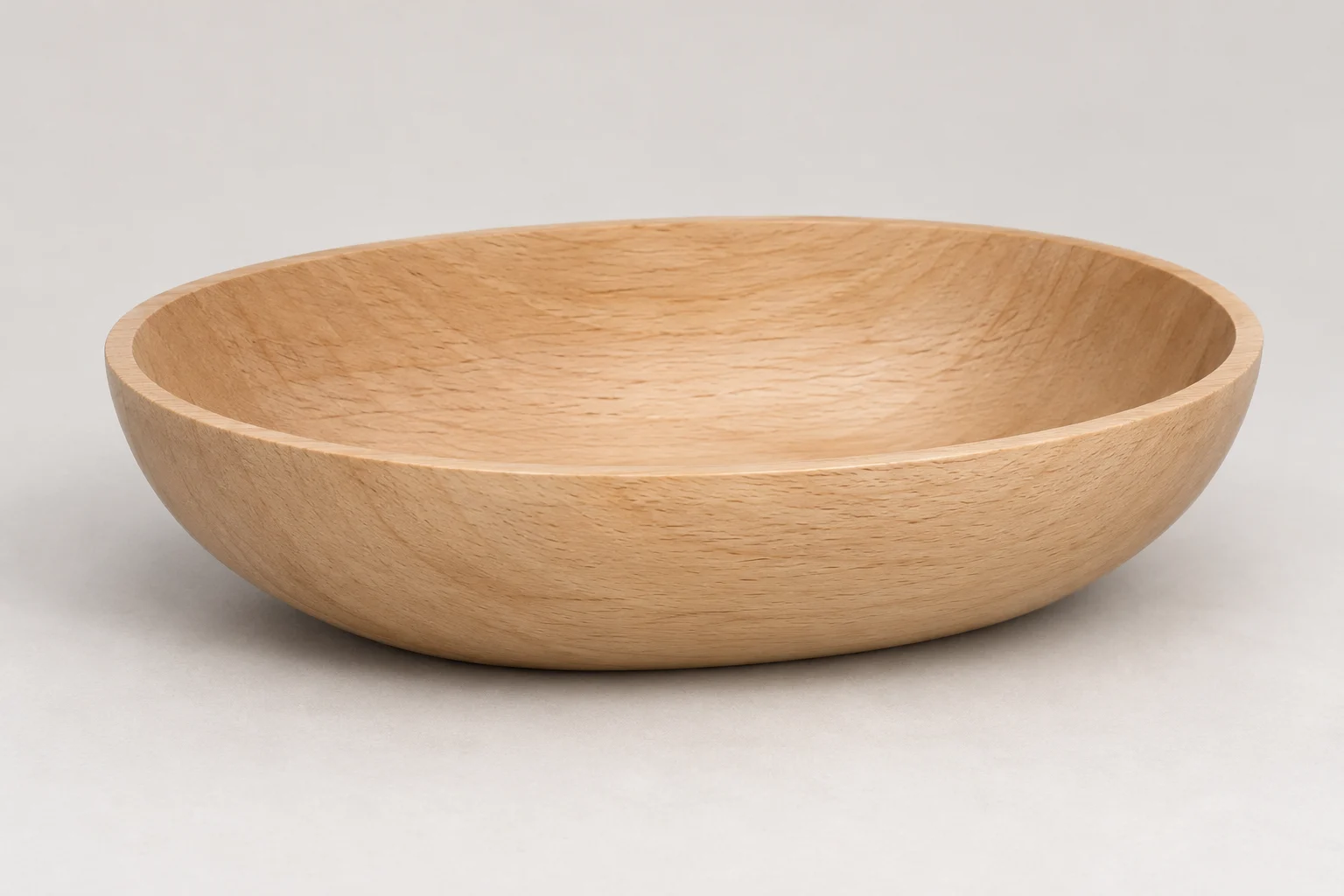
Generated interpretation of a published historical teaching design; not an authenticated specimen or exact replica. Colour and surface appearance are interpretive.
Overview
The fourteenth model is headed Bowl for Toilette, &c., while its plate adds the writing table as another setting. The perspective view shows a plain, shallow oval bowl without handles, ornament or a separate projecting foot. Plans and a section accompany it, distinguishing the larger upper ellipse from the smaller flat area beneath. Sutcliffe specifies beech, and his lesson first establishes the outline and the division between top and bottom. The hollow is shaped and smoothed before the exterior is finished. This combination of views and text supports the bowl’s general form, while supplying no provenance for a surviving specimen or evidence of its actual contents.
The lesson ends by calling this bowl a demanding test of application, care and skill, because careless work would remain visible. That observation connects its unadorned surface with the broader purpose of the manual: the pupil’s work is meant to demonstrate control and finish, rather than acquire value from applied decoration. Sutcliffe’s author note also says that handling tools should be learned from a competent teacher in practice, rather than from written suggestions alone. The bowl is consequently presented here as a historical teaching design within an advocated method of hand education. Its inclusion does not establish a universal Swedish domestic type or a present-day instructional standard.
History & identity
John D. Sutcliffe, identified with the Manchester Recreative Evening Classes, presents Hand-Craft as an English exposition of Swedish Slöjd. The retained title names a New York edition published by Charles E. Merrill & Co. in 1890. T. C. Horsfall supplies the introduction; Sutcliffe’s own note is dated at Pendleton, Manchester, in March 1890. Publication location, educational references and model design do not identify an individual object’s maker.
Sources & representation
The numbered lesson is bound to a complete model drawing showing exterior form and additional projections. This is evidence of a published teaching design, not an authenticated surviving specimen.
Selected bibliography
Documented works and useful reading. This is not a list of every appearance.
- 01
Hand-Craft: The Most Reliable Basis of Technical Education in Schools and Classes
New York, Charles E. Merrill & Co. Title, introduction, author note, complete preliminary teaching context and selected complete model lessons retained.
Language & cultural connections
Source-supported language and cultural connections have not yet been compiled for this profile.
References
Sources supporting this profile. Linked pages have their own scope and editorial standards.
- Period educational woodwork manual with model drawings and instructionsHand-Craft, 1890 editionResearch access: 2026-10-18
Image credits
AI-generatedGenerated interpretation of a published historical teaching design; not an authenticated specimen or exact replica. Colour and surface appearance are interpretive.