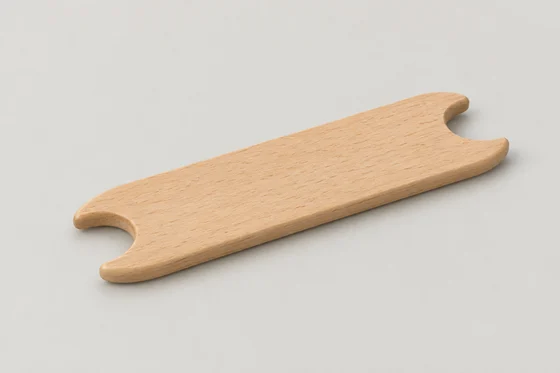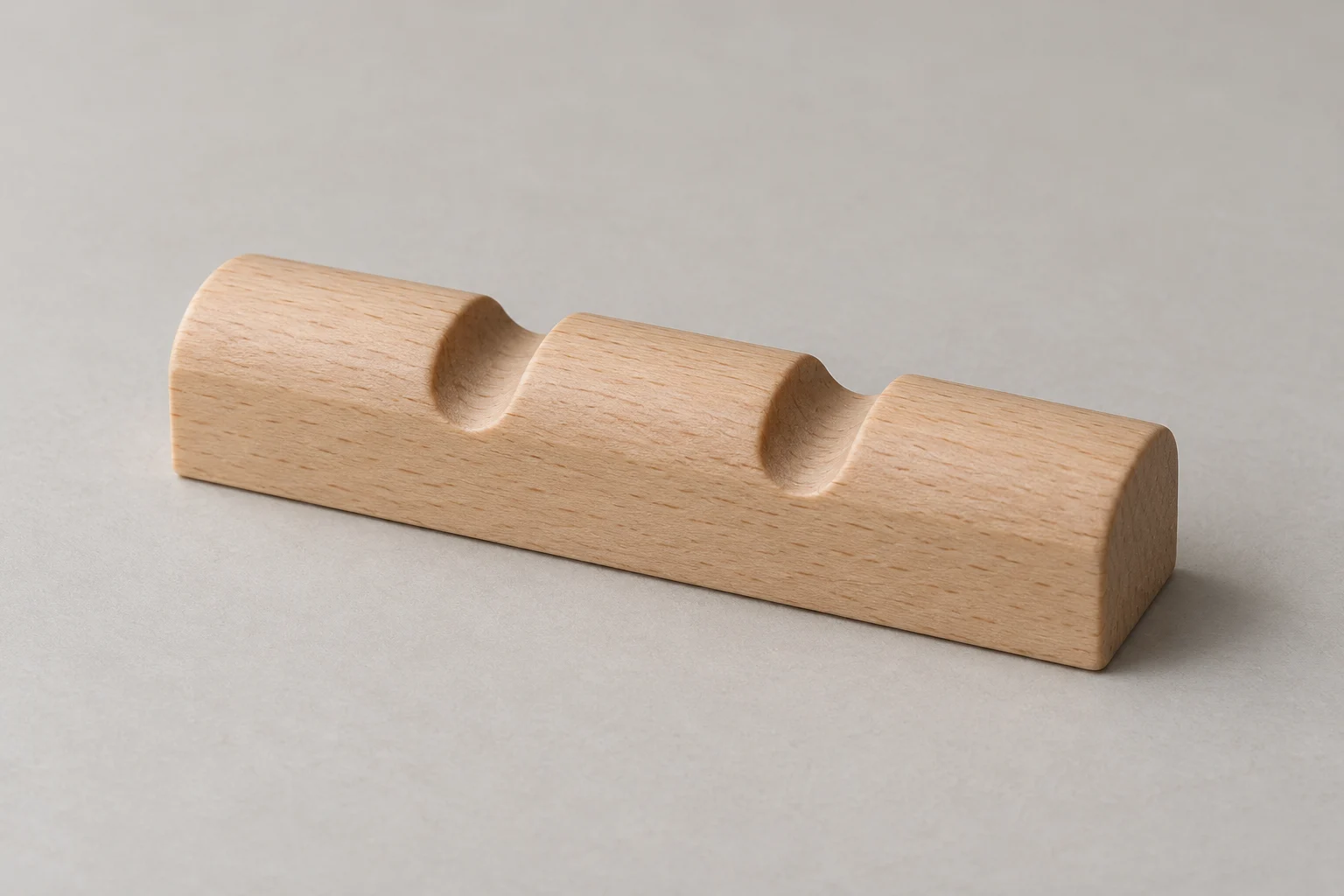
Generated interpretation of a published historical teaching design; not an authenticated specimen or exact replica. Colour and surface appearance are interpretive.
Overview
The tenth model in Sutcliffe’s manual is a pen rest made from beech. Its drawing shows a short, low body whose rounded upper surface is interrupted by two transverse recesses, leaving three raised portions of equal height. The lower part remains continuous, with a flat bottom and square ends. A cross-section distinguishes the rounded exterior from the bases of the recesses. These views matter because the side outline alone could be mistaken for separate blocks rather than one shaped piece. The lesson confirms that the form begins as a single piece of wood, with the spaces subsequently cut and their bases rounded before the surface is finished.
The pen rest combines straight preparation with controlled shaping. Sutcliffe first establishes level surfaces and marked reference lines, then relates the curved upper part to semicircles at the ends. The recesses introduce additional cuts whose sides are checked for squareness before the bases are rounded. In the broader manual, the complete model remains one pupil’s responsibility, and accurate form and finish are presented as the purpose of the exercise. The pen rest belongs to that advocated training sequence. It is shown here as the bare published design, without inventing a particular pen, school desk, owner or surviving workshop example associated with the illustration.
History & identity
John D. Sutcliffe, identified with the Manchester Recreative Evening Classes, presents Hand-Craft as an English exposition of Swedish Slöjd. The retained title names a New York edition published by Charles E. Merrill & Co. in 1890. T. C. Horsfall supplies the introduction; Sutcliffe’s own note is dated at Pendleton, Manchester, in March 1890. Publication location, educational references and model design do not identify an individual object’s maker.
Sources & representation
The complete numbered lesson is bound to a model drawing with a plan and edge view. The source establishes a published teaching form, not an individually provenanced specimen.
Selected bibliography
Documented works and useful reading. This is not a list of every appearance.
- 01
Hand-Craft: The Most Reliable Basis of Technical Education in Schools and Classes
New York, Charles E. Merrill & Co. Title, introduction, author note, complete preliminary teaching context and selected complete model lessons retained.
Language & cultural connections
Source-supported language and cultural connections have not yet been compiled for this profile.
References
Sources supporting this profile. Linked pages have their own scope and editorial standards.
- Period educational woodwork manual with model drawings and instructionsHand-Craft, 1890 editionResearch access: 2026-10-18
Image credits
AI-generatedGenerated interpretation of a published historical teaching design; not an authenticated specimen or exact replica. Colour and surface appearance are interpretive.