Generated interpretation of a published historical teaching design; not an authenticated specimen or exact replica. Colour and surface appearance are interpretive.
Overview
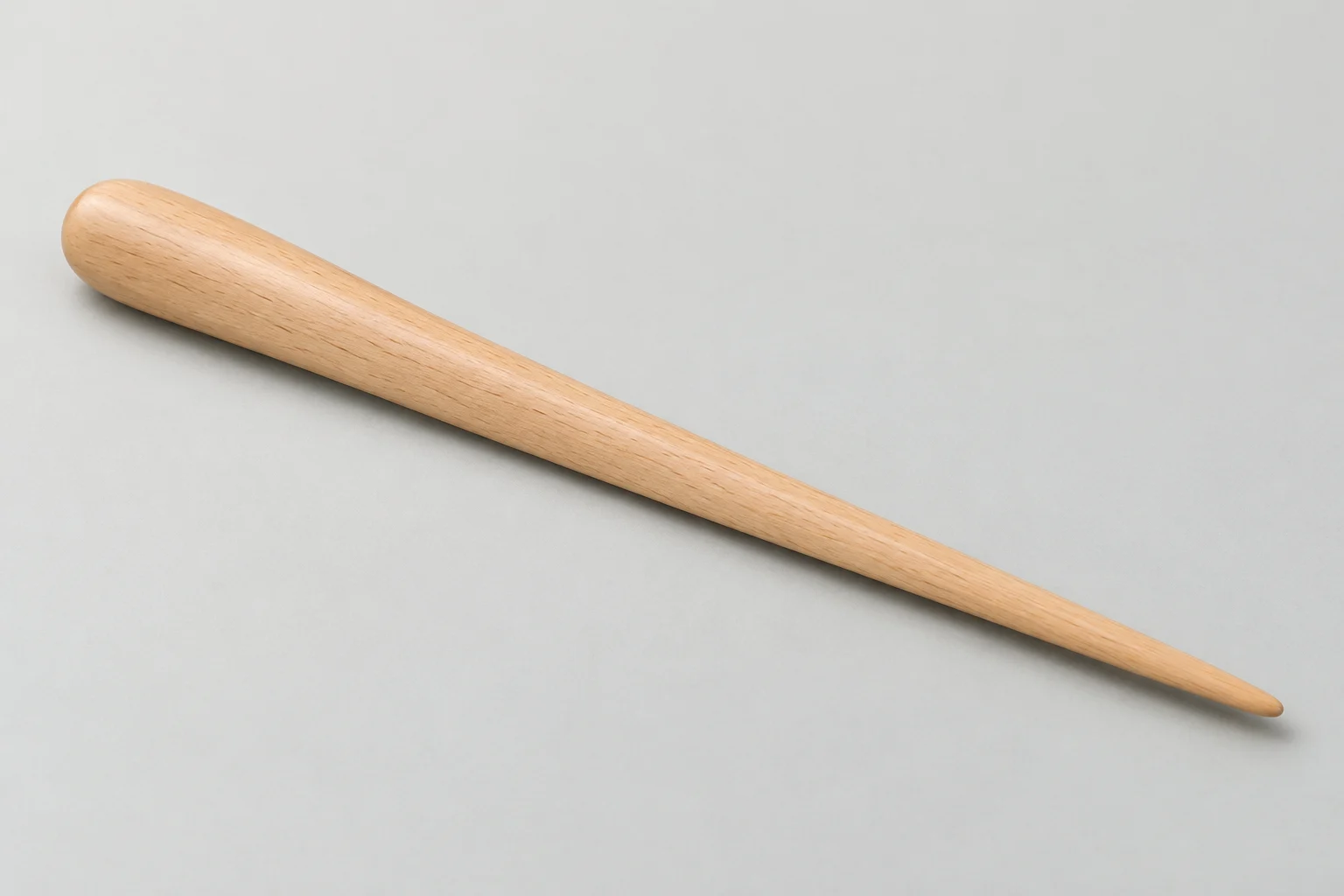
Sutcliffe’s fourth model is an envelope opener cut from beech. Its drawings give two complete longitudinal views and an end section, showing a slender taper with one flat face and a rounded opposite face. The wider end is smoothly rounded, and the narrower end is also finished symmetrically rather than supplied with a separate metal point. The text explains the curved face through its relation to a semicircle marked on the thick end. Thus the taper is supported by both the lesson and more than one projection, rather than inferred from a single silhouette. No separate handle, fitting, ornament or inscription is described for the model.
The lesson develops the rounded face through successive angular stages while preserving the reference face. Its closing instruction is to round the ends and finish the piece with sand-paper. This plain result reflects the manual’s emphasis on control and surface finish in small objects, rather than a decorative treatment applied afterwards. Only four numbered exercises are attached to the model, placing it early in the teaching series. Sutcliffe’s author note also warns that handling tools is properly learned from a competent teacher in practice, not from written hints alone. The opener is therefore presented as a dated classroom design, without claiming that the illustration records an individually owned object or a present-day teaching standard.
History & identity
John D. Sutcliffe, identified with the Manchester Recreative Evening Classes, presents Hand-Craft as an English exposition of Swedish Slöjd. The retained title names a New York edition published by Charles E. Merrill & Co. in 1890. T. C. Horsfall supplies the introduction; Sutcliffe’s own note is dated at Pendleton, Manchester, in March 1890. Publication location, educational references and model design do not identify an individual object’s maker.
Sources & representation
The complete numbered lesson is bound to a model drawing with a plan and edge view. The source establishes a published teaching form, not an individually provenanced specimen.
Selected bibliography
Documented works and useful reading. This is not a list of every appearance.
- 01
Hand-Craft: The Most Reliable Basis of Technical Education in Schools and Classes
New York, Charles E. Merrill & Co. Title, introduction, author note, complete preliminary teaching context and selected complete model lessons retained.
Language & cultural connections
Source-supported language and cultural connections have not yet been compiled for this profile.
References
Sources supporting this profile. Linked pages have their own scope and editorial standards.
- Period educational woodwork manual with model drawings and instructionsHand-Craft, 1890 editionResearch access: 2026-10-18
Image credits
AI-generatedGenerated interpretation of a published historical teaching design; not an authenticated specimen or exact replica. Colour and surface appearance are interpretive.