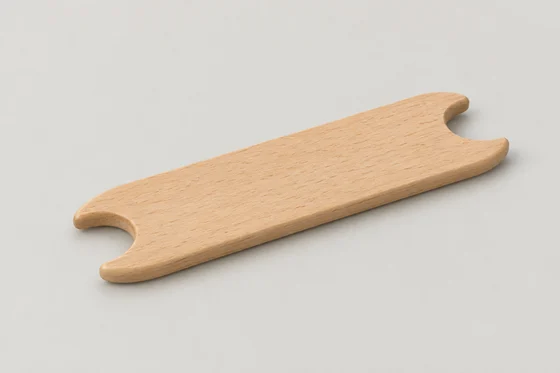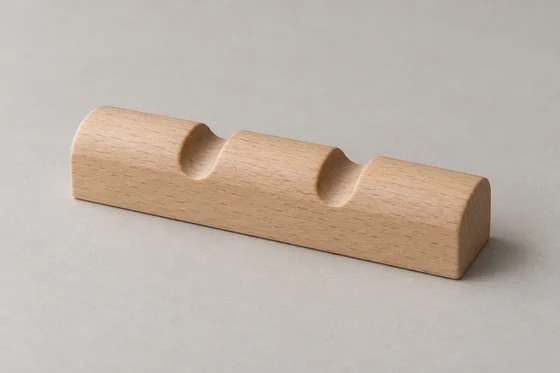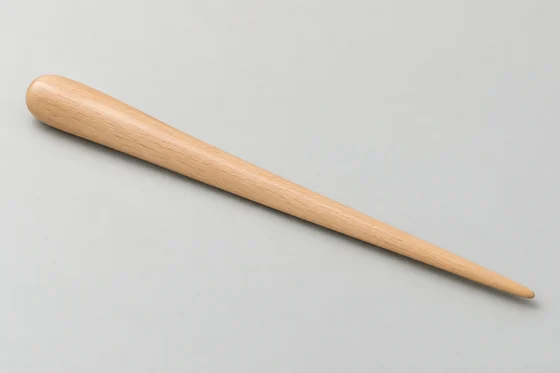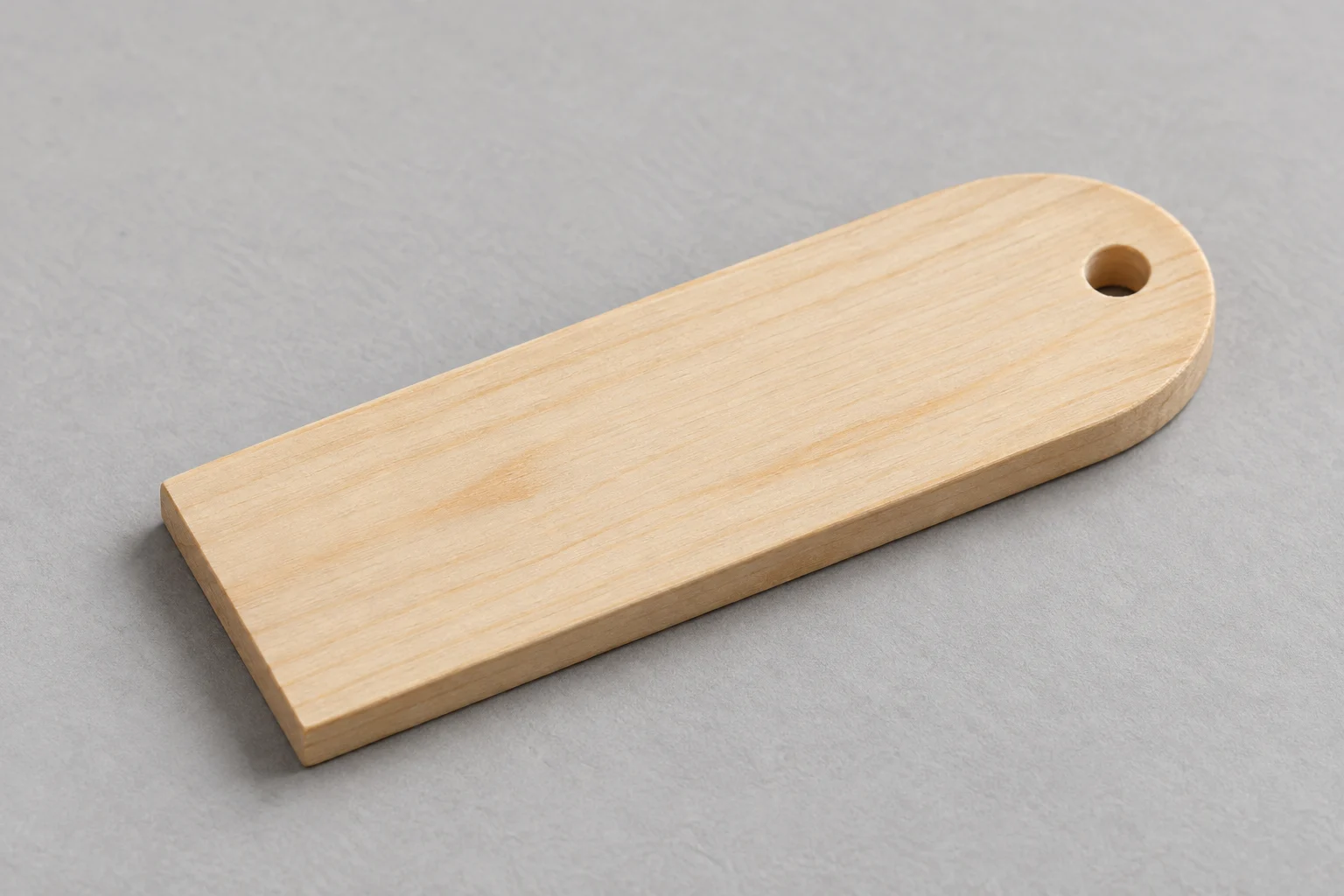
Generated interpretation of a published historical teaching design; not an authenticated specimen or exact replica. Colour and surface appearance are interpretive.
Overview
The seventh model in Sutcliffe’s manual is a key label. Its drawing shows a flat rectangular piece with one square end and one semicircular end, pierced by a single round hole at the centre of the semicircle. An edge view makes the thickness and through-hole explicit. The lesson combines this outline with a sequence for establishing straight surfaces, marking the centre and finishing the rounded end. It recommends beginning with enough material for two models. The lesson specifies pine for this model. The table likewise marks the key label F, a code defined in the manual as fir, commonly called deal or pine. These are the manual’s period material terms.
Sutcliffe explicitly calls the key label mainly an exercise in planing. The small finished object is the result of repeatedly checking straightness, squareness and thickness, followed by smoothing the ends and surface. In the preliminary discussion he presents small models as opportunities for careful attention to form and finish, and gives the complete product to one operator rather than dividing its manufacture into separate jobs. The key label illustrates that teaching scheme without requiring a decorative pattern or elaborate joint. Its title identifies the intended class of object, but the source supplies neither an inscribed key number nor a particular lock, owner or institution to which it belonged.
History & identity
John D. Sutcliffe, identified with the Manchester Recreative Evening Classes, presents Hand-Craft as an English exposition of Swedish Slöjd. The retained title names a New York edition published by Charles E. Merrill & Co. in 1890. T. C. Horsfall supplies the introduction; Sutcliffe’s own note is dated at Pendleton, Manchester, in March 1890. Publication location, educational references and model design do not identify an individual object’s maker.
Sources & representation
The complete numbered lesson is bound to a model drawing with a plan and edge view. The source establishes a published teaching form, not an individually provenanced specimen.
Selected bibliography
Documented works and useful reading. This is not a list of every appearance.
- 01
Hand-Craft: The Most Reliable Basis of Technical Education in Schools and Classes
New York, Charles E. Merrill & Co. Title, introduction, author note, complete preliminary teaching context and selected complete model lessons retained.
Language & cultural connections
Source-supported language and cultural connections have not yet been compiled for this profile.
References
Sources supporting this profile. Linked pages have their own scope and editorial standards.
- Period educational woodwork manual with model drawings and instructionsHand-Craft, 1890 editionResearch access: 2026-10-18
Image credits
AI-generatedGenerated interpretation of a published historical teaching design; not an authenticated specimen or exact replica. Colour and surface appearance are interpretive.