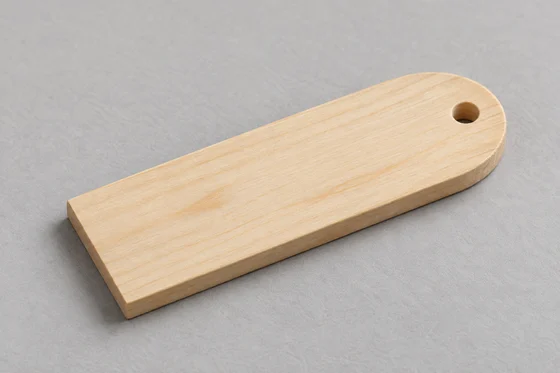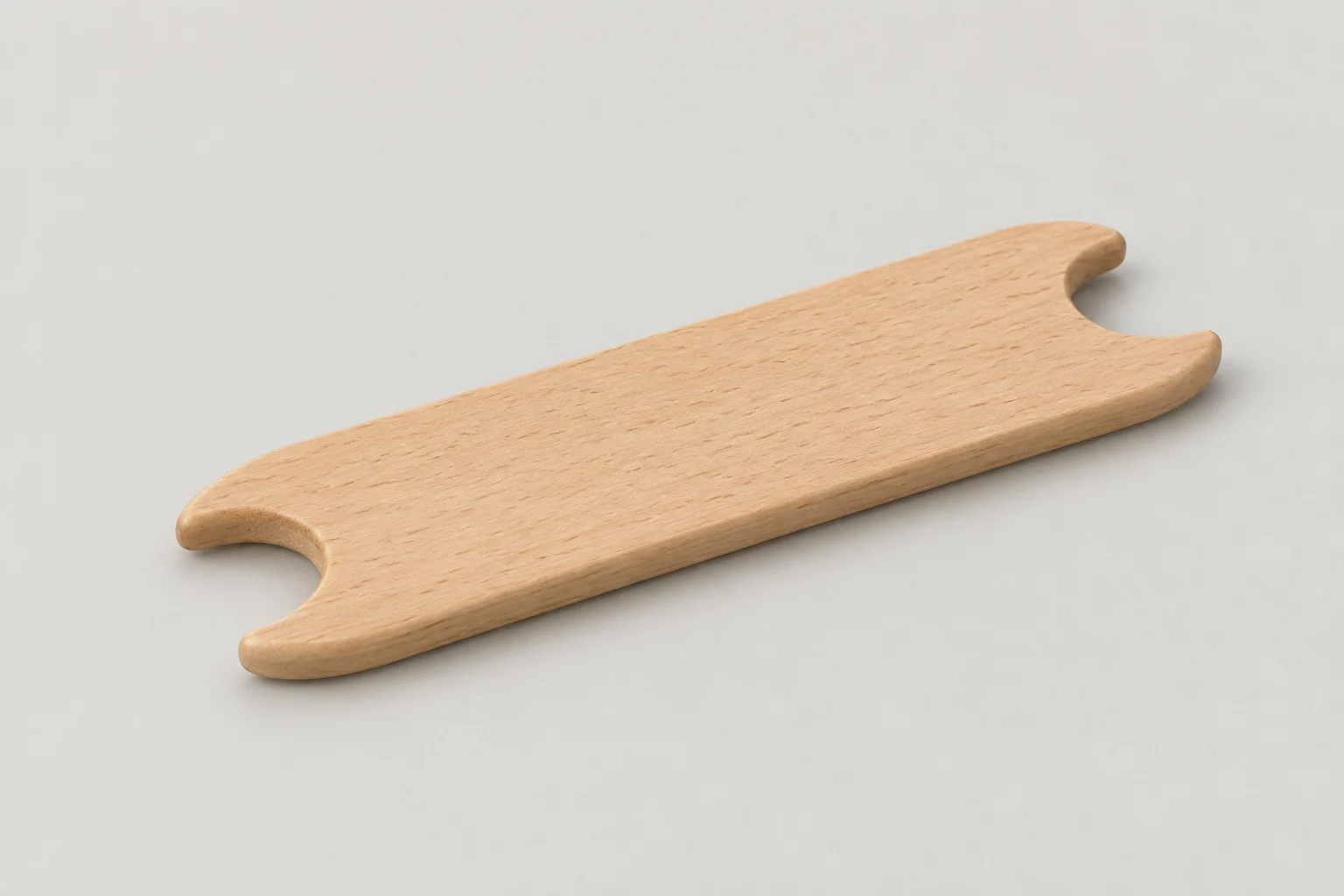
Generated interpretation of a published historical teaching design; not an authenticated specimen or exact replica. Colour and surface appearance are interpretive.
Overview
Sutcliffe’s eighth model is a thread-winder, labelled Pack Thread Winder in the accompanying drawing. Its plan is an elongated, symmetrical tablet with rounded shoulders and a semicircular recess in each short end. The additional edge and section views clarify its thin form and softened edges. The lesson specifies beech and relates the outline to a centre line, compass work and paired openings that become the end recesses when the surrounding shape is cut out. It concludes by removing layout marks and finishing the surface. The drawing shows the bare model rather than thread wound around it, so it does not establish a particular wrapping arrangement.
The thread-winder brings several operations together in one small piece: the lesson combines planing and gauging with curved sawing, knife work, drilling and filing. Its place in the numbered series matters as much as the resulting household form. In the preliminary teaching discussion, Sutcliffe says that the objects are small so that attention can be given to exact shape and finish, and that one pupil is responsible for the complete production rather than one divided task. He presents these features as educational advantages. The model therefore belongs to an advocated training sequence, not a catalogue of items attributed to a particular workshop or community of makers.
History & identity
John D. Sutcliffe, identified with the Manchester Recreative Evening Classes, presents Hand-Craft as an English exposition of Swedish Slöjd. The retained title names a New York edition published by Charles E. Merrill & Co. in 1890. T. C. Horsfall supplies the introduction; Sutcliffe’s own note is dated at Pendleton, Manchester, in March 1890. Publication location, educational references and model design do not identify an individual object’s maker.
Sources & representation
The numbered lesson is bound to a complete model drawing showing exterior form and additional projections. This is evidence of a published teaching design, not an authenticated surviving specimen.
Selected bibliography
Documented works and useful reading. This is not a list of every appearance.
- 01
Hand-Craft: The Most Reliable Basis of Technical Education in Schools and Classes
New York, Charles E. Merrill & Co. Title, introduction, author note, complete preliminary teaching context and selected complete model lessons retained.
Language & cultural connections
Source-supported language and cultural connections have not yet been compiled for this profile.
References
Sources supporting this profile. Linked pages have their own scope and editorial standards.
- Period educational woodwork manual with model drawings and instructionsHand-Craft, 1890 editionResearch access: 2026-10-18
Image credits
AI-generatedGenerated interpretation of a published historical teaching design; not an authenticated specimen or exact replica. Colour and surface appearance are interpretive.