A sourced illustration has not yet been added. This gap is included in the coverage record.
Overview
The three young men travel to an outlying village to visit maidens. On their outward journey the stream is shallow enough to wade, but when they return with the women it is full. One proposes turning back; the others insist on continuing. The narrative identifies their specialist roles with prayer, archery and wrestling and asks each to solve the crossing by his own skill.
The prayer specialist prostrates himself, spits on his staff and strikes the water. It opens to let him and his companion cross, then closes again. The bowman lays his arrows in a line from bank to bank. He and his companion walk over them, and he retrieves them afterward. The wrestler first searches unsuccessfully for a method. Becoming angry, he twists his leg around his companion’s with a wrestling move and leaps with her, landing on the far bank. All three crossings succeed. The ending asks the audience to compare their abilities without selecting a winner.
Origins & earliest records
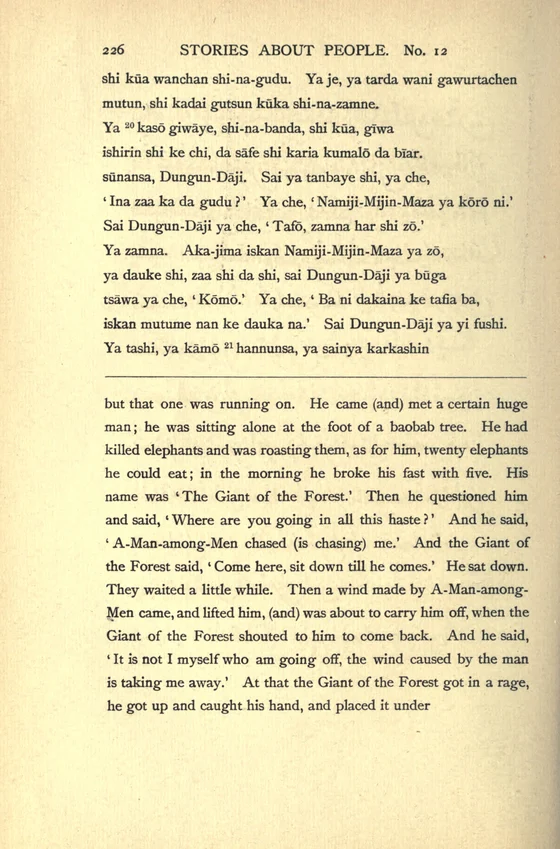
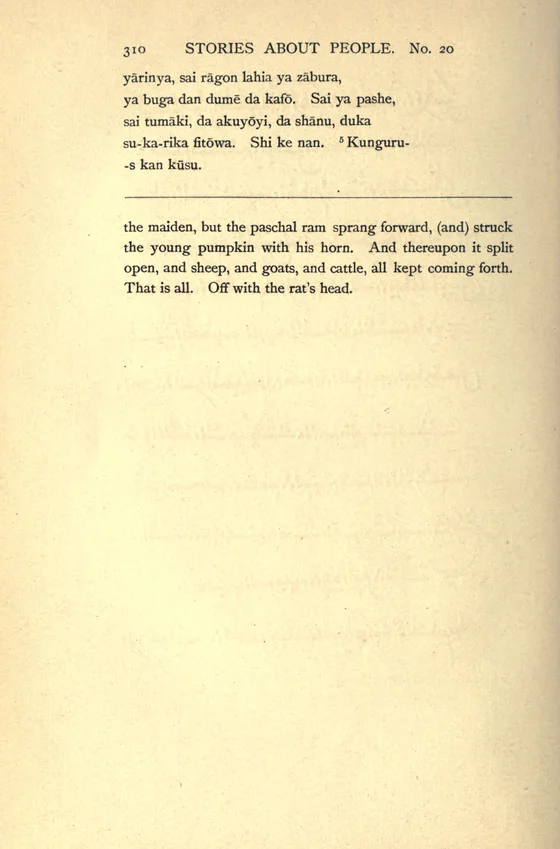
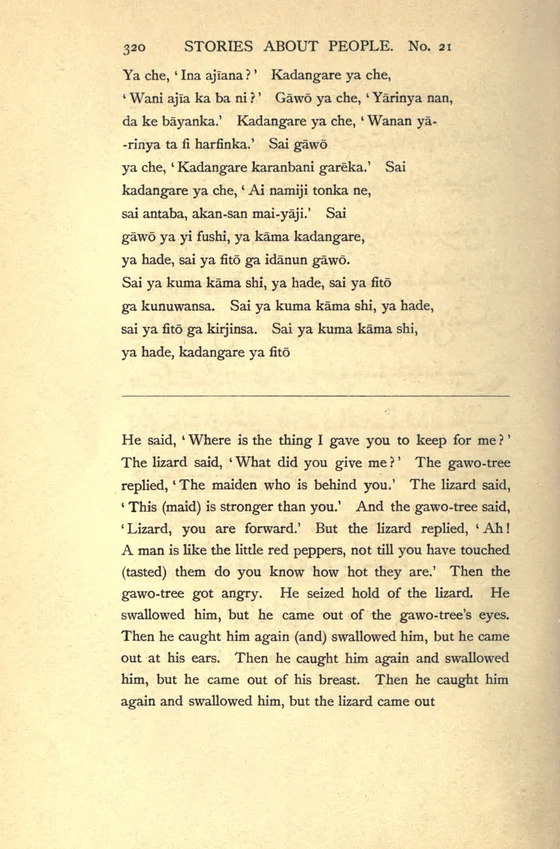
Malam Shaihu supplied written Hausa material, sometimes translated from Arabic manuscripts; Rattray transliterated and translated it into English. The author note dates the manuscript collection to 1907–1911.
Records & interpretation
Shaihu/Rattray, Hausa Folk-Lore, Customs, Proverbs, etc., Volume I (1913), tale 11, complete pp. 204–208; three crossings pp. 206–208.
Selected bibliography
Documented works and useful reading. This is not a list of every appearance.
- 01
Hausa Folk-Lore, Customs, Proverbs, etc., Volume I
Shaihu/Rattray, Hausa Folk-Lore, Customs, Proverbs, etc., Volume I (1913), tale 11, complete pp. 204–208; three crossings pp. 206–208.
Family & connections
A source-supported family tree or inspiration record has not yet been compiled for this profile. Related reading below indicates a connection in subject matter, not a proven lineage or creative influence.
References
Sources supporting this profile. Linked pages have their own scope and editorial standards.
- Bilingual manuscript tale; digitized primary OCRShaihu/Rattray — three successful stream crossingsResearch access: 2026-10-05
- Compiler methodologyAuthor’s NoteResearch access: 2026-10-05
Image credits
A sourced illustration has not yet been added. This gap is included in the coverage record.