A sourced illustration has not yet been added. This gap is included in the coverage record.
Overview
Malam Shaihu’s historical opening describes the king of Bornu as owning a horse with a golden horn. It is kept hidden in a house and neighs only on Fridays, with a sound compared to a tornado. The king’s son repeatedly gives its keeper money and robes to arrange mating with his own mare. The king has forbidden anyone to possess a foal from the royal horse, threatening execution. Nevertheless, the mare bears a colt which grows up undetected.
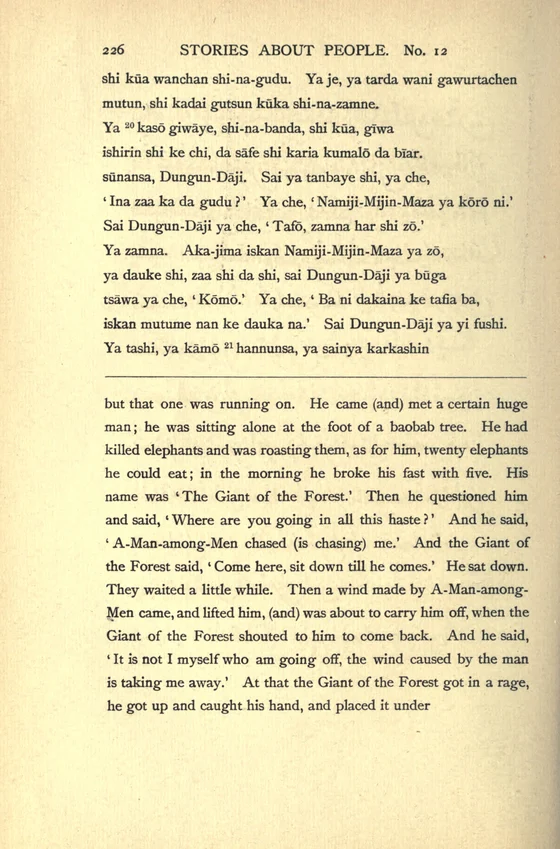
When the king’s horse neighs, the young horse answers and exposes its presence. Councillors searching the town find the king’s son with an animal resembling the royal horse and bearing its golden horn. The prince strikes down two men, saddles the young horse and escapes. The mounted townspeople cannot overtake him. The narrative explains that the father’s horse could have done so, but the king has prohibited anyone from mounting it.
The prince eventually reaches Daura and stays with the king’s daughter, who possesses the town. They agree to marry and have a son and a daughter; the account presents their union as the origin of the Hausa nation and names Barebari and Daura ancestors. This is the completed horse-and-flight origin episode before the text turns to the spread of Islam. It does not name the prince Bayajidda, describe a well-serpent fight or assign winged flight to either horse.
Origins & earliest records
Malam Shaihu’s written material, published with transliteration and English translation by R. Sutherland Rattray. The Author’s Note explains that Shaihu wrote contributions or translated Arabic manuscripts and that much material passed through Arabic, Hausa and English; the individual derivation of this opening is not specified. The account’s own claim to authenticity is preserved as a narrative position rather than accepted as archaeological history.
Records & interpretation
Hausa Folk-Lore, Customs, Proverbs, etc., Volume I (1913), Part I Historical, complete origin episode pp. 2–6; compiler methodology p. xii.
Selected bibliography
Documented works and useful reading. This is not a list of every appearance.
- 01
Hausa Folk-Lore, Customs, Proverbs, etc., Volume I
Hausa Folk-Lore, Customs, Proverbs, etc., Volume I (1913), Part I Historical, complete origin episode pp. 2–6; compiler methodology p. xii.
Family & connections
A source-supported family tree or inspiration record has not yet been compiled for this profile. Related reading below indicates a connection in subject matter, not a proven lineage or creative influence.
References
Sources supporting this profile. Linked pages have their own scope and editorial standards.
- Bilingual manuscript tale; digitized primary OCRShaihu/Rattray 1913 — Golden-horned royal horsesResearch access: 2026-10-05
- Compiler methodologyAuthor’s NoteResearch access: 2026-10-05
Image credits
A sourced illustration has not yet been added. This gap is included in the coverage record.