Stymphalian Birds
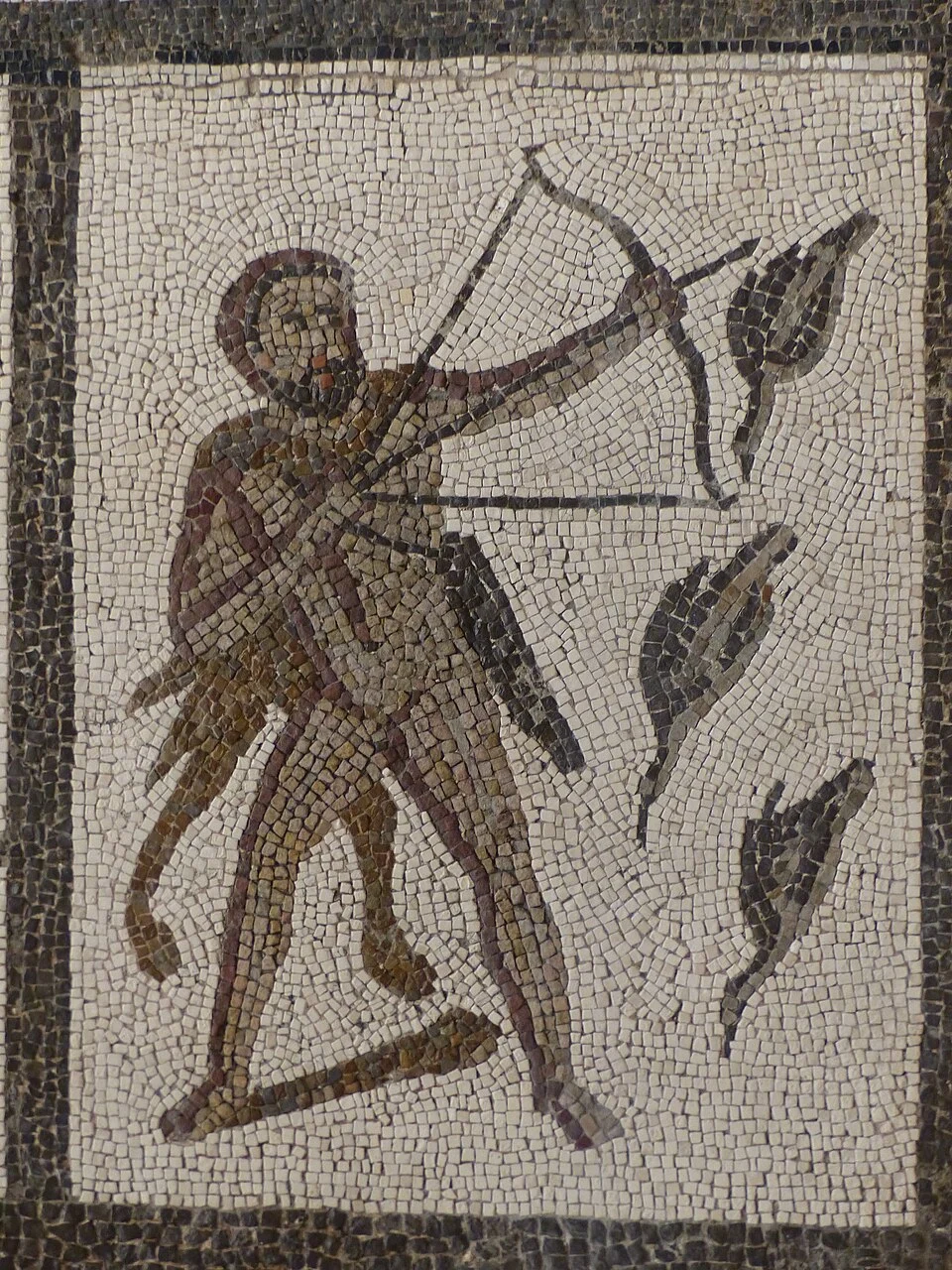
Image associated with the exact linked encyclopedia article; consult credited file description for its interpretation.
Overview
In the Library’s account, countless birds gather by the Stymphalian lake in a wooded setting, avoiding wolves. Heracles cannot readily drive them from their refuge. Athena supplies bronze castanets made by Hephaestus, whose sound frightens the flock into flight and gives the hero an opportunity to shoot them.
The solution depends on changing the birds’ behavior rather than reaching them one at a time in the wood. This selected account does not describe every feature found in later popular versions, such as metallic projectile feathers, so those require another cited witness. The group is a particular mythic flock tied to a Heraclean labor, not evidence that ancient observers identified a natural species with supernatural weaponry.
Pausanias preserves competing outcomes: the local story has Heracles shoot man-eating birds, while his citation of Peisander says noise drove them away. He also describes supposedly similar Arabian birds with piercing beaks, but expressly doubts whether they share the Arcadian flock’s identity. His account of temple carvings is firmer about representation than anatomy: birds appear near the roof, and bird-legged marble maidens stand behind the sanctuary. Those separate figures are not automatically the flock’s bodily form.
In Argonautica II, Amphidamas recalls Heracles frightening the Stymphalian flock with bronze noise when arrows would not suffice. He uses that precedent against the birds on Ares’s island. Those island birds wound Oileus with a feather and later shower the shielded ship with feather-shafts. The comparison explains the Argonauts’ tactic; it does not explicitly make every Stymphalian bird identical with the projectile-feather flock.
Origins & earliest records
This entry follows The Library, Book II, at 2.5.6, in the linked English translation. The work preserves a particular ancient narrative rather than establishing the first appearance of every motif. Its composition period dates a surviving literary witness; older oral transmission and earlier artistic evidence require separate investigation.
Records & interpretation
Library 2.5.6 supplies woodland refuge, divine castanets and shooting; Pausanias 8.22.4–7 records alternate outcome, uncertain Arabian comparison and sanctuary representations; Argonautica 2.1030–1089 gives an explicitly comparative island encounter.
Selected bibliography
Documented works and useful reading. This is not a list of every appearance.
- 01
The Library, Book II, 2.5.6
Complete 2.5.6 labor episode.
- 02
Description of Greece 8.22.4–7
Local story, Peisander variant, Arabian comparison and temple representations.
- 03
Argonautica 2.1030–1089
Complete birds-of-Ares attack and defense, including Amphidamas’s Stymphalian comparison.
- 04
The Library (Bibliotheca)
Pseudo-Apollodorus, The Library, James George Frazer translation, Loeb Classical Library 121–122; Harvard University Press / William Heinemann, 1921.
Family & connections
A source-supported family tree or inspiration record has not yet been compiled for this profile. Related reading below indicates a connection in subject matter, not a proven lineage or creative influence.
Located primary passages
Specific passages supporting details in this entry, grouped by their published witness.
The Library, Book II, 2.5.6
Pseudo-Apollodorus, The Library, James George Frazer translation, Loeb Classical Library 121–122; Harvard University Press / William Heinemann, 1921.
- The birds gather at a wooded lake in Stymphalus, fearing wolves.
- Athena supplies brazen castanets that frighten the birds into flight, allowing Hercules to shoot them.
A version-specific primary witness, not an earliest-attestation claim or proof of zoological existence.
Encyclopedia background
An additional attributed reference, separate from the editorial profile above.
Read the open encyclopedia overview
The Stymphalian birds ( stim-FAY-lee-ən; Ancient Greek: Στυμφαλίδες ὄρνιθες, romanized: Stymphalídes órnithes) are a group of voracious birds in Greek mythology. The birds' appellation is derived from their dwelling in a swamp in Stymphalia.
Text from Wikipedia contributors, “Stymphalian birds”. CC BY-SA 4.0. Extracted introduction; formatting changed. Retrieved 5 October 2026. The source article may have changed since retrieval.
References
Sources supporting this profile. Linked pages have their own scope and editorial standards.
- Primary textThe Library, Book II: 2.5.6 (Theoi Classical Texts Library or Project Gutenberg transcription)Research access: 2026-10-05
- Primary textPausanias 8.22Research access: 2026-10-05
- Primary textApollonius, Argonautica IIResearch access: 2026-10-05
Image credits
Reference illustrationStymphalian Birds
Image associated with the exact linked encyclopedia article; consult credited file description for its interpretation.