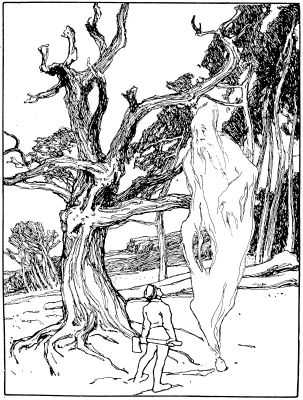
The Spirit in the Bottle, illustration by Otto Ubbelohde,1909
Exact named Grimm tale artwork,1909; artist1867–1922. Creature interpretation belongs to this historical illustration.
Overview
The spirit's encounter begins during a poor student's interruption of his woodcutting work. Unable to continue his education because his father's savings have run out, the young man accompanies him into the forest with a borrowed axe. At midday he wanders away and hears a muffled plea beneath a very old oak, so broad that five men could not span it. Digging among the roots, he finds a glass bottle containing a moving, frog-shaped creature. Removing the cork releases a spirit who rapidly grows to roughly half the oak's height. The change is visible and explicitly narrated: the small occupant and enormous threatening figure are the same being. Calling himself Mercurius, he says his imprisonment was punishment and announces that he must strangle anyone who releases him. The tale does not explain who confined him, what earlier offence caused it, or why this penalty should fall on the liberator.
The student answers force with a challenge to the spirit's credibility: if he can truly fit inside the little bottle, he should demonstrate it. Mercurius shrinks and re-enters, allowing the student to replace the cork and put the bottle back among the roots. This second confinement shifts the bargaining power. A renewed promise of reward wins another release, followed by a small plaster-like gift with two distinct uses: one end heals wounds, the other changes iron or steel into silver. The student tests healing on damaged tree bark before parting with the spirit. His first attempt to use the silver-making end bends the borrowed axe, since silver is softer; a goldsmith values it at four hundred thalers, pays three hundred immediately and owes the rest. The son reimburses the neighbour twice the axe's original price, gives his father a hundred thalers and returns to education. The conclusion makes him a celebrated physician. These consequences show that the reward works within the story, while the spirit itself departs without further punishment. Its name invites historical comparison with Mercury traditions, but a shared name alone cannot establish identity with every classical god or alchemical concept.
Origins & earliest records
This entry follows tale 99 in the Grimm brothers’ Household Tales, using Margaret Hunt’s 1884 English translation. The collection was repeatedly revised during the nineteenth century and mediates material from storytellers and earlier literature. Its publication and translation dates identify the selected witness, not the beginning of every related oral narrative.
Records & interpretation
The numbered tale supplies the being’s appearance, speech and actions in a collected literary narrative. It documents storytelling and editorial transmission, rather than biological existence or actual animal behaviour. Different editions and related oral tales may alter transformations, endings or motives; the selected passage is identified so those differences can be compared.
In the literature
“I am the mighty Mercurius. Whoso releases me, him must I strangle.”
Tale 99 The Spirit in the Bottle; paragraph beginning “There was once a poor woodcutter who toiled from early morning till…” · Margaret Hunt
The released spirit names himself Mercurius and threatens his liberator.
“stretched himself out and became as big as a giant.”
Tale 99 The Spirit in the Bottle; paragraph beginning “And now the scolar was about to return to his father, but…” · Margaret Hunt
The spirit grows to giant size when released again.
Selected bibliography
Documented works and useful reading. This is not a list of every appearance.
- 01
Household Tales, tale 99: The Spirit in the Bottle
Specific public-domain collected tale inspected. The selected English edition is a literary witness, not a transcript of a universal oral version.
- 02
Household Tales: 99 The Spirit in the Bottle
Margaret Hunt’s English translation, London: George Bell and Sons, 1884; Gutenberg e-text identifies Hunt. Translation date corroborated by the Wikisource scanned title page and National Library of New Zealand catalogue.
Family & connections
A source-supported family tree or inspiration record has not yet been compiled for this profile. Related reading below indicates a connection in subject matter, not a proven lineage or creative influence.
Located primary passages
Specific passages supporting details in this entry, grouped by their published witness.
Household Tales, tale 99: The Spirit in the Bottle
Margaret Hunt’s English translation, London: George Bell and Sons, 1884; Gutenberg e-text identifies Hunt. Translation date corroborated by the Wikisource scanned title page and National Library of New Zealand catalogue.
- The released spirit names himself Mercurius and threatens his liberator.
- The spirit grows to giant size when released again.
- The scholar tricks the threatening spirit back into the bottle and recorks it.
- The spirit’s reward can change steel or iron into silver, besides healing wounds in the story.
This describes the version printed in Hunt’s translation; German tale origin and other versions require separate evidence.
Encyclopedia background
An additional attributed reference, separate from the editorial profile above.
Read the open encyclopedia overview
"The Spirit in the Bottle" (German: Der Geist im Glas) is a German fairy tale collected by the Brothers Grimm, tale number 99. In the Aarne–Thompson–Uther Index, it is type 331. It is of Jewish and Arabian origin, later appearing in Europe during the Middle Ages.
Text from Wikipedia contributors, “The Spirit in the Bottle”. CC BY-SA 4.0. Extracted introduction; formatting changed. Retrieved 5 October 2026. The source article may have changed since retrieval.
References
Sources supporting this profile. Linked pages have their own scope and editorial standards.
- Primary textGrimm/Hunt, Household Tales, tale 99Research access: 2026-10-05
Image credits
Historical illustrationThe Spirit in the Bottle, illustration by Otto Ubbelohde,1909
Exact named Grimm tale artwork,1909; artist1867–1922. Creature interpretation belongs to this historical illustration.