Sphinx (Egyptian)
Image associated with the exact linked encyclopedia article; consult credited file description for its interpretation.
Overview
Egyptian sphinx imagery commonly joins a human head to a lion body and associates royal identity with strength. The Metropolitan Museum’s Hatshepsut sculpture, object 31.3.166, dates to about 1473–1458 BCE. Its nemes headcloth and false beard present the female pharaoh through royal conventions. The museum identifies it as one of at least six granite sphinxes at her Deir el-Bahri mortuary temple.
This particular commission can be compared with the much earlier Giza sphinx attributed to Khafre. Neither supplies the Greek Sphinx’s riddle narrative: the shared English name does not erase different settings and functions. The surviving sculpture provides material evidence for royal representation, while its excavation and reconstruction belong to a separate history. The Dream Stela should not be treated as a contemporary inscription of Hatshepsut’s object.
Origins & earliest records
Egyptian sphinx imagery is securely attested in ancient monuments long before Hatshepsut’s New Kingdom examples. The Dream Stela is a later royal textual witness associated with the Great Sphinx. A surviving record dates its documentation, not the beginning of an oral tradition; earlier transmission cannot be timed precisely from this witness alone.
Records & interpretation
Surviving sculptures, inscriptions and excavation records establish actual ancient objects and their contexts. The existence of those sculptures does not imply that a human-headed lion existed as a zoological organism. This is evidence for cultural expression and recorded interpretation, rather than a zoological specimen or independently verified supernatural event.
In the literature
“It had the body of a lion, and the upper part of a woman.”
Chapter X, “The Sphinx”, encounter with Oedipus
Refers to the Greek Theban Sphinx, not Egyptian royal sphinx iconography.
“the deadly Sphinx which destroyed the Cadmeans,”
Theogony, lines 306–332 · Hugh G. Evelyn-White
The Greek Sphinx afflicts the Cadmeans; surrounding grammar places her among the offspring of Echidna and Orthrus.
“The riddling Sphinx compelled us to let slide The dim past and attend to instant needs.”
Opening Creon–Oedipus exchange, reply explaining why Laius’s murder was not investigated · Francis Storr
Creon identifies the former Sphinx crisis as the obstacle to investigating Laius’s death.
Selected bibliography
Documented works and useful reading. This is not a list of every appearance.
- 01
Dream Stela of Thutmose IV
Selected relevant primary or ethnographic work; the online source below is separate.
Family, evolution & connections
Lion
The Met’s Hatshepsut sphinx combines a carefully observed lion body with the ruler’s idealized human head. The animal form conveys royal force within an Egyptian sculptural setting. A lion comparison describes the artwork’s anatomy, not a hybrid animal species; the named royal subject remains central to the meaning of this particular object.
Sphinx (Greek)
Hatshepsut’s sphinx is a royal Egyptian sculpture, while the Library’s Theban Sphinx is a winged, destructive riddle-giver with named mythic parents. Human and lion features invite comparison, but their functions and identities differ. This link alone does not establish a complete transmission history or make every Egyptian sphinx the monster defeated by Oedipus.
Encyclopedia background
An additional attributed reference, separate from the editorial profile above.
Read the open encyclopedia overview
A sphinx ( SFINKS; Ancient Greek: σφίγξ, pronounced [spʰíŋks]; pl. sphinxes or sphinges ) is a mythical creature with the head of a human, the body of a lion, and the wings of an eagle.
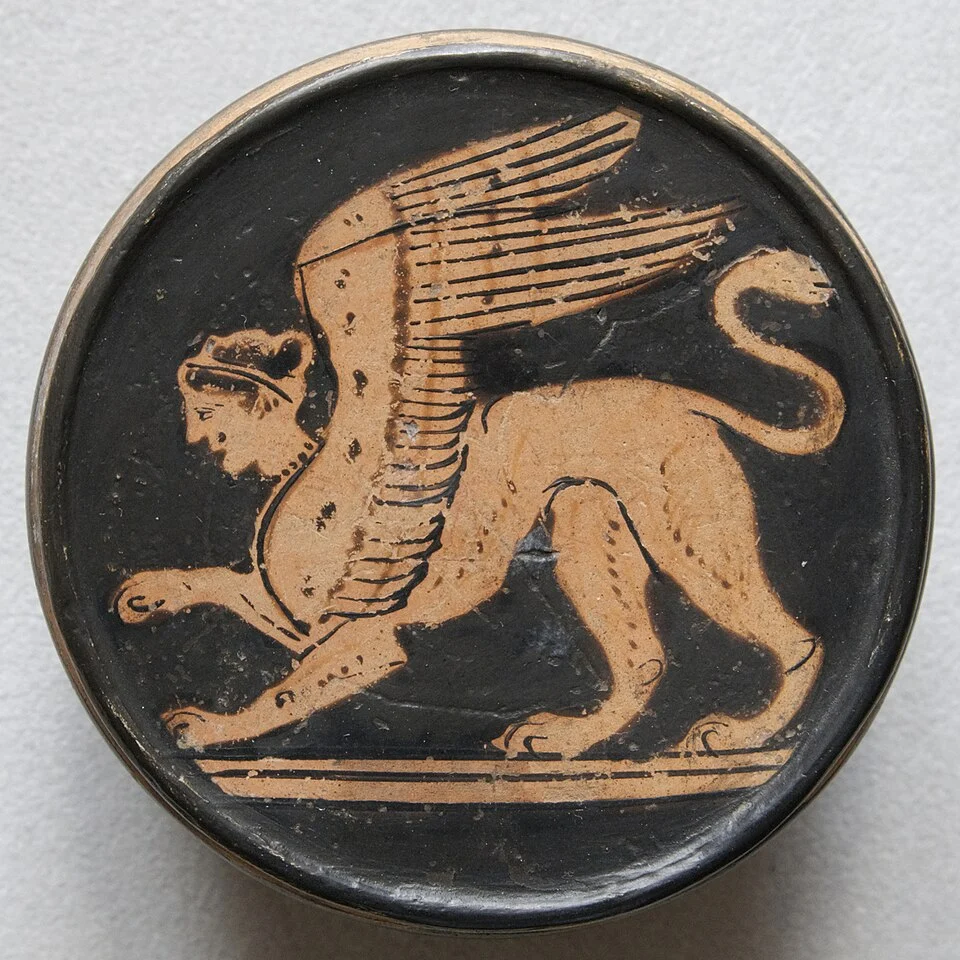
In Greek tradition, the sphinx is a treacherous and merciless being with the head of a woman, the haunches of a lion, and the wings of a bird.
According to Greek myth, she challenges those who encounter her to answer a riddle, and kills and eats them when they fail to solve the riddle. This deadly version of a sphinx appears in the myth and drama of Oedipus.
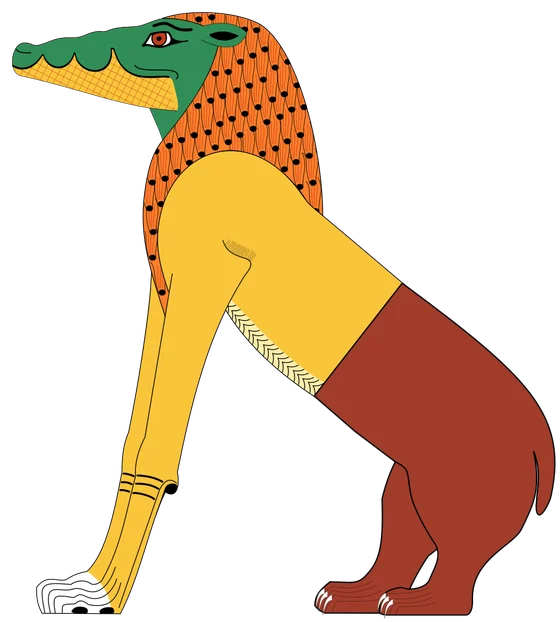
In Egyptian mythology, in contrast, the sphinx is typically depicted as a man (an androsphinx (Ancient Greek: ἀνδρόσφιγξ)), and is seen as a benevolent representation of strength and ferocity, usually of a pharaoh. Unlike Greek or Levantine/Mesopotamian ones, Egyptian sphinxes were not winged.
Both the Greek and Egyptian sphinxes were thought of as guardians, and statues of them often flank the entrances to temples. During the Renaissance, the sphinx enjoyed a major revival in European decorative art. During this period, images of the sphinx were initially similar to the ancient Egyptian version, but when later exported to other cultures, the sphinx was often conceived of quite differently, partly due to varied translations of descriptions of the originals, and partly through the evolution of the concept as it was integrated into other cultural traditions.
However, depictions of the sphinx are generally associated with grand architectural structures, such as royal tombs or religious temples.
Text from Wikipedia contributors, “Sphinx”. CC BY-SA 4.0. Extracted introduction; formatting changed. Retrieved 5 October 2026. The source article may have changed since retrieval.
References
Sources supporting this profile. Linked pages have their own scope and editorial standards.
- MuseumThe Metropolitan Museum of Art: Sphinx of HatshepsutResearch access: 2026-10-05
Image credits
Reference illustrationSphinx (Egyptian)
Image associated with the exact linked encyclopedia article; consult credited file description for its interpretation.