A sourced illustration has not yet been added. This gap is included in the coverage record.
Overview
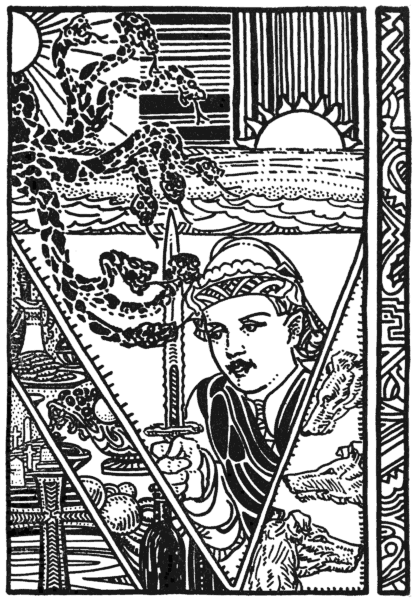
The Six-Headed Serpent, another son of Suyettar, holds the Moon after the Evil One curses it because its light obstructs his thefts. It remains at sea for two days before returning. The second princess is prepared as its demanded meal, but Six Bottles rescues her and confronts the arriving monster. Its six heads rise through six swirling movements, and it repeats the predatory rhyme attributed to its mother.
The serpent first demands a silver combat platform; Six Bottles makes it instead breathe out red copper. It fights with six scaly heads and pours fire and smoke from every mouth. The hero cuts away five heads, but the last becomes difficult to reach as he tires. His dog is released at a thrown-shoe signal and helps him finish the creature. The Moon reappears while the exhausted rescuer sleeps. This is a distinct middle opponent between the Dawn’s three-headed captor and the Sun’s nine-headed captor, not a changing head count assigned to one serpent.
Origins & earliest records
Parker Fillmore, Mighty Mikko (1922), Log, printed pp. 69–98; author’s note vii–xi.
Records & interpretation
Complete English retelling, with separate three-, six- and nine-headed brothers and the hero’s final fate. Fillmore’s version is not presented as a literal translation of an independently read Finnish text.
Selected bibliography
Documented works and useful reading. This is not a list of every appearance.
- 01
Mighty Mikko: Log, pp. 69–98
Complete selected chapter through blue-cross ending and widow’s remarriage. Three serpent brothers explicitly sons of Suyettar; head counts and captive luminaries remain distinct.
Family, evolution & connections
Suyettar’s three serpent sons — Fillmore’s Log retelling
Complete Log literary retelling, pp.69–98; separate from The True Bride.
Scroll sideways to see all branches. With a keyboard, focus the tree and use the arrow keys.
- Suyettar in Log, explicit mother
Repeated explicit Suyettar mother/sons statements and serpent brotherhood. No father is supplied. The retelling’s ordinal descriptions vary, so head counts identify the sons without establishing birth order. Suyettar’s companions are not assigned biological sisterhood merely from address, and the false-bride profile from another tale is not used as the mother endpoint.
Suyettar in Fillmore’s Log retelling
The narrative explicitly identifies this serpent as Suyettar’s son. This mother belongs to the Log retelling; shared naming does not automatically merge her biography with the false bride in The True Bride. No father is supplied.
References
Sources supporting this profile. Linked pages have their own scope and editorial standards.
- Primary historical literary retelling of folkloreFillmore1922: LogResearch access: 2026-10-05
Image credits
A sourced illustration has not yet been added. This gap is included in the coverage record.