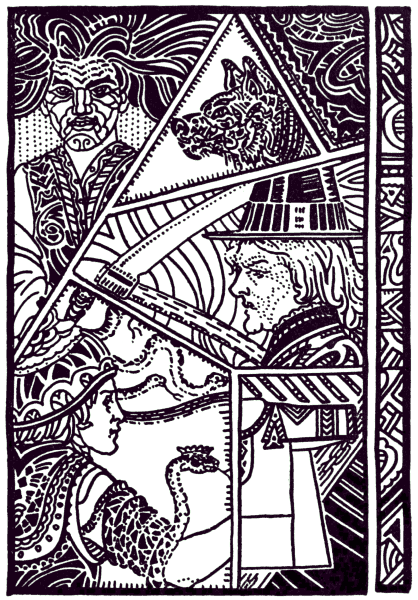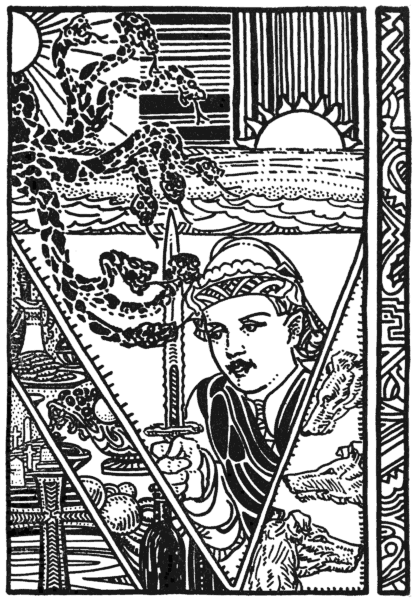
Log confronting the Sun-holding serpent in Van Everen’s1922 illustration
This is the final serpent encounter in Fillmore’s Log, identified by the adjacent declaration and the captive Sun. It depicts the nine-headed brother’s narrative rather than supplying an image for the separate three- or six-headed captors.
Overview
The strongest of Suyettar’s three serpent sons holds the Sun, cursed by the Evil One because its rays blistered him. Returning from the ocean on the third night, it demands the youngest princess. Log rescues her before the nine heads and coils approach. The monster demands a golden platform for their contest; Log instead requires silver, which the creature breathes into being. It attacks with nine scaly heads while expelling fire and smoke from all nine mouths.
Log cuts off six heads through combat, then uses false warnings about the escaping Sun and the serpent’s wife to distract it while cutting two more. The final head requires his dog’s assistance. The Sun rises again the next morning, and Log later carries the severed heads to the king as proof. The wife appears only in Log’s distracting claim; the passage neither identifies her nor describes any actual mistreatment. The story explicitly makes the three captors brothers and Suyettar their mother, but supplies no father.
Origins & earliest records
Parker Fillmore, Mighty Mikko (1922), Log, printed pp. 69–98; author’s note vii–xi.
Records & interpretation
Complete English retelling, with separate three-, six- and nine-headed brothers and the hero’s final fate. Fillmore’s version is not presented as a literal translation of an independently read Finnish text.
Selected bibliography
Documented works and useful reading. This is not a list of every appearance.
- 01
Mighty Mikko: Log, pp. 69–98
Complete selected chapter through blue-cross ending and widow’s remarriage. Three serpent brothers explicitly sons of Suyettar; head counts and captive luminaries remain distinct.
Family, evolution & connections
Suyettar’s three serpent sons — Fillmore’s Log retelling
Complete Log literary retelling, pp.69–98; separate from The True Bride.
Scroll sideways to see all branches. With a keyboard, focus the tree and use the arrow keys.
- Suyettar in Log, explicit mother
Repeated explicit Suyettar mother/sons statements and serpent brotherhood. No father is supplied. The retelling’s ordinal descriptions vary, so head counts identify the sons without establishing birth order. Suyettar’s companions are not assigned biological sisterhood merely from address, and the false-bride profile from another tale is not used as the mother endpoint.
Suyettar in Fillmore’s Log retelling
The narrative explicitly identifies this serpent as Suyettar’s son. This mother belongs to the Log retelling; shared naming does not automatically merge her biography with the false bride in The True Bride. No father is supplied.
The three-headed and six-headed serpents in Log
The three serpents are identified as Suyettar’s sons, and the six-headed serpent is explicitly likened to his brother. Head counts distinguish them; the retelling’s inconsistent ordinal descriptions are not converted into birth order.
References
Sources supporting this profile. Linked pages have their own scope and editorial standards.
- Primary historical literary retelling of folkloreFillmore1922: LogResearch access: 2026-10-05
Image credits
Historical illustrationLog confronting the Sun-holding serpent in Van Everen’s1922 illustration
This is the final serpent encounter in Fillmore’s Log, identified by the adjacent declaration and the captive Sun. It depicts the nine-headed brother’s narrative rather than supplying an image for the separate three- or six-headed captors.