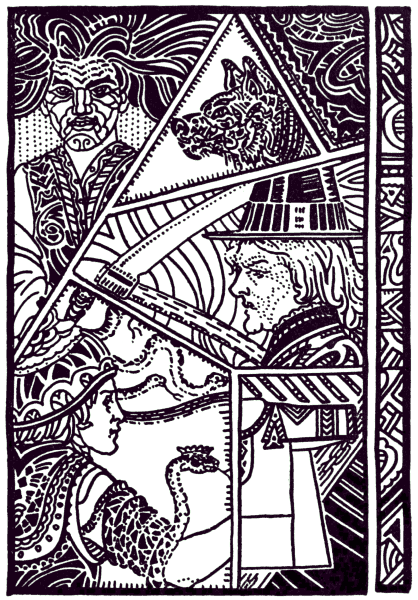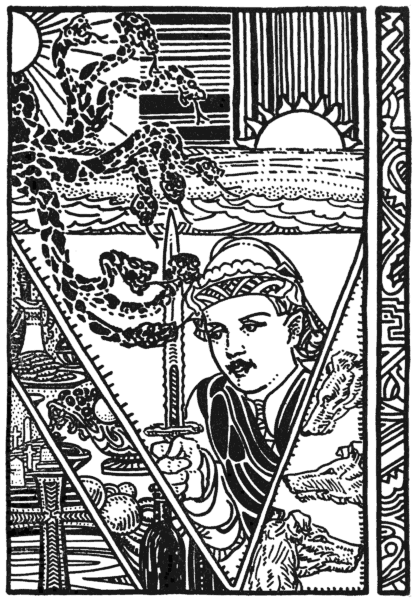
Log with sword beside the many-headed Sun captor, Jay Van Everen, 1922
Van Everen’s illustration accompanies Log’s declaration before the final serpent battle in Fillmore’s1922 retelling. The young swordsman and serpent are shown together, with the Sun and shoreline; this scene does not depict his earlier wooden infancy or later blue-cross transformation.
Overview
A childless couple dress an alder log as a baby and tend its cradle for three years. It then becomes a living child, grows rapidly as it eats and reaches manhood with exceptional strength and gentleness. When the Sun, Moon and Dawn vanish, the king tests prospective rescuers with strengthening waters. Log alone can drink nine bottles; his two companions can take three and six. Together they travel to the kingdom threatened by Suyettar’s three serpent sons. His companions kill the three- and six-headed captors, freeing the Dawn and Moon, while Log battles the nine-headed serpent holding the Sun.
Log severs six heads directly, cuts another when he falsely warns that the Sun is escaping and another when he falsely reports trouble for the serpent’s wife. His dog assists with the final head. After marrying the youngest rescued princess, Log transforms himself into firewood to overhear Suyettar plotting revenge. He learns how to dispel food, water and bed traps, but also learns that disclosing the plot will change him into a blue cemetery cross. He prevents the first two traps, yet can protect only one bed; his companions and their brides fall under Suyettar’s power.
At home, he refuses to explain their deaths because of the threat, but suspicion that he killed them eventually forces the king to demand an account. He tells the truth and disappears before the court. A new blue cross is found in the cemetery and remains as his memorial. The king protects Log’s widow and eventually marries her. This is the complete ending of Fillmore’s 1922 retelling, rather than a triumphant return without further loss.
Origins & earliest records
Parker Fillmore, Mighty Mikko (1922), Log, printed pp. 69–98; author’s note vii–xi.
Records & interpretation
Complete English retelling, with separate three-, six- and nine-headed brothers and the hero’s final fate. Fillmore’s version is not presented as a literal translation of an independently read Finnish text.
Selected bibliography
Documented works and useful reading. This is not a list of every appearance.
- 01
Mighty Mikko: Log, pp. 69–98
Complete selected chapter through blue-cross ending and widow’s remarriage. Three serpent brothers explicitly sons of Suyettar; head counts and captive luminaries remain distinct.
Family, evolution & connections
Log’s social parents — Fillmore’s retelling
Complete Log retelling, with opening caregiving and later marriage distinguished.
Scroll sideways to see all branches. With a keyboard, focus the tree and use the arrow keys.
- Unnamed caregiving couple (social parents, not birth parents)
Narrator’s explicit parents designation after the couple care for a wooden baby that becomes living. This is social caregiving, not a biological birth lineage. The couple and princess have no personal names. Log’s bride later marries the commissioning home king, distinct from her own father; no children or descendants are stated.
The unnamed childless couple who care for the alder log
The couple care for an alder log as a baby before it becomes living, and the narrator calls them its parents. This stated caregiving relation is preserved without inventing biological conception or a divine father.
The youngest of the rescued king’s three daughters
The rescued princess’s father gives her in marriage to Log, while her older sisters marry his two companions. Their father is distinct from the home king who commissioned the heroes. No children of Log’s marriage are stated.
The home king’s later marriage to Log’s bride
After Log becomes the blue cross, the home king protects and then marries his bride. This is a later marriage to a different king, not marriage between the princess and her own father.
References
Sources supporting this profile. Linked pages have their own scope and editorial standards.
- Primary historical literary retelling of folkloreFillmore1922: LogResearch access: 2026-10-05
Image credits
Historical illustrationLog with sword beside the many-headed Sun captor, Jay Van Everen, 1922
Van Everen’s illustration accompanies Log’s declaration before the final serpent battle in Fillmore’s1922 retelling. The young swordsman and serpent are shown together, with the Sun and shoreline; this scene does not depict his earlier wooden infancy or later blue-cross transformation.