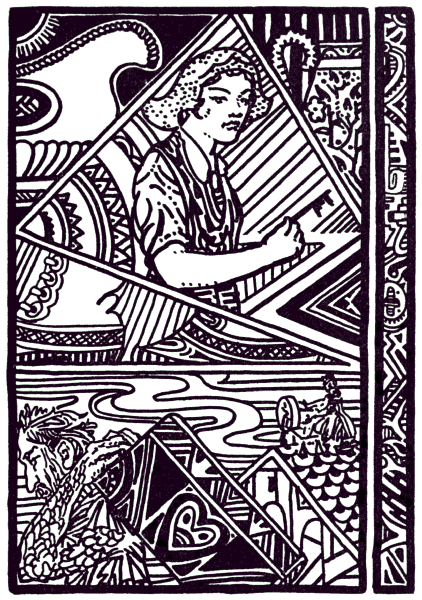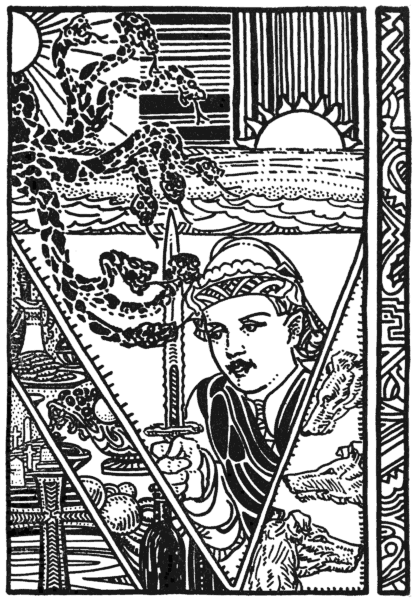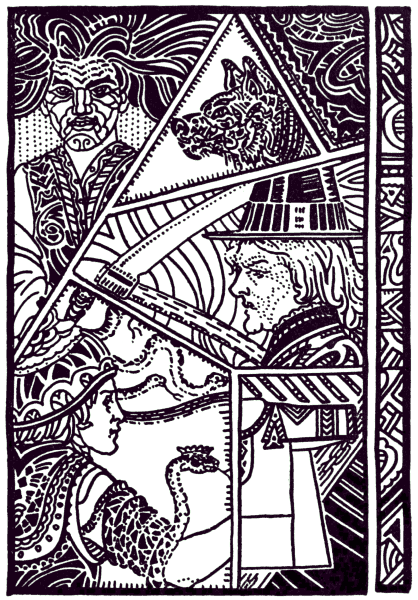
An old woman’s grimacing face, an animal head, a young man, and a snake coiled around another man’s arm in a segmented black-and-white illustration.
Jay Van Everen’s montage for The True Bride, with an ominous portrait, Pilka and Osmo’s snake ordeal; the portrait is interpreted as Suyettar from the story context.
Overview
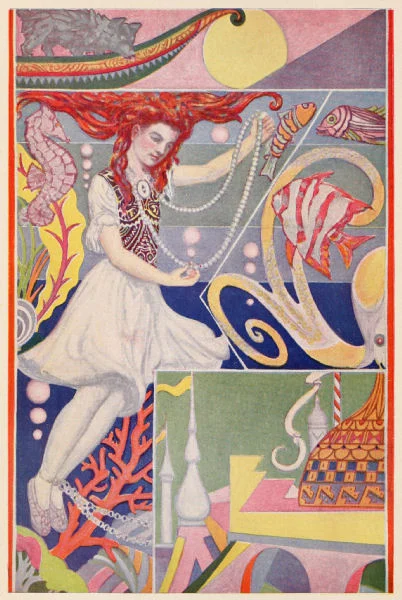
Suyettar enters the boat carrying Osmo and his sister Ilona despite Ilona’s warnings. When she learns that the girl is to marry the King’s Son, she casts a spell that prevents brother and sister from hearing one another. She supplies false instructions in Osmo’s name until Ilona leaps into the water, then restrains Osmo from saving her. Taking the girl’s clothes and ribbons, she briefly appears pretty enough to pass as the promised bride. Osmo, afraid of punishment, presents her in his sister’s place. The prince marries her but soon regards her as ugly and evil and imprisons Osmo among serpents.
While Ilona makes limited visits from the Sea King’s palace, her dog carries two pieces of embroidery to the prince. Suyettar falsely claims to have made them and tries to take them away. After the prince rescues Ilona, the girl warns that Suyettar would kill and eat her if they met; this is a warning, not a completed attack. The prince later traps the witch in burning tar at the sauna. Fillmore’s narrator states that burning is the only means of destroying her. Before dying, she scatters her hair and commands it to become mosquitoes, worms and moths that trouble humanity.
Fillmore explicitly prints Suyettar as his rendering of Syöjätär. His 1922 author’s note calls the stories his own versions rather than translations and acknowledges Lydia Tulonen’s assistance and Salmelainen’s collections generally. Those statements locate this particular performance of the witch without proving that its costume disguise, death scene or pest-origin ending belongs to every earlier Syöjätär account.
Origins & earliest records
Parker Fillmore, Mighty Mikko (New York: Harcourt, Brace, 1922), The True Bride, printed pp. 3–24; author’s note vii–xi.
Records & interpretation
Complete English retelling and author’s note. Fillmore explicitly distinguishes his own versions from translations; no underlying Finnish tale or original-language manuscript is claimed as independently read.
Selected bibliography
Documented works and useful reading. This is not a list of every appearance.
- 01
Mighty Mikko: The True Bride, pp. 3–24
Complete selected retelling. Author’s note acknowledges Lydia Tulonen and Salmelainen’s collections generally, without an individual source-text locator.
Family, evolution & connections
Ilona, the Chained Sea Bride in Fillmore’s Retelling
Suyettar wears Ilona’s clothes and is presented under Ilona’s identity. The narrator keeps false bride and true bride distinct; this deception does not establish biological sisterhood or a transformation of Ilona into Suyettar.
References
Sources supporting this profile. Linked pages have their own scope and editorial standards.
- Primary historical literary retelling of folkloreFillmore 1922: The True Bride and author’s noteResearch access: 2026-10-05
Image credits
Historical contextual narrative montage with interpretive character identificationAn old woman’s grimacing face, an animal head, a young man, and a snake coiled around another man’s arm in a segmented black-and-white illustration.
Jay Van Everen’s montage for The True Bride, with an ominous portrait, Pilka and Osmo’s snake ordeal; the portrait is interpreted as Suyettar from the story context.