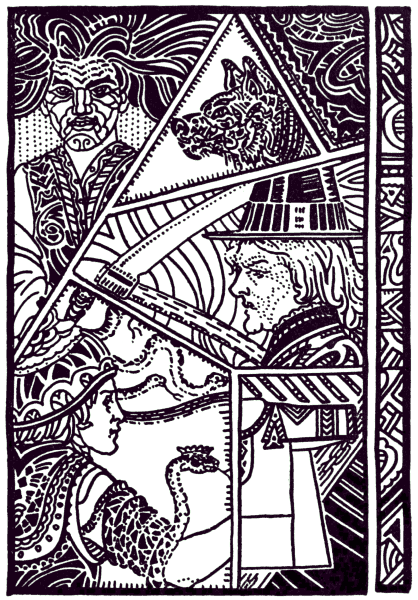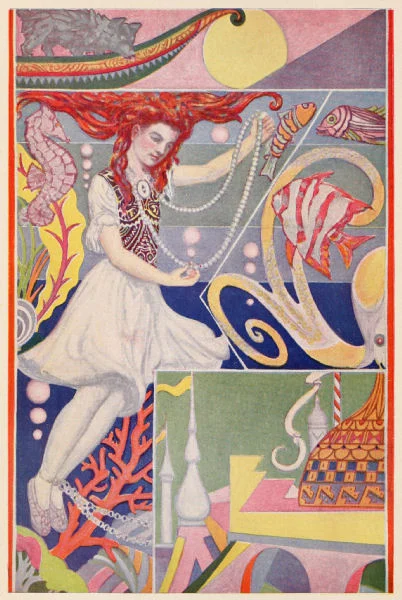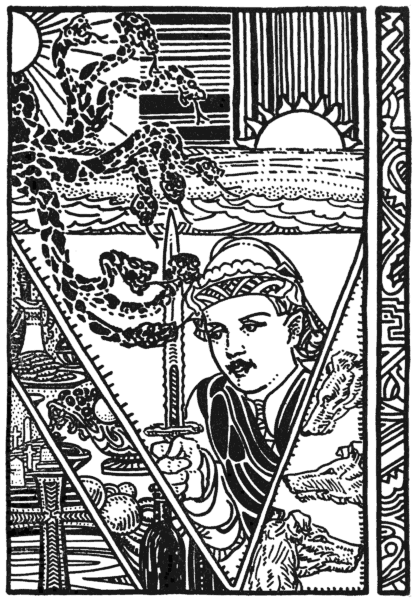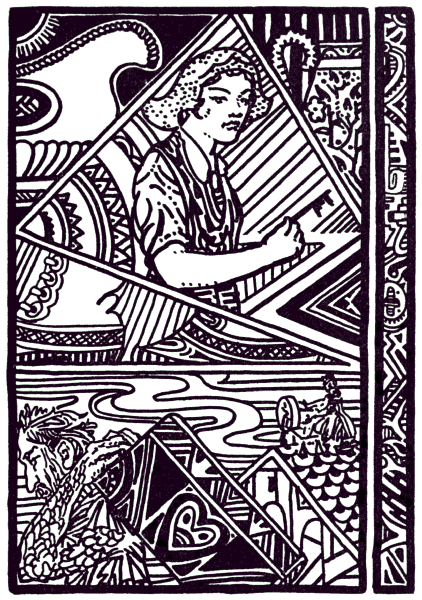
Lisa holding a key, pitchers, an ornate building, and a bearded aquatic figure beside water in a segmented black-and-white illustration.
Jay Van Everen’s montage for The Three Chests, including Lisa with a key and the lake encounter associated with Wetehinen.
Overview
Wetehinen lives in a large house beneath a lake. He first catches a farmer by the beard and demands a daughter as the price of release. The farmer sends his eldest to the shore under a false errand, and Wetehinen carries her underwater. He gives her household keys while forbidding one room. Inside it she finds a shining ring in a pool of blood; taking the ring stains her fingers. The stains burn Wetehinen’s ear when she tends his head, revealing her disobedience, and he beheads her. He obtains the second sister by immobilising the farmer’s boat, and repeats the murder after she likewise enters the room.
To secure the youngest daughter, Lisa, he leaves enchanted birch-bark shoes that force her father into progressively deeper water until he promises her. Lisa discovers her sisters’ remains but avoids the bloody ring. Using Water of Life from the forbidden room, she replaces their heads and revives them, then fills its emptied pitcher with Water of Death. She hides each sister in a chest and persuades Wetehinen to carry them to their father. For her own escape she disguises a churn as a spinning woman on the roof and hides in the third chest, repeatedly speaking so that he thinks the figure can see him trying to open it.
After delivering the final chest, Wetehinen returns and angrily pulls at the dummy’s skirt. The churn falls on his head, knocks him from the roof and cracks his skull. He pours the substituted Water of Death over the injury, making it worse; the ending says that neither the sisters nor anyone else around the lake is troubled by him again. It does not provide an explicit burial or witnessed final death. Fillmore identifies the tale as his own retelling and compares its type with Grimm’s Fitcher’s Bird in the author’s note; that comparison does not establish direct borrowing or identical beings.
Origins & earliest records
Parker Fillmore, Mighty Mikko (1922), The Three Chests, printed pp. 49–65; author’s note vii–xi.
Records & interpretation
Complete English retelling and collection note. Underwater home, coercive bargains, enchanted shoes, stained-finger test and final chest deception are particular to this published version.
Selected bibliography
Documented works and useful reading. This is not a list of every appearance.
- 01
Mighty Mikko: The Three Chests, pp. 49–65
Complete selected retelling; note compares it with Fitcher’s Bird, without providing a specific underlying Finnish passage.
Family & connections
A source-supported family tree or inspiration record has not yet been compiled for this profile. Related reading below indicates a connection in subject matter, not a proven lineage or creative influence.
References
Sources supporting this profile. Linked pages have their own scope and editorial standards.
- Primary historical literary retelling of folkloreFillmore1922: The Three ChestsResearch access: 2026-10-05
Image credits
Historical contextual narrative montage with interpretive character identificationLisa holding a key, pitchers, an ornate building, and a bearded aquatic figure beside water in a segmented black-and-white illustration.
Jay Van Everen’s montage for The Three Chests, including Lisa with a key and the lake encounter associated with Wetehinen.