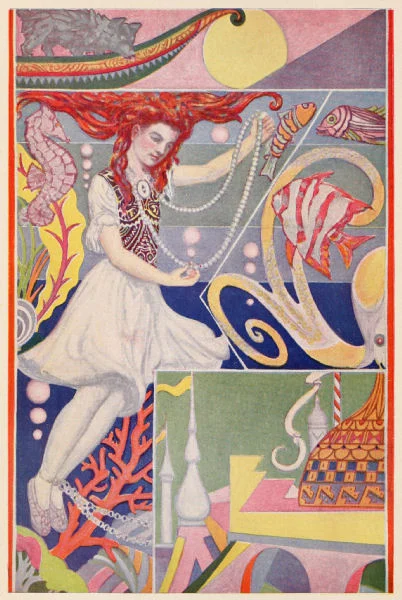
Ilona with human legs, pearls and ankle chains beneath the waves, Jay Van Everen, 1922
Van Everen depicts Ilona returning from the Sea King’s palace with pearls and silver ankle chains in Fillmore’s 1922 retelling. She has two human legs and feet; the nearby fish do not make her a mermaid. This scene precedes the rescue and successive transformations.
Overview
Ilona leaves her ancestral farmhouse only after her brother Osmo secretly breaks several inherited household objects that she had named as reasons to remain. On their boat journey, Suyettar isolates their hearing and persuades her that Osmo orders her to jump into the sea. Ilona sinks to the Sea King’s palace, where she is kindly received but refuses his son’s proposal because she longs for the upper world. The king permits her to return on three successive nights. Decked in pearls and attached to long silver ankle chains, she rises to the sound of bell-like chimes.
Her speaking dog Pilka carries embroidery to the prince she was to marry and reports on Osmo’s imprisonment. Guided by an old woman, the prince waits for Ilona’s final visit, pulls her ashore and cuts the silver chains. She immediately becomes a slippery fish, then a struggling bird and a lizard, followed by further diminishing forms. The old woman had attributed these changes to the Sea King’s enchantment. The prince kills each transient form until the last mosquito is crushed, whereupon Ilona appears again as herself. The account does not narrate her permanent death in these episodes.
Ilona initially shelters with the old woman because she fears Suyettar. After the false bride is destroyed, she reunites with Osmo, marries the prince at a new feast and says she is finally glad to have left the ancestral home. This profile follows Fillmore’s 1922 Finnish-derived retelling; it does not identify Ilona as a mermaid or assign a fish tail to her human appearance.
Origins & earliest records
Parker Fillmore, Mighty Mikko (New York: Harcourt, Brace, 1922), The True Bride, printed pp. 3–24; author’s note vii–xi.
Records & interpretation
Complete English retelling and author’s note. Fillmore explicitly distinguishes his own versions from translations; no underlying Finnish tale or original-language manuscript is claimed as independently read.
Selected bibliography
Documented works and useful reading. This is not a list of every appearance.
- 01
Mighty Mikko: The True Bride, pp. 3–24
Complete selected retelling. Author’s note acknowledges Lydia Tulonen and Salmelainen’s collections generally, without an individual source-text locator.
Family, evolution & connections
Osmo and Ilona — Fillmore’s True Bride retelling
Complete 1922 The True Bride retelling, pp.3–24; not a verbatim Finnish oral transcription.
Scroll sideways to see all branches. With a keyboard, focus the tree and use the arrow keys.
- Two orphan siblings (group, not a parent)
- Osmo, brother
Explicit opening brother and sister, with the ending’s marriage retained as an annotation. Sibling-group root is not an invented parent. No parental personal names, birth order or descendants are supplied. Suyettar is an impersonator, Pilka a dog companion, and the Sea King’s Son’s refused proposal is distinct from the human prince’s completed marriage.
Osmo
The opening identifies the orphans Osmo and Ilona as brother and sister. Their parents are not personally named, and Suyettar’s impersonation does not make her Osmo’s actual sister.
The unnamed human King’s Son
The ending celebrates Ilona’s marriage to the human King’s Son. The Sea King’s Son is a different figure whose earlier proposal she refuses; no offspring of the completed marriage are stated.
References
Sources supporting this profile. Linked pages have their own scope and editorial standards.
- Primary historical literary retelling of folkloreFillmore 1922: The True Bride and author’s noteResearch access: 2026-10-05
Image credits
Historical illustrationIlona with human legs, pearls and ankle chains beneath the waves, Jay Van Everen, 1922
Van Everen depicts Ilona returning from the Sea King’s palace with pearls and silver ankle chains in Fillmore’s 1922 retelling. She has two human legs and feet; the nearby fish do not make her a mermaid. This scene precedes the rescue and successive transformations.