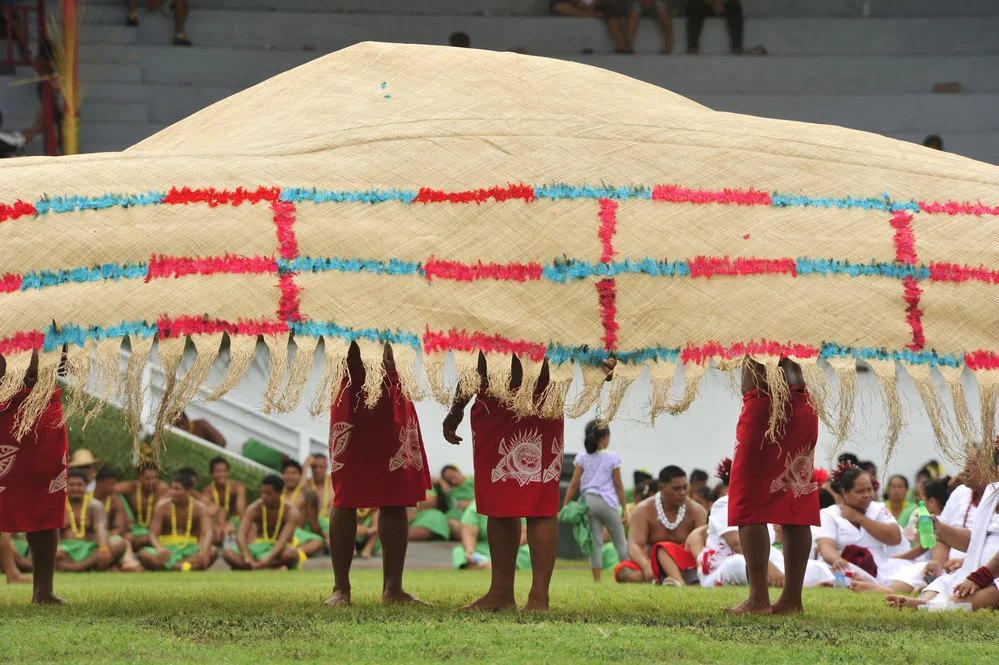
A Samoan ʻie tōga fine mat held out before spectators, National Park Service photograph
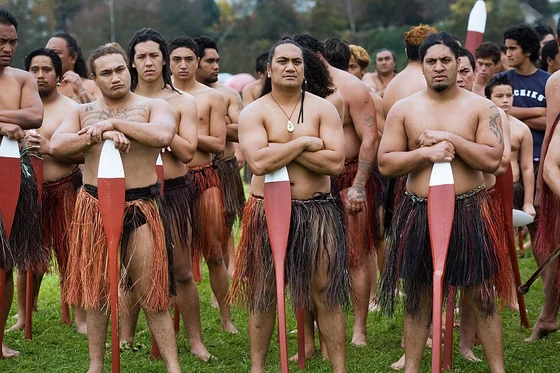
The National Park Service identifies the finely woven object as an ʻie tōga, a valued Samoan fine mat. It is held out before spectators, with red and blue border decoration visible. This is one documented scene associated with American Samoa; the record does not name the people or the occasion. Their individual identities and ceremonial roles are not inferred.
Overview
Samoans belong to communities in Samoa, American Samoa and overseas; these settings share cultural relationships while having distinct political jurisdictions. Samoa Tourism Authority presents fa‘a Samoa through family obligations, community relationships and remembered genealogies. Its social overview identifies ‘āiga, extended families, and matai titles connected with families, villages and land. This is a public introduction to social structures rather than a rule that every household lives alike. The National Park of American Samoa’s account adds that family connections can include marriage and adoption, and describes matai representing families in village councils. Its regional framing should be retained rather than assuming identical administration or citizenship across the archipelago.
Contemporary cultural institutions combine teaching, performance and preservation. Samoa’s Ministry of Education and Culture describes an Apia culture and arts centre with exhibition galleries, workshops and educational programmes. It identifies weaving, carving and other crafts alongside discussions of fa‘a Samoa and contemporary cultural expression. The department’s services page separately sets out the Museum of Samoa’s responsibilities as a repository and interpreter of material and intangible heritage. Research, collaboration with schools and attention to fading skills are part of these stated functions. A ministry’s description of a centre and its responsibilities documents an institutional approach; it does not establish that every listed goal has been fully achieved.
A particular museum object illustrates how material heritage can carry historical relationships. Te Papa’s account of an ‘ie toga presented by the Tamasese family to Helen Clark in June 2002 links the gift to her apology for wrongs during New Zealand’s administration of Samoa. The text identifies the 1918 influenza disaster and the fatal shooting of Mau protesters in 1929 within that history. It describes the mat as a valued heirloom whose significance accumulates through people and events associated with it. This specific diplomatic presentation is distinct from the wider diversity of fine mats and their histories. The source documents this object’s recorded meaning; it is not a guide to conducting an exchange.
Language teaching connects heritage with present aspirations abroad. In a May 2025 report, the Ministry for Pacific Peoples identifies F.A.G.A.S.A as a national organisation dedicated to teaching gagana Samoa in Aotearoa New Zealand. Its secretary, Ete Etelei, connects language learning with young people’s cultural confidence and describes transmission as work extending beyond a single language week. This is a named educator’s perspective, not an anonymous claim that every Samoan shares one level of proficiency. Together, family and village introductions, museum documentation and diaspora teaching show several ways of sustaining affiliation. They leave room for differing lives, mixed backgrounds and changing practices within a living people.
Author and teacher Dahlia Malaeulu offers an individual perspective in a Te Papa Press interview about Going to Te Papa. She describes working with curators Sean Mallon and Rachel Yates and selecting everyday Samoan objects for a board book aimed at younger readers. Her purpose was to help children recognise their own experiences while making the material accessible to other families. Malaeulu also reflects on learning Samoan later in life and wanting to pass language to another generation. Her account connects museum collections with authorship, family recognition and language learning; the interview was read, while the book and collection objects were not inspected.
History & identity
A living community account separating cultural relationships across Samoa and American Samoa from political jurisdiction, migration and citizenship. The 2002 diplomatic gift and contemporary institutional programmes are located documentary examples, not an origin date for identity.
Sources & representation
Official cultural introductions are paired with Samoa’s ministry documentation, Te Papa’s complete located fine-mat history and a named diaspora educator in a dated report. Tourist character stereotypes, fixed 3,000-year continuity claims and universal religious or household assumptions are excluded.
Selected bibliography
Documented works and useful reading. This is not a list of every appearance.
- 01
Our People
Complete social overview read; family, matai and village structures selected. Promotional character and fixed-age claims excluded.
- 02
People
Complete family and matai sections read; American Samoan regional scope retained. Deep-age and universal claims omitted.
- 03
Samoa Culture and Arts Centre
Complete indexed centre description read; exhibitions, workshops and school partnerships documented.
- 04
Our Services: Museum of Samoa
Complete indexed Culture and Museum sections read; institutional responsibilities distinguished from completed outcomes.
- 05
‘Ie toga (fine mat)
Complete object account read; 2002 Tamasese gift and apology context retained. No exchange protocol reproduced.
- 06
Vaiaso o le Gagana Samoa 2025 begins
Complete 30 May 2025 report read; F.A.G.A.S.A and Ete Etelei language-education perspective attributed.
- 07
Dahlia Malaeulu: Going to Te Papa Q&A
Complete ten-question interview read; book and objects not inspected.
Language & cultural connections
Source-supported language and cultural connections have not yet been compiled for this profile.
References
Sources supporting this profile. Linked pages have their own scope and editorial standards.
- Government cultural introductionOur PeopleResearch access: 2026-10-05
- Government regional cultural documentationPeopleResearch access: 2026-10-05
- Government institutional self-descriptionSamoa Culture and Arts CentreResearch access: 2026-10-05
- Government programme documentationOur Services: Museum of SamoaResearch access: 2026-10-05
- Museum object history‘Ie toga (fine mat)Research access: 2026-10-05
- Dated community programme reportVaiaso o le Gagana Samoa 2025 beginsResearch access: 2026-10-05
- Named author interviewDahlia Malaeulu: Going to Te Papa Q&AResearch access: 2026-10-05
Image credits
Contextual community photographA Samoan ʻie tōga fine mat held out before spectators, National Park Service photograph
The National Park Service identifies the finely woven object as an ʻie tōga, a valued Samoan fine mat. It is held out before spectators, with red and blue border decoration visible. This is one documented scene associated with American Samoa; the record does not name the people or the occasion. Their individual identities and ceremonial roles are not inferred.