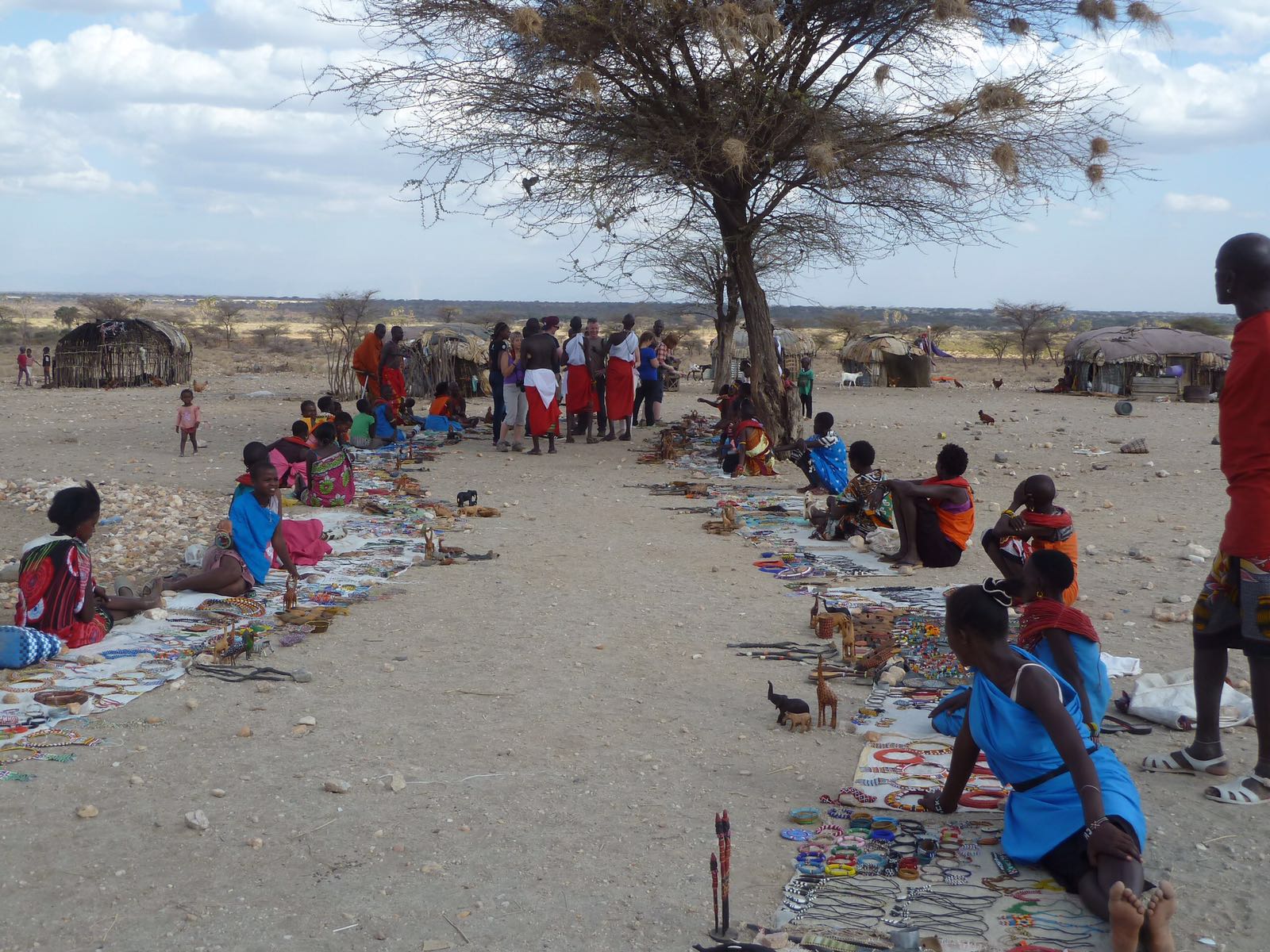
People sit beside rows of crafts on cloths beneath a tree, with several visitors and rounded buildings behind them; the photographer identifies the craft sellers as Samburu women.
A particular craft-display scene photographed by Lilian Maina in Kenya, 10 May 2017. The author identifies the women as Samburu; the village name is not supplied, and the image does not identify every visitor as Samburu.
Overview
Samburu cultural life in northern Kenya includes Maa language, pastoral histories, artistic work and changing forms of community organisation. National Museums of Kenya’s exhibition, curated by Philemon Nyamanga, describes connections with Maasai communities while maintaining a distinct Samburu identity. Its collection examples include beaded jewellery, clothing and a six-stringed lyre. The exhibit also locates public cultural presentation at the Desert Museum in Loiyangalani and the Lake Turkana Festival. These museum-selected objects and accounts provide particular historical and interpretive examples; they do not prescribe how every Samburu person dresses, works or understands their identity today.
Contemporary self-description adds voices beyond the museum account. Samburu Women Trust identifies itself as an Indigenous women-led network supporting participation in decision-making and public policy. Its work connects grassroots organisations with wider movements through the Indigenous Women Council. The public profile names Silvana Lesuuda, founder of Network for Empowering Samburu Transformation, as a youth advocate, and Florence Ntisiai as a Samburu woman with a disability engaged in organisational leadership. These examples show different contributors to public cultural and social life. The Trust’s membership and advocacy purposes should not be mistaken for representation of every Samburu household or for a list of universally shared views.
Pawanka Fund’s September 2018 account describes a specific collaboration implemented by the Trust during July 2015–June 2016. Salante Leburkash of Merilosho Cultural Manyatta and volunteer Ntinina Leosono are named among its facilitators. Workshops brought elders, women and younger participants together, followed by youth mentorship meetings and discussion forums. Drought disrupted activities and displaced some families, placing the project within concrete environmental circumstances. The fund’s account also describes a later festival showing crafts and project materials. Its assessment of increased confidence remains the supporter’s interpretation; the underlying interviews, recordings and cultural knowledge were not inspected or reproduced.
A March 2019 UNEP article records another dimension of the Trust’s work through Jane Meriwas’s testimony. It describes efforts to make information about land and environmental rights understandable and to help women participate in public decision-making. Contacts with county institutions and women’s groups formed part of that account. The article connects social participation with the management of land and natural resources, showing that cultural life involves political and economic concerns alongside dress and performance. The evidence is a dated institutional report with named testimony, rather than an independent legal review or a present-day census of land ownership and community governance.
History & identity
The profile combines a named-curator museum exhibit with community organisation self-description and dated supporter accounts; no biological descent or first-origin date inferred.
Sources & representation
Complete selected public written bodies read; museum interpretation, organisation purposes and project assessments remain attributed.
Selected bibliography
Documented works and useful reading. This is not a list of every appearance.
- 01
The Samburu Community of Kenya
Complete exhibit narrative and credits read; language, distinct identity and selected collection examples used; migration theory and ritual procedures excluded.
- 02
About Us
Complete Our Story and Voices sections read; named public advocates and network purposes retained, not universal representation.
- 03
Samburu Women Trust Their Future
Complete September 2018 written account read through indexed body; project dates, facilitators and drought context retained; underlying recordings not inspected.
- 04
Empowering women means taking a stand for environmental rights
Complete 1 March 2019 body read through indexed page; rights advocacy attributed; private cases, global statistics and independent legal verification excluded.
Language & cultural connections
Source-supported language and cultural connections have not yet been compiled for this profile.
References
Sources supporting this profile. Linked pages have their own scope and editorial standards.
- Museum interpretationThe Samburu Community of KenyaResearch access: 2026-10-05
- Community organisation self-descriptionAbout UsResearch access: 2026-10-05
- Project supporter account with named community contributorsSamburu Women Trust Their FutureResearch access: 2026-10-05
- Institutional report with named testimonyEmpowering women means taking a stand for environmental rightsResearch access: 2026-10-05
Image credits
Contextual community activity photographPeople sit beside rows of crafts on cloths beneath a tree, with several visitors and rounded buildings behind them; the photographer identifies the craft sellers as Samburu women.
A particular craft-display scene photographed by Lilian Maina in Kenya, 10 May 2017. The author identifies the women as Samburu; the village name is not supplied, and the image does not identify every visitor as Samburu.