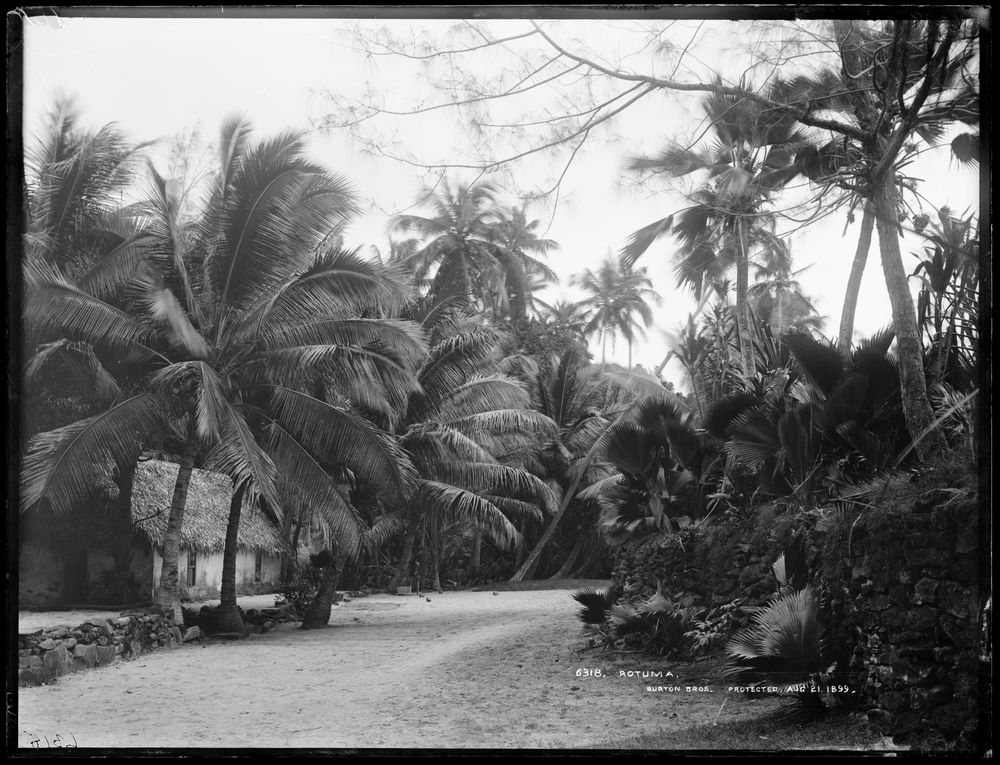
Historical photograph of a path, stone walls, thatched fale and coconut palms in Rotuma, Te Papa C.017573
This historical photograph shows a path bordered by stone walls, a thatched fale and coconut palms in Rotuma. The print bears the Burton Bros. name and an 1899 protection notice; Te Papa catalogues the negative under Muir & Moodie and an unidentified Fiji photographer. It documents one settlement scene rather than a representative appearance of Rotuman people or their present-day homes.
Overview
Rotumans have a homeland on Rotuma and communities elsewhere in Fiji and overseas. The Rotuma Website, maintained by Alan Howard, presents itself as both an information resource and a place for people around the world to exchange news. Its community sections include life stories, creative work, language lessons and district associations. The cultural overview describes kinship relationships and an emphasis on sharing, alongside influences from neighbouring Pacific societies. Such regional connections do not erase a distinct Rotuman identity or make political membership in Fiji identical to cultural affiliation. Older overview statements about all households, occupations or personal character are not a current census of a diverse people.
District connections can organise practical support across distance. The website’s association section invites reports about projects, homecomings and community news from groups linked to a district or part of one. It identifies Suva Oinafa and Suva Juju organisations, giving named examples of this structure rather than implying one organisation represents everyone abroad. This sits beside a broader publishing space where Rotumans can contribute opinions and accounts of their lives. Maintaining links may therefore involve local affiliation, family relationships and participation in a wider network. A website directory documents these channels of communication; it does not measure how regularly every member uses them.
Language learning has several institutional settings. The University of the South Pacific advertises conversational Rotuman classes at Laucala for adults and children, while separately listing credit courses in language, culture, literature and writing. Its programme permits a Rotuman minor, participation in Pacific Language Studies and elective study. Class dates are left to be announced, so the page establishes the teaching offer rather than a verified current timetable. In a May 2025 Ministry for Pacific Peoples report, Jioji Vai of the Hata Collective encourages belonging and continued learning regardless of proficiency. The report identifies the collective as a partner in New Zealand’s Rotuma Language Week. This is a named diaspora voice, not a test that excludes less-fluent descendants.
Creative work also makes connections visible. The website’s artist directory describes Tamara Aisake’s combination of visual media, education and children’s language-learning books. It presents Sofia Tekela-Smith as a maker of jewellery and art objects, and identifies Vilsoni Hereniko’s writing, theatre and filmmaking. These are distinct individual practices rather than a single fixed traditional style. The directory includes people working in different countries and media, with entries from different dates. Their work shows cultural affiliation finding expression through contemporary art and education; the listing should not be read as a verified roster of everyone’s present employment or as permission to reproduce their copyrighted creations.
History & identity
A living community account distinguishing Rotuma, Fiji political affiliation, district ties and overseas cultural participation. Historical connections and institutional publication dates are not an ethnic founding chronology.
Sources & representation
Community-facing publishing is read alongside university teaching documentation and a dated government report containing a named diaspora leader’s perspective. Selected artist entries are attributed to their directory, with old generalisations and current-employment assumptions excluded.
Selected bibliography
Documented works and useful reading. This is not a list of every appearance.
- 01
Rotuma Website: purpose and community sections
Complete landing page read; community purpose and resource sections used. Appearance-based and numerical population claims excluded.
- 02
Rotuman Culture: An overview
Complete overview read; kinship, sharing and regional influences used. Undated household and character generalisations excluded.
- 03
District Associations
Complete directory introduction read; district-linked projects and two named Suva associations documented.
- 04
Rotuman teaching programmes
Complete programme page read; social and credit teaching distinguished. Unannounced class dates remain unspecified.
- 05
Fäeag Rotuḁm Ta language a gift: Rotuma Language Week
Complete 9 May 2025 report read; Jioji Vai and Hata Collective perspective scoped to diaspora language work.
- 06
Contemporary Rotuman Artists
Complete directory read; selected Aisake, Tekela-Smith and Hereniko entries used, without current employment or image-rights assumptions.
- 07
Tribute to Elizabeth Kafonika Fiu Inia
Alan Howard and Jan Rensel, community-hosted Archive2009 memorial tribute to Elizabeth Kafonika Fiu Inia(1925–2009); exact posting day not established
- 08
Kato’aga: Rotuman Ceremonies — author’s preface
Community-hosted English transcription; signed 22 June 2001.
Language & cultural connections
Source-supported language and cultural connections have not yet been compiled for this profile.
Located primary passages
Specific passages supporting details in this entry, grouped by their published witness.
Tribute to Elizabeth Kafonika Fiu Inia
Alan Howard and Jan Rensel, community-hosted Archive2009 memorial tribute to Elizabeth Kafonika Fiu Inia(1925–2009); exact posting day not established
- Howard and Rensel describe their colleague Elisapeti Inia as a teacher and contributor to Rotuman-language scholarship. They identify her publications on proverbs and ceremonies and her work on the New Rotuman Dictionary. Their personal testimony documents one educator’s intellectual contributions; its commemorative praise should not be treated as a comprehensive account of Rotuman society.
No book, film or ceremony independently reviewed. Memorial praise and the claimed first professionally trained Rotuman woman teacher are attributed recollections, not independently verified chronological superlatives.
Kato’aga: Rotuman Ceremonies — author’s preface
2001 dated preface
- Inia explains how family learning, fellow Rotumans and archival records informed her book. She describes drafting and editorial dialogue with Alan Howard and Jan Rensel. She explicitly allows for changing culture and differing local interpretations rather than asserting one universally correct account.
Complete Preface; especially archival sources, collaborative preparation and final two paragraphs.
Ceremonial chapters, chants, archival originals and whole books unreviewed; no practical or ritual instructions reproduced.
References
Sources supporting this profile. Linked pages have their own scope and editorial standards.
- Community-facing scholarly resourceRotuma Website: purpose and community sectionsResearch access: 2026-10-05
- Historical scholarly overviewRotuman Culture: An overviewResearch access: 2026-10-05
- Community institutional directoryDistrict AssociationsResearch access: 2026-10-05
- University programme documentationRotuman teaching programmesResearch access: 2026-10-05
- Dated community programme reportFäeag Rotuḁm Ta language a gift: Rotuma Language WeekResearch access: 2026-10-05
- Community arts documentationContemporary Rotuman ArtistsResearch access: 2026-10-05
Image credits
Historical contextual settlement photographHistorical photograph of a path, stone walls, thatched fale and coconut palms in Rotuma, Te Papa C.017573
This historical photograph shows a path bordered by stone walls, a thatched fale and coconut palms in Rotuma. The print bears the Burton Bros. name and an 1899 protection notice; Te Papa catalogues the negative under Muir & Moodie and an unidentified Fiji photographer. It documents one settlement scene rather than a representative appearance of Rotuman people or their present-day homes.