Raven Princess (Grimm)
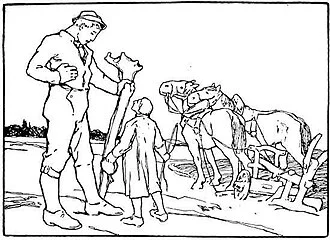
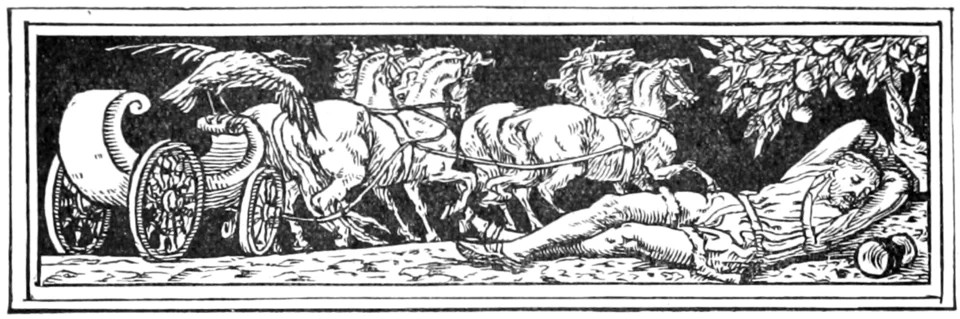
The raven perched on the carriage belongs to the princess’s repeated visits to the sleeping traveller. Crane’s black-and-white drawing cannot distinguish the tale’s successive white, red and black horse teams. The feathered form and carriage scene belong to this illustrated Grimm witness.
Overview
The queen, exhausted by her crying child, wishes that she were a raven and would fly away. The girl immediately leaves through the window in bird form and remains in a dark forest. She eventually explains her royal identity to a traveller and tells him to refuse an old woman's refreshments. Three carriage visits offer a chance of rescue, but he drinks and sleeps through each one.
Despite these failures, the princess leaves inexhaustible bread, meat and wine, a ring and directions to Stromberg's golden castle. Two giant brothers help the traveller locate it on old maps. Its glass mountain defeats his attempts to climb until he obtains a suitable horse, an opening stick and an invisibility mantle from fighting robbers. Returning her ring in a wine cup reveals his arrival and completes her release; her personal name is not stated.
Origins & earliest records
This individual transformation belongs to Grimm's tale93, Die Rabe, selected here through Margaret Hunt's1884 Household Tales translation. The story's ring bears the princess's name, but the printed account does not disclose it. The numbered tale supplies a traceable literary attestation, while its publication does not establish when versions of this bird-enchantment narrative began orally.
Records & interpretation
The account explicitly links the queen's spoken wish with an immediate raven transformation and later describes the carriage vigils, inexhaustible supplies and glass-mountain rescue. These are primary textual details, not observations of bird anatomy. Unlike Grimm's seven and twelve raven brothers, this protagonist is one princess; a shared bird form does not merge their stories.
In the literature
“the child was changed into a raven”
Tale 93, The Raven; The queen’s impatient wish at the palace window · Margaret Hunt
The narrated transformation follows the mother’s words immediately.
Selected bibliography
Documented works and useful reading. This is not a list of every appearance.
- 01
Household Tales, tale 93: The Raven
Specific numbered primary tale inspected. English translation terms and literary transmission remain distinct from oral origin.
- 02
Household Tales — The Raven
Margaret Hunt historical English translation (1884); Project Gutenberg5314. Exact numbered tale and observed HTML anchor used; no inferred printed page or earliest oral date.
Family, evolution & connections
The queen in The Raven
The queen’s impatient wish transforms the little daughter she is carrying into a raven. The princess also identifies herself as a king’s daughter; the transformation does not make her a bird-born child.
Donkey Prince (Grimm)
The raven princess begins as a human child changed by her mother’s wish; the donkey prince is born with an animal-shaped exterior. Their royal parentage is explicit in both texts, but the different origins prevent treating all animal spouses as one genealogy.
Located primary passages
Specific passages supporting details in this entry, grouped by their published witness.
Household Tales, tale 93: The Raven
Margaret Hunt historical English translation (1884); Project Gutenberg5314. Exact numbered tale and observed HTML anchor used; no inferred printed page or earliest oral date.
- An impatient queen wishes her infant daughter a raven, causing the transformation. Later the princess instructs a man to avoid an old woman’s food and drink and meet three afternoon carriage visits. He drinks each day, falls asleep and fails each visit.
Tale 93, The Raven; Mother’s wish and three failed carriage visits
- After the failures she leaves inexhaustible bread, meat and wine, an inscribed ring and directions to Stromberg. The provisions avert a giant’s attempt to eat the man; older maps held by a second giant locate the distant castle, and that giant carries him most of the way.
Tale 93, The Raven; Inexhaustible provisions and giant-assisted search
- The man waits below the glass mountain a year, then takes a door-opening stick, invisibility mantle and mountain-climbing horse from quarrelling robbers. He enters unseen and drops her ring into a wine cup; she recognizes it and declares herself freed when he reveals himself.
Tale 93, The Raven; Glass mountain and recognition by the ring
Complete named tale read. Original narrative curse causes and modern species identities are not inferred; prose only, no song or ritual-formula excerpts.
References
Sources supporting this profile. Linked pages have their own scope and editorial standards.
- Primary textHunt's Household Tales — 93 The RavenResearch access: 2026-10-05
Image credits
Historical illustrationRaven Princess (Grimm)
The raven perched on the carriage belongs to the princess’s repeated visits to the sleeping traveller. Crane’s black-and-white drawing cannot distinguish the tale’s successive white, red and black horse teams. The feathered form and carriage scene belong to this illustrated Grimm witness.