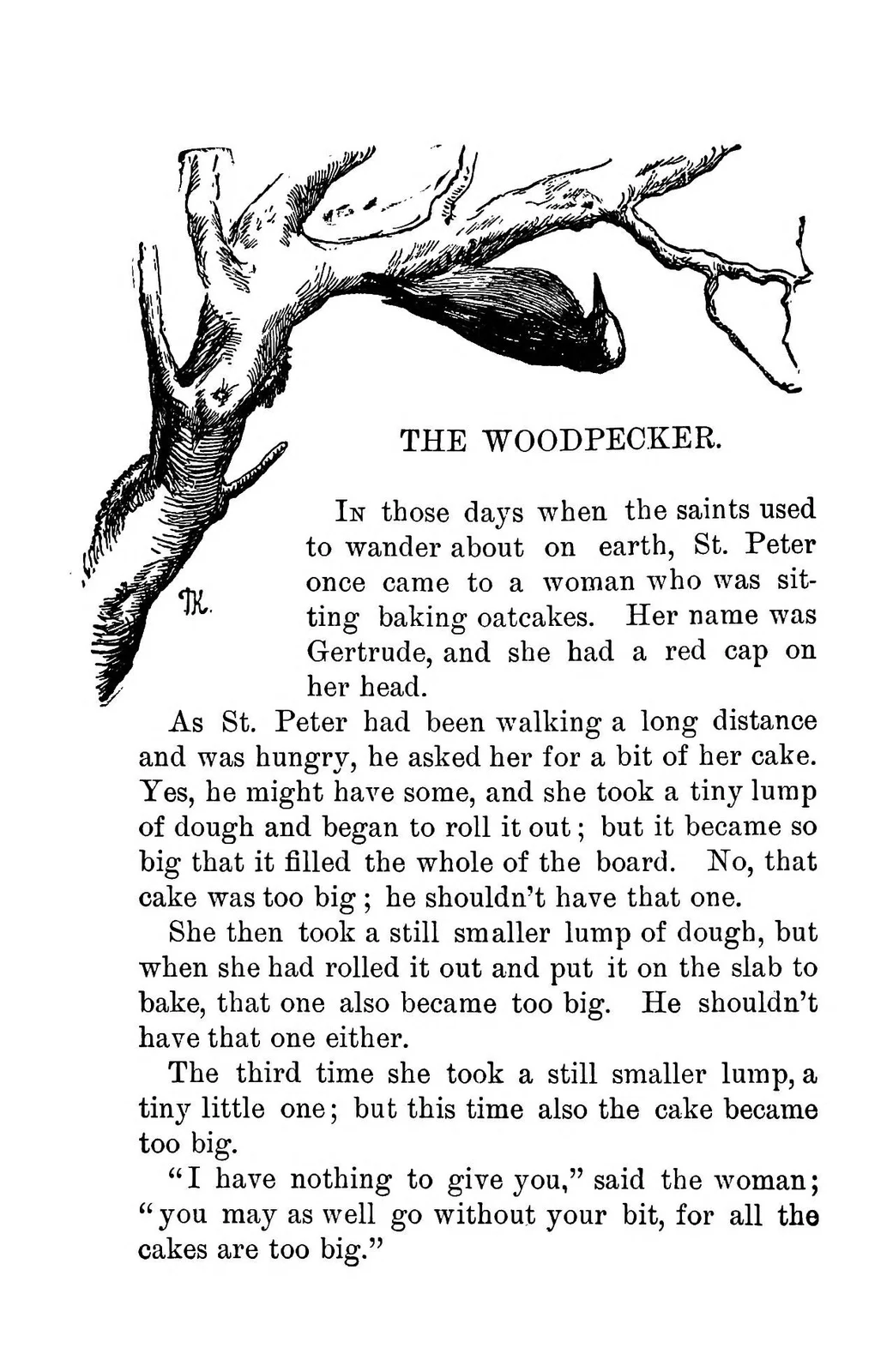
Kittelsen: Gertrude transformed into a woodpecker on a branch
Kittelsen’s heading illustration accompanies the named Gertrude legend in Braekstad’s translation. It represents the transformed baker; the story’s red cap is not established by this monochrome print.
Overview
In a Norwegian Christian legend, Christ and Saint Peter visit Gertrude while she bakes. She agrees to give them a small bannock, but each piece of dough expands across the griddle. Even after reducing its size repeatedly, she judges every loaf too large to share. Her refusal brings a transformation into a bird that must seek food between a tree's bark and trunk.
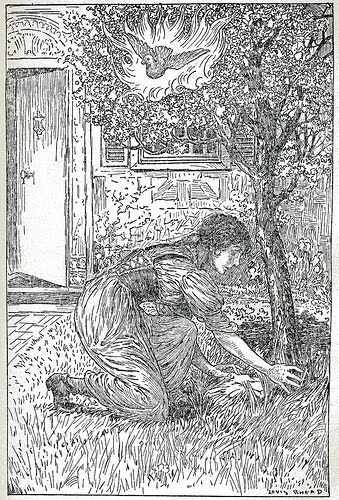
Gertrude flies up the chimney as a large black woodpecker. Her former red cap remains visible in the bird's head marking, while chimney soot accounts for the dark plumage. The punishment allows her drinking water only when it rains, explaining the bird's call before wet weather. These are narrative explanations attached to a real bird, not ornithological claims that woodpeckers are transformed women or live entirely on rainwater.
Origins & earliest records
Gertrude's Bird is a short legend in the Norwegian collection translated by Dasent, first issued in English in 1859. The inspected electronic witness incorporates a notice to a second edition. This accessible literary attestation preserves Christian visitors and a local bird name; it does not independently establish when the explanatory story first entered oral circulation.
Records & interpretation
The text directly connects Gertrude's red cap, passage through a sooty chimney and food refusal with the woodpecker's appearance and behaviour. That makes it an etiological narrative witness. The bird itself belongs to natural history, but this profile concerns the legendary transformed woman; zoological evidence cannot verify the story's moral cause or supernatural origin.
In the literature
“she was turned into a great black woodpecker”
Tale XXXI, Gertrude’s Bird; Sentence followed by chimney escape · George Webbe Dasent
The text names the bird resulting from Gertrude’s punishment without supplying a scientific species identification.
Selected bibliography
Documented works and useful reading. This is not a list of every appearance.
- 01
Gertrude’s Bird (Popular Tales from the Norse)
Inspected named tale XXXI. Electronic witness includes a notice to the second edition; its exact print date is unresolved.
- 02
Popular Tales from the Norse — Gertrude’s Bird
Dasent historical English translation of Asbjørnsen and Moe. Hosted PG8933 text includes a Second Edition notice but does not establish the exact selected print edition date or printed pagination. The 1859 first English publication is context, not an asserted date for this selected witness. Exact observed HTML tale anchors and narrative episodes provide locators.
Family & connections
A source-supported family tree or inspiration record has not yet been compiled for this profile. Related reading below indicates a connection in subject matter, not a proven lineage or creative influence.
Located primary passages
Specific passages supporting details in this entry, grouped by their published witness.
Popular Tales from the Norse — Gertrude’s Bird
Dasent historical English translation of Asbjørnsen and Moe. Hosted PG8933 text includes a Second Edition notice but does not establish the exact selected print edition date or printed pagination. The 1859 first English publication is context, not an asserted date for this selected witness. Exact observed HTML tale anchors and narrative episodes provide locators.
- Gertrude refuses bread to the hungry Lord and Peter because each small piece grows too large on the griddle. The Lord sentences her to find food beneath bark and drink only when it rains.
Tale XXXI, Gertrude’s Bird; Three enlarging bannocks and sentence
- She becomes a black woodpecker and flies up the chimney; the narrator connects her red cap and sooty body with that escape and explains her tree-pecking and rain calls.
Tale XXXI, Gertrude’s Bird; Transformation and concluding explanation
Complete named tale read. No invented print pages, exact selected edition date, earliest attestation or general rule for all members of a creature class is inferred.
References
Sources supporting this profile. Linked pages have their own scope and editorial standards.
- Primary textPopular Tales from the Norse — Gertrude’s Bird (tale XXXI)Research access: 2026-10-05
Image credits
Historical illustrationKittelsen: Gertrude transformed into a woodpecker on a branch
Kittelsen’s heading illustration accompanies the named Gertrude legend in Braekstad’s translation. It represents the transformed baker; the story’s red cap is not established by this monochrome print.