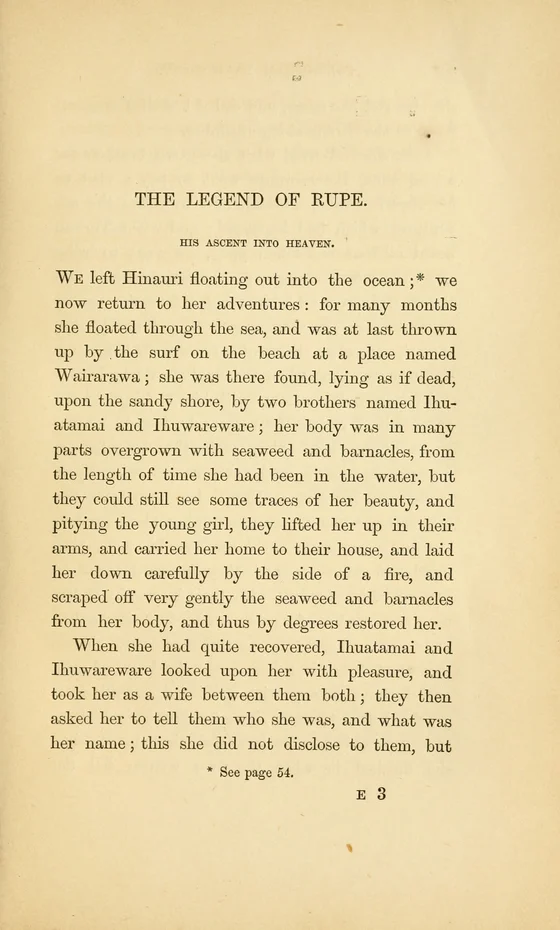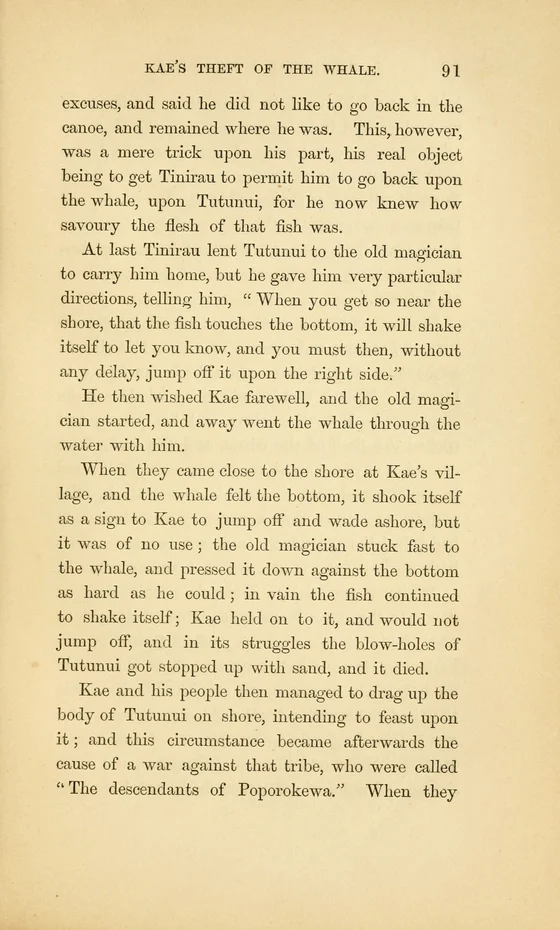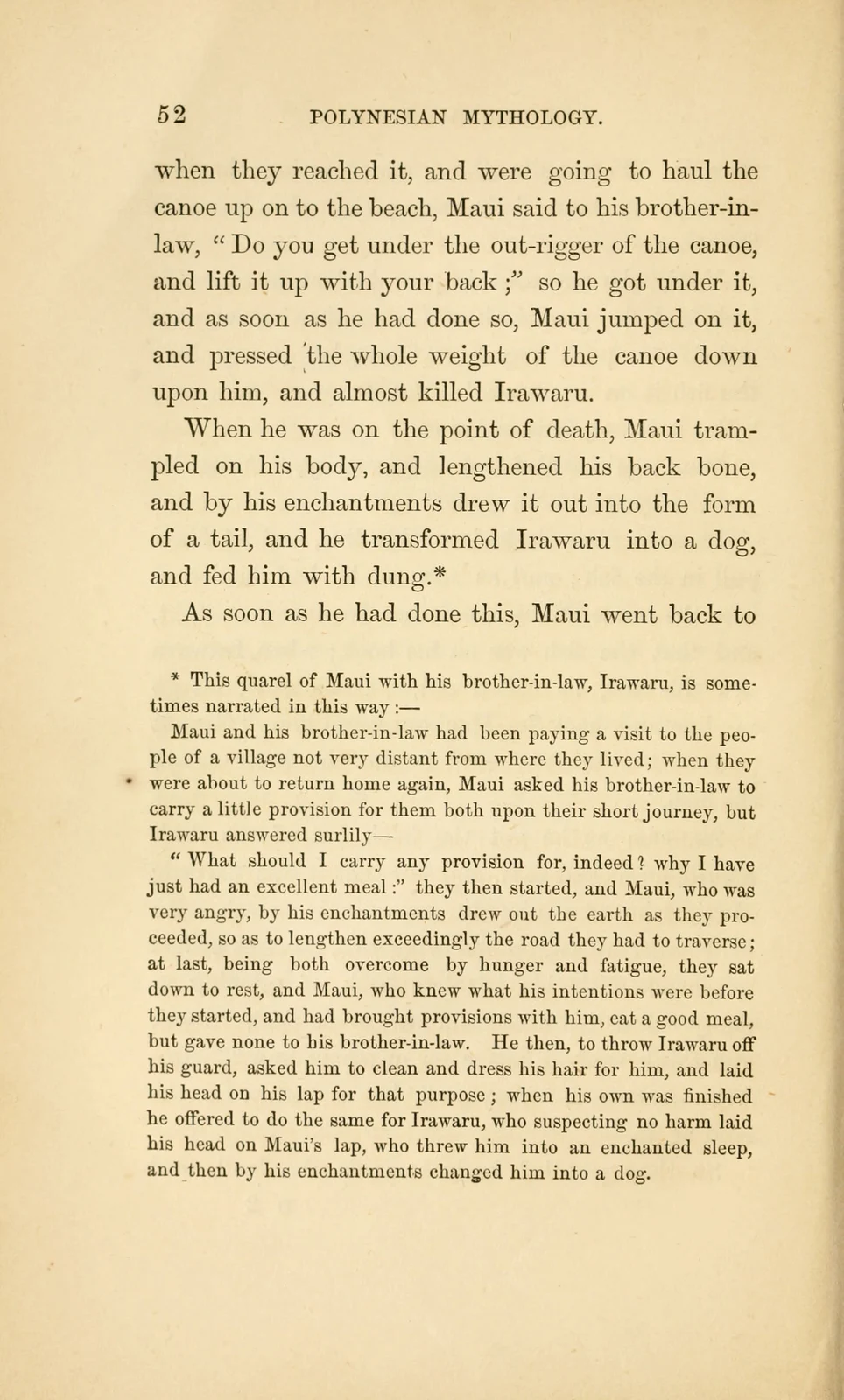
Irawaru in The Legend of Maui, historical printed chapter opening; documentary source-page facsimile
Primary text witness to Irawaru in The Legend of Maui in the 1855 edition. Documentary text facsimile, not creature artwork; historical terminology and collector interpretations belong to the original publication.
Overview
Grey’s main version presents Irawaru as Hinauri’s husband and Māui’s fishing companion. Jealousy over their unequal catches leads Māui to attack him after returning ashore and alter his body into a dog. Irawaru recognises Hinauri’s voice and follows her home in canine form, but her discovery of the transformation causes profound grief. The account links his altered form to dogs’ ancestry.
An accompanying variant replaces the fishing quarrel with disputes over provisions and a deceptively induced sleep. Keeping this alternative visible shows that the cause and method differ even within one collector’s volume. Irawaru is an ancestral figure in a Māori narrative, not a biological theory of dog evolution. The transformation’s family consequences matter alongside the animal form and should not be erased by a short monster label.
Origins & earliest records
This profile follows The Legend of Maui: Irawaru episode and variant footnote in George Grey’s English Polynesian Mythology of 1855. Grey edited and translated material received from Māori narrators; the resulting volume is a mediated written witness. Its publication date does not establish oral origins, and public community versions can differ in language, emphasis and detail.
Records & interpretation
The cited collected narrative documents a named being’s representation and transmission within Māori traditions. It supplies textual evidence, not zoological proof. Public contemporary community accounts provide another kind of witness concerning continuing relationships with place and ancestry; these should not be displaced by a collector’s wording or merged with restricted knowledge.
Selected bibliography
Documented works and useful reading. This is not a list of every appearance.
- 01
Polynesian Mythology: The Legend of Maui: Irawaru episode and variant footnote
Selected public-domain collected narrative inspected. The English text reflects collector editing and translation, not a universal Māori version.
- 02
Polynesian Mythology and Ancient Traditional History of the New Zealand Race
English work first published1855; online transcription derived from Sacred Texts. Exact print edition underlying this mirror is not independently established.
Family, evolution & connections
Hinauri
Grey’s Legend of Maui explicitly says Hinauri married Irawaru before the fishing quarrel and transformation into a dog. Her recognition of his voice follows that established marriage. This records an affinal relationship within the selected published account; it does not merge Hinauri with every Polynesian Hina or treat the transformation as an ordinary inherited animal trait.
Māui in Grey’s Legend of Maui
Grey repeatedly calls Irawaru Maui’s brother-in-law and separately identifies Hinauri as Maui’s sister and Irawaru’s wife. That explicit relationship explains the family setting of the quarrel. The publication also gives a different version of the circumstances in a footnote, so the connection preserves affinal kinship without insisting that one transformation sequence was the sole traditional account.
Dogs in Grey’s mythic origin account
After Irawaru’s transformation, Grey’s narrative calls him the progenitor from whom all dogs sprang. This is a documented origin statement within that particular story, not scientific ancestry for domestic dogs. It remains explicitly mythic, with the published collector’s broad wording attributed to his account rather than adopted as a universal statement of contemporary Māori belief.
Located primary passages
Specific passages supporting details in this entry, grouped by their published witness.
Polynesian Mythology: The Legend of Maui: Irawaru episode and variant footnote
English work first published1855; online transcription derived from Sacred Texts. Exact print edition underlying this mirror is not independently established.
- Maui’s anger is linked to Irawaru’s more successful barbed fishing hook in this variant.
The Legend of Maui; paragraph beginning “As soon as he got the hook out of the fish's…”
- Maui transforms Irawaru into a dog.
- Irawaru is represented as the progenitor of dogs in this collected narrative.
The Legend of Maui; paragraph beginning “But his young sister said: 'Why did not you both come…”
This is an edited English witness of a Māori narrative, not a universal version. Grey’s publication credit does not identify every Māori contributor; transcription print edition remains unconfirmed.
Encyclopedia background
An additional attributed reference, separate from the editorial profile above.
Read the open encyclopedia overview
In Māori mythology, Irawaru is the origin of the dog. He is the husband of Hinauri, the sister of Māui. Māui becomes annoyed with Irawaru and stretches out his limbs, turning him into a dog. When Hinauri asks Māui if he has seen her husband, Māui tells her to call "Moi! Moi!" whereupon the poor dog runs up to Hinauri. Learning the truth, she throws herself to Tangaroa (the ocean) never to be seen again.
Versions differ as to the cause of Māui's annoyance with his brother-in-law. In some, he is jealous of Irawaru's success at fishing; in others, he is angry at Irawaru's refusal to give him a cloak, or disgusted at Irawaru's greedy nature.
In other Ngā Puhi Nui Tonu mythology, three dogs were brought to Aotearoa by Kupe. These spirits were known as kehua or guardians brought over from Hawaiki. During the arrival to Aotearoa they were sent to Cape Reinga with a few men to guard the escape of their souls. The iwi later was named Ngāti Kurī. Their job was to guard the spirits through to the afterlife.
In traditional Māori society, dogs (kurī) were given the best cuts of meat and were highly regarded as sacred. Their fur was highly regarded for cloaks reserved for rangatira.
The story accounts for the characteristics of dogs: they warn of danger or night raids, they respond to commands, and are loyal companions that ward off evil spirits.
Text from Wikipedia contributors, “Irawaru”. CC BY-SA 4.0. Extracted introduction; formatting changed. Retrieved 5 October 2026. The source article may have changed since retrieval.
References
Sources supporting this profile. Linked pages have their own scope and editorial standards.
- Primary textGrey 1855, The Legend of Maui: Irawaru episode and variant footnoteResearch access: 2026-10-05
Image credits
Historical text facsimileIrawaru in The Legend of Maui, historical printed chapter opening; documentary source-page facsimile
Primary text witness to Irawaru in The Legend of Maui in the 1855 edition. Documentary text facsimile, not creature artwork; historical terminology and collector interpretations belong to the original publication.