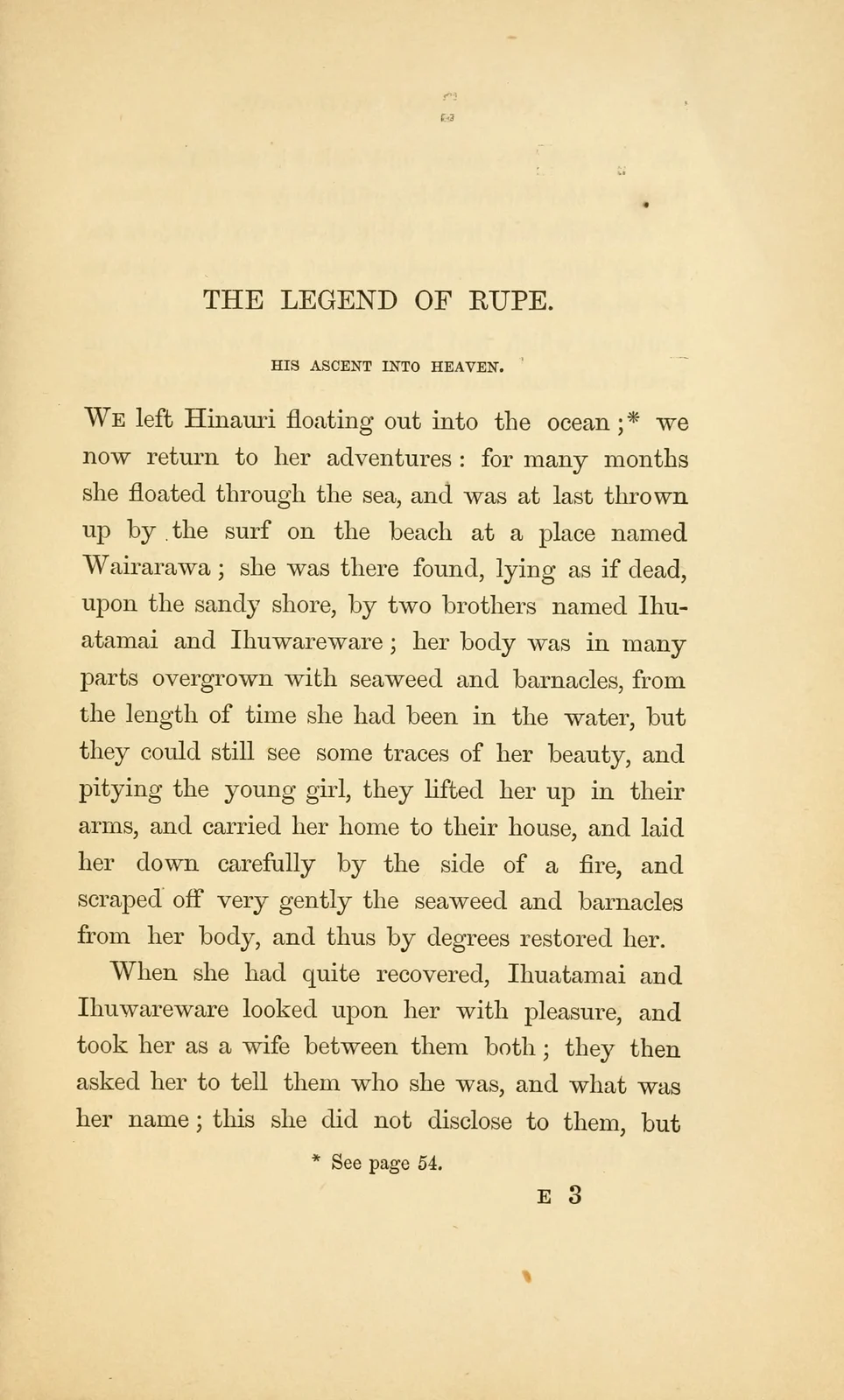
The Legend of Rupe, historical printed chapter opening; documentary source-page facsimile
Primary text witness to The Legend of Rupe in the 1855 edition. Documentary text facsimile, not creature artwork; historical terminology and collector interpretations belong to the original publication.
Overview
The selected account identifies Rupe as Māui-mua, a brother troubled by Hinauri’s disappearance. He ascends through successive inhabited heavens to consult the ancestor Rehua and learns where to seek her. Changing into a pigeon, he reaches Tinirau’s home and resists attempts to spear or snare him. Hinauri recognises her brother despite the animal form, making kinship knowledge central to the encounter.
Rupe then carries Hinauri and her child upward to Rehua and later undertakes work at the heavenly household. His bird appearance is part of an ancestral narrative involving family recovery and relations between realms. The entry concerns the Māori account selected by Grey; similarly named figures in other Polynesian traditions require separate attribution, and the transformation is not evidence about ordinary pigeons or a universal island-wide myth.
Grey’s account makes the upward journey a determined search rather than a casual flight. At successive inhabited levels, residents tell Rupe that he cannot pass the heavens fixed by Tāne; he nevertheless forces his way through until the tenth heaven and Rehua’s dwelling. Rehua initially welcomes him without recognizing him, then understands his identity through their exchange. Rupe refuses the offered tūī birds because he has seen them emerge from Rehua’s hair and regards their food there as connected with the ancestor’s sacred head. Rehua reports distant voices from Motu-tapu, giving him the clue that leads to the pigeon transformation.
At Tinirau’s window, the bird turns aside a thrown spear with its bill so that the weapon strikes the wood and breaks. It also avoids a noose by turning its head. Hinauri stops the attackers and recognizes Rupe; their reunion occurs on the day her child is born. He carries both mother and newborn to Rehua. Later he makes two named wooden shovels, Tahitahia and Rake-rakea, to clean the neglected courtyard and adds a building. A badly fixed beam causes Rehua’s son Kaitangata to fall and die; his blood is presented as an explanation of redness in the heavens. Grey explicitly states in a footnote that this final episode is considerably shortened in translation because he judged it unlikely to interest European readers. The selected account thus gives Rupe practical household work and a fatal consequence alongside his successful family rescue.
Origins & earliest records
This profile follows Rupe’s Ascent into Heaven in George Grey’s English Polynesian Mythology of 1855. Grey edited and translated material received from Māori narrators; the resulting volume is a mediated written witness. Its publication date does not establish oral origins, and public community versions can differ in language, emphasis and detail.
Records & interpretation
Grey’s complete selected chapter documents the ancestor’s realm-crossing, pigeon transformation, defensive actions and household work. Its own note marks a shortened final episode; literary explanations of natural appearance are not treated as physical evidence.
Selected bibliography
Documented works and useful reading. This is not a list of every appearance.
- 01
Polynesian Mythology: Rupe’s Ascent into Heaven
Complete hosted Rupe’s Ascent into Heaven account, including the stated shortening of Kaitangata’s death in the English translation; original Māori account and manuscripts not independently collated.
- 02
Polynesian Mythology and Ancient Traditional History of the New Zealand Race
English work first published1855; online transcription derived from Sacred Texts. Exact print edition underlying this mirror is not independently established.
Family, evolution & connections
Hinauri
Rupe’s Ascent into Heaven identifies Rupe, also called Mauimua, as Hinauri’s brother. Their exchanged laments make the relationship explicit when she recognizes him in pigeon form. This preserves the sibling connection in Grey’s published account while leaving its younger-brother wording and the songs’ young-sister wording visible as a textual variation, rather than forcing a secure birth order.
Rehua
Grey’s Rupe episode calls Rehua Rupe’s great ancestor and describes the upward journey to consult him. The relationship is therefore documented, but its generational distance is unspecified. Rehua is not placed as an immediate father in a tree, and the journey through heavens is retained as narrative setting rather than converted into an evolutionary or historical migration claim.
Located primary passages
Specific passages supporting details in this entry, grouped by their published witness.
Polynesian Mythology: Rupe’s Ascent into Heaven
English work first published1855; online transcription derived from Sacred Texts. Exact print edition underlying this mirror is not independently established.
- Rupe reaches Rehua in the tenth heaven.
- Rupe changes himself into a pigeon to descend to Motu-tapu.
- Rupe carries Hinauri and her newborn away through the air.
This is an edited English witness of a Māori narrative, not a universal version. Grey’s publication credit does not identify every Māori contributor; transcription print edition remains unconfirmed.
References
Sources supporting this profile. Linked pages have their own scope and editorial standards.
- Primary textGrey 1855, Rupe’s Ascent into HeavenResearch access: 2026-10-05
Image credits
Historical text facsimileThe Legend of Rupe, historical printed chapter opening; documentary source-page facsimile
Primary text witness to The Legend of Rupe in the 1855 edition. Documentary text facsimile, not creature artwork; historical terminology and collector interpretations belong to the original publication.