Tutunui in The Legend of Kae, historical printed chapter opening; documentary source-page facsimile
Primary text witness to Tutunui in The Legend of Kae in the 1855 edition. Documentary text facsimile, not creature artwork; historical terminology and collector interpretations belong to the original publication.
Overview
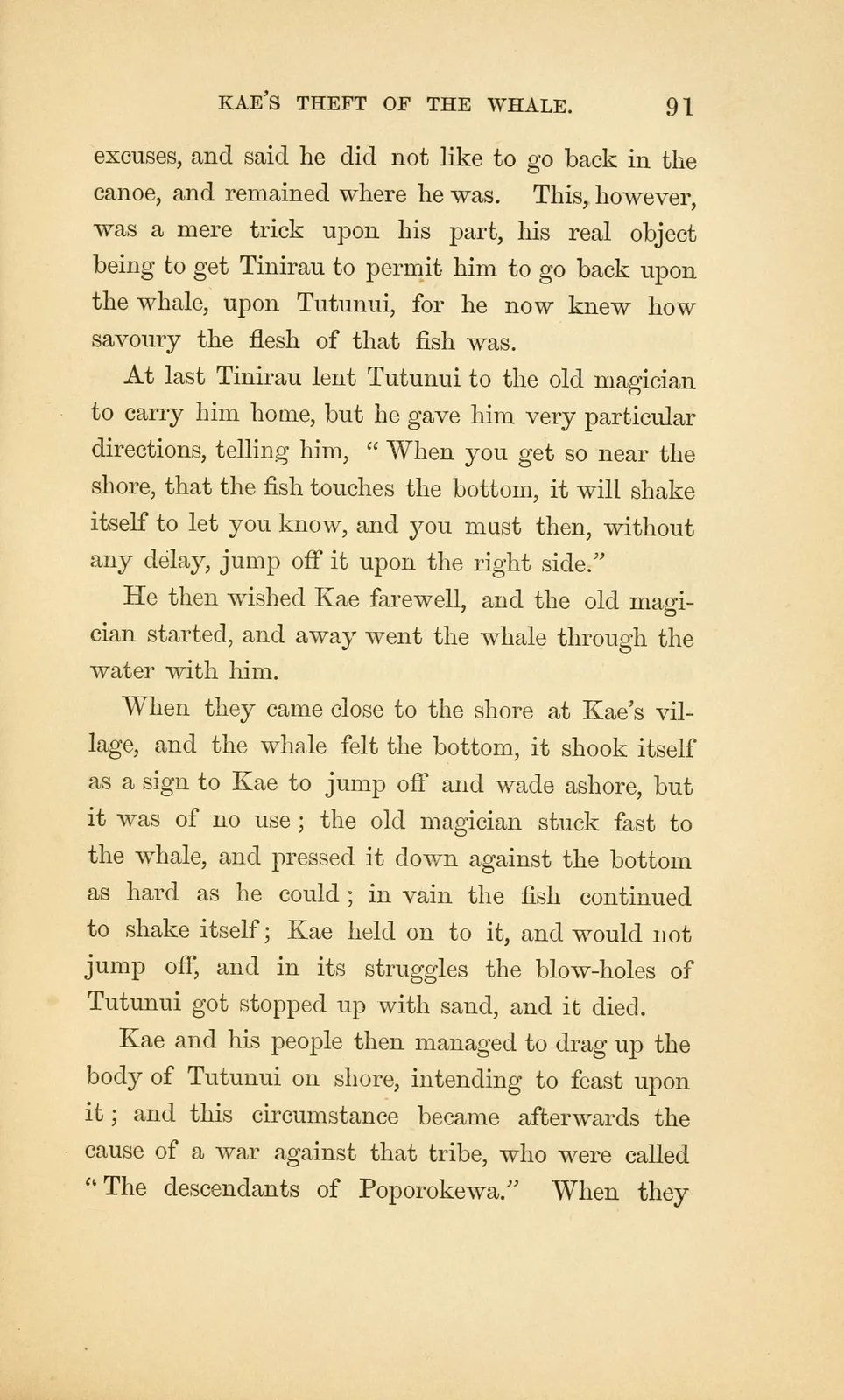
In Grey’s selected account, Tutunui is Tinirau’s responsive whale companion. Kae admires a meal provided from the whale and then manoeuvres to return home on its back instead of by canoe. Tinirau lends the animal with precise instructions: when shallow water causes it to signal, the rider must get off. The agreement places the whale’s safety within the guest’s responsibility.
Kae remains aboard and presses Tutunui against the bottom until the whale dies. The killing and feast lead Tinirau’s people to identify and capture Kae through a carefully organised visit. Tutunui is therefore a named animal at the centre of hospitality, betrayal and revenge. The extraordinary relationship and narrated consequences are culturally situated storytelling, not a general claim that biological whales can be ridden in this manner.
Grey places the encounter after the birth of Tuhuruhuru, when Kae visits Tinirau’s settlement to perform ceremonies for the child. Tutunui responds to its keeper’s signal, comes ashore and supplies a slice of flesh for the guest’s meal. The subsequent borrowing is motivated by Kae’s appetite, not simply admiration for a convenient mount. Tinirau specifies that the rider must dismount on the right as soon as the whale shakes in shallow water. Kae instead holds on and presses it down; the struggles fill its blowholes with sand. The flesh is then cooked by Kae’s people. The narrated scent reaches Tinirau and his wife across the sea, telling them why the animal has not returned.
The account links Tutunui with the family’s affection for Tuhuruhuru and gives the betrayal consequences beyond the feast. Forty women travel to Kae’s village so their arrival will not look like an attack. Their performance makes him laugh, exposing uneven overlapping teeth and remnants of the whale’s flesh. After putting the gathering into an enchanted sleep, they pass the sleeping man from one pair of hands to the next into their canoe. Kae wakes in Tinirau’s differently built house, initially deceived by a deliberately similar sleeping-place, and is killed. The chapter then records retaliatory violence by his people against Tinirau’s son. Hospitality, deliberate harm, recognition and successive revenge therefore form the selected narrative’s wider setting. These actions remain Grey’s mediated English witness rather than a single authoritative account for every Māori community.
Origins & earliest records
This profile follows Kae’s Theft of the Whale in George Grey’s English Polynesian Mythology of 1855. Grey edited and translated material received from Māori narrators; the resulting volume is a mediated written witness. Its publication date does not establish oral origins, and public community versions can differ in language, emphasis and detail.
Records & interpretation
The complete Grey chapter supplies the responsive named whale, shallow-water signal, deliberate killing, household recognition and revenge sequence. It is a mediated textual witness to Māori storytelling, distinct from zoological observation and from differently situated community versions.
Selected bibliography
Documented works and useful reading. This is not a list of every appearance.
- 01
Polynesian Mythology: Kae’s Theft of the Whale
Complete Kae’s Theft of the Whale chapter through Kae’s death and the retaliation notice, using the hosted Grey English transcription. The original Māori text and manuscripts were not independently collated.
- 02
Polynesian Mythology and Ancient Traditional History of the New Zealand Race
English work first published1855; online transcription derived from Sacred Texts. Exact print edition underlying this mirror is not independently established.
Family & connections
A source-supported family tree or inspiration record has not yet been compiled for this profile. Related reading below indicates a connection in subject matter, not a proven lineage or creative influence.
Located primary passages
Specific passages supporting details in this entry, grouped by their published witness.
Polynesian Mythology: Kae’s Theft of the Whale
English work first published1855; online transcription derived from Sacred Texts. Exact print edition underlying this mirror is not independently established.
- Tutunui is Tinirau’s tamed pet whale.
- Tinirau instructs Kae to dismount Tutunui to the right when the whale touches the bottom.
- Kae refuses to dismount; Tutunui’s blowholes stop with sand and the whale dies.
This is an edited English witness of a Māori narrative, not a universal version. Grey’s publication credit does not identify every Māori contributor; transcription print edition remains unconfirmed.
References
Sources supporting this profile. Linked pages have their own scope and editorial standards.
- Primary textGrey 1855, Kae’s Theft of the WhaleResearch access: 2026-10-05
Image credits
Historical text facsimileTutunui in The Legend of Kae, historical printed chapter opening; documentary source-page facsimile
Primary text witness to Tutunui in The Legend of Kae in the 1855 edition. Documentary text facsimile, not creature artwork; historical terminology and collector interpretations belong to the original publication.