A sourced illustration has not yet been added. This gap is included in the coverage record.
Overview
The account concerns the house of Job John Harry, where unexplained knocking develops into conversation. Neighbours gather to watch, and one brings a gun to shoot the spirit. The presence allegedly warns the householder, then singles out that armed visitor with thrown stones until he retreats. It subsequently speaks from an oven near the hearth and plays the owner's fiddle at night.
As the household grows accustomed to its visitor, fear gives way to joking conversation. The spirit claims a connection with a nearby mountain place and eventually leaves on Easter Wednesday. Sikes says the accounts usually keep it invisible, while noting a rare story of a white hand shown through the floor. He therefore questions whether his fairy classifications fit and places it among spirit-world hauntings. Its individual farm association makes it more specific than the overlapping Welsh word pwca.
Origins & earliest records
Sikes's 1880 account combines his enquiries around Trwyn Farm with an episode assigned by narrators to the preceding century. He acknowledges accounts that put the spirit much earlier. This disagreement is retained rather than converted into a precise origin date; the profile concerns a named local haunting, not the earliest history of every being called pwca.
Records & interpretation
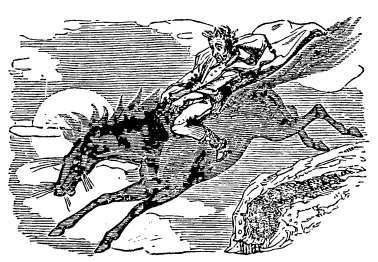
The source records local testimony, named participants and a collector's classification debate. Knocking, speech and thrown stones appear as reported events inside that testimony, without independent experimental confirmation. The generally invisible spirit consequently has little verified visual specification, and illustrations should not import the horse shape of an Irish púca or the body of a generic goblin.
In the literature
“During this time it spoke, and did many remarkable things, but was always invisible.”
Book II, chapter V; printed p. 188
The Trwyn farm spirit is reported chiefly as a speaking, unseen presence.
Selected bibliography
Documented works and useful reading. This is not a list of every appearance.
- 01
British Goblins: Welsh Folk-lore, Fairy Mythology, Legends and Traditions
Book II, chapter V, pp. 187–190. Selected inspected witness; bibliography is not exhaustive.
- 02
British Goblins: Welsh Folk-lore, Fairy Mythology, Legends and Traditions — Book II, chapter V
London: Sampson Low, Marston, Searle & Rivington, 1880. Original English compilation by Wirt Sikes; hosted Project Gutenberg transcription retains printed page anchors. Selected reports, quoted older authorities and the compiler’s comparative theories are distinguished.
Family & connections
A source-supported family tree or inspiration record has not yet been compiled for this profile. Related reading below indicates a connection in subject matter, not a proven lineage or creative influence.
Located primary passages
Specific passages supporting details in this entry, grouped by their published witness.
British Goblins: Welsh Folk-lore, Fairy Mythology, Legends and Traditions — Book II, chapter V
London: Sampson Low, Marston, Searle & Rivington, 1880. Original English compilation by Wirt Sikes; hosted Project Gutenberg transcription retains printed page anchors. Selected reports, quoted older authorities and the compiler’s comparative theories are distinguished.
- The farm spirit announces its presence by knocking, warns Job of a gun-bearing visitor, and throws stones at Thomas Evans until he flees; Sikes says he collected local information about the account.
Book II, chapter V; pp. 187–188; Job John Harry and Thomas Evans
- Family members become accustomed to the speaking and fiddle-playing presence. It names Mare’s Pit as its origin and leaves on Easter Wednesday; a white-hand variant qualifies the usual invisibility, and Sikes chooses to classify it among spirits.
Book II, chapter V; pp. 188–190; conversation, departure and classification
Selected complete episodes read in the hosted primary compilation. Earlier Jones, Iolo MSS., Pughe and Vale of Glamorgan citations are attributed as Sikes’s sources; their original editions have not been independently checked here. The compiler’s broad comparative etymologies are not adopted as established modern scholarship.
Encyclopedia background
An additional attributed reference, separate from the editorial profile above.
Read the open encyclopedia overview
The púca (Irish for spirit/ghost; plural púcaí), puca (Old English for goblin), also pwca, pooka, pookah, phouka, and puck, is a creature of Celtic, English, and Channel Islands folklore. Considered to be bringers both of good and bad fortune, they could help or hinder rural and marine communities. Púcaí can have dark or white fur or hair. The creatures were said to be shape-changers that could take the appearance of horses, goats, cats, dogs, and hares. They may also take a human disguise, which includes various animal features, such as animal ears or a tail.
Text from Wikipedia contributors, “Púca”. CC BY-SA 4.0. Extracted introduction; formatting changed. Retrieved 5 October 2026. The source article may have changed since retrieval.
References
Sources supporting this profile. Linked pages have their own scope and editorial standards.
- Primary textSikes, British Goblins: Book II, chapter V, pp. 187–190Research access: 2026-10-05
Image credits
A sourced illustration has not yet been added. This gap is included in the coverage record.