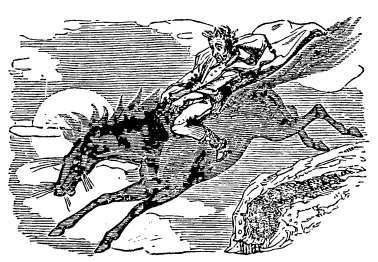
Phooka carrying Morty Sullivan across the mountains, Croker1844 Spirit Horse illustration
This engraving opens Croker’s Spirit Horse account: Morty Sullivan rides the dark horse through a rocky landscape. Its position and scene identify that particular Phooka witness. The picture does not show Peggy Barrett’s separate goatlike burden, and its visible reins and mane are artistic details rather than proof that the story’s shadow mane could be grasped.
Overview
In Croker’s Spirit Horse, Morty Sullivan’s late return to his home country is framed through sorrow over his dead parents. A pilgrimage to Saint Gobnait’s chapel takes him into mountain paths, darkness and thick fog. A distant light appears to retreat as he approaches, and he first interprets it as holy guidance. At last he sees an old woman beside a fire that has somehow travelled ahead of him. Her eyes are described as red rather than ordinary human colours and turn pale green during the exchange, while a sulphurous breath accompanies her speech. Her presence belongs to this particular encounter; the source does not identify her simply as another body of the horse. Religious names and Morty’s fearful interpretation are features of the narrator’s frame, not independently verified divine direction.
The woman takes Morty toward a mountain cavern, calls for a horse and forcibly mounts him on the emerging jet-black steed. Its hoofbeats sound from the rocky interior, but its mane cannot be grasped: his hand catches only a shadow. Despite that insubstantial quality, the animal supports and transports him, bounding down precipices and over torrents. Pilgrims later discover him severely bruised beneath a cliff, and the narrator identifies the creature that threw him as the Phooka. Morty’s concluding oath concerns carrying a full quart bottle of whisky on future pilgrimages, giving the account a deliberately ironic alternative frame. That ending does not prove every Irish púca report is drunken invention; it belongs to this edited story. The profile retains the contrast between a tangible rider’s injuries and a shadowy mount without importing uninspected harvest customs, other animal shapes or a fixed benign temperament.
A contrasting appearance occurs in The Crookened Back, presented as Peggy Barrett’s story told beside a winter hearth. On the evening before May Day, the newly widowed Peggy returns from working alone in her garden. She sees a small black goatlike figure standing on its hind legs upon a wall, with wide horns turned outward. Farther along the road it appears on the opposite wall, several times larger and nearly human height. It leaps onto her back, its front feet gripping her shoulders and its rear feet caught in her folded dress.
Peggy describes being forced to walk while unable to speak, run or turn her head. At her closed house she cannot call or knock; after three attempts to bless herself, the burden springs away, the door opens violently and she falls inside. She attributes her lasting bent posture to that event and finally names the creature as the Phooka. Croker’s surrounding narrator emphasizes her storytelling skill, the influence of occasion and audience, and possible imagination. Her account therefore remains an attributed supernatural explanation, not a medical diagnosis. The goatlike visitor is not identified as the same individual horse Morty rode.
Origins & earliest records
The selected witness is Croker’s 1844 condensed Philadelphia collection, drawing on his earlier fairy-legend volumes. Phooka is its witness spelling beside modern Púca. The source dates an edited spirit-horse account, without establishing an oral beginning or equating every related regional spirit with this particular mount.
Records & interpretation
The complete episode explicitly supplies the receding fire, separate old woman, black horse, shadow mane, night ride and injured traveller. Its drinking-related ending limits the represented testimony. These are literary observations inside a legend, not independently documented transport or physical examination of a supernatural horse. The Crookened Back preserves Peggy’s first-person account within an explicitly described storytelling occasion; its attribution of a bodily condition to the Phooka remains the character’s explanation.
Selected bibliography
Documented works and useful reading. This is not a list of every appearance.
- 01
Fairy Legends and Traditions of the South of Ireland, The Spirit Horse, XIV, pp 101–104
Inspected selected tale and section notes. Condensed/revised edition and editorial comparisons distinguished from oral origins.
- 02
Fairy Legends XVI: The Crookened Back, pp. 112–116; Phooka section note, p. 117
Complete Peggy Barrett narrative and audience frame read. Peggy names the visitor at the close; the separate section note offers editorial comparisons rather than an independently established identity with other spirits.
Family & connections
A source-supported family tree or inspiration record has not yet been compiled for this profile. Related reading below indicates a connection in subject matter, not a proven lineage or creative influence.
Encyclopedia background
An additional attributed reference, separate from the editorial profile above.
Read the open encyclopedia overview
The púca (Irish for spirit/ghost; plural púcaí), puca (Old English for goblin), also pwca, pooka, pookah, phouka, and puck, is a creature of Celtic, English, and Channel Islands folklore. Considered to be bringers both of good and bad fortune, they could help or hinder rural and marine communities. Púcaí can have dark or white fur or hair. The creatures were said to be shape-changers that could take the appearance of horses, goats, cats, dogs, and hares. They may also take a human disguise, which includes various animal features, such as animal ears or a tail.
Text from Wikipedia contributors, “Púca”. CC BY-SA 4.0. Extracted introduction; formatting changed. Retrieved 5 October 2026. The source article may have changed since retrieval.
References
Sources supporting this profile. Linked pages have their own scope and editorial standards.
- Primary textCroker, Fairy Legends,1844 selected edition, The Spirit Horse, XIV, pp 101–104Research access: 2026-10-05
- Primary edited folklore narrativeCroker, 1844: The Crookened Back and Phooka noteResearch access: 2026-10-05
Image credits
Historical illustrationPhooka carrying Morty Sullivan across the mountains, Croker1844 Spirit Horse illustration
This engraving opens Croker’s Spirit Horse account: Morty Sullivan rides the dark horse through a rocky landscape. Its position and scene identify that particular Phooka witness. The picture does not show Peggy Barrett’s separate goatlike burden, and its visible reins and mane are artistic details rather than proof that the story’s shadow mane could be grasped.