Dullahan
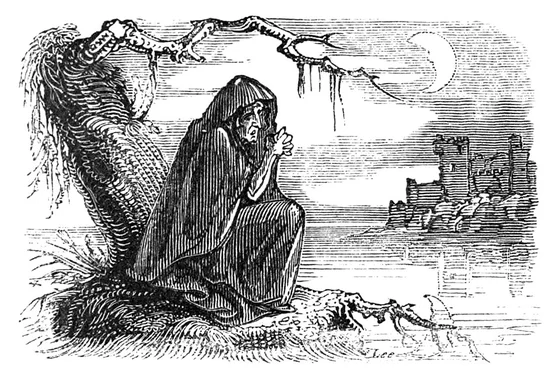
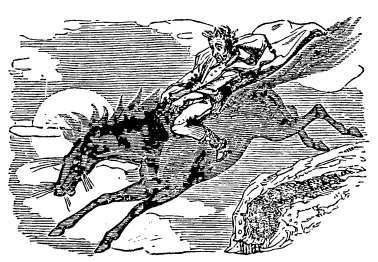
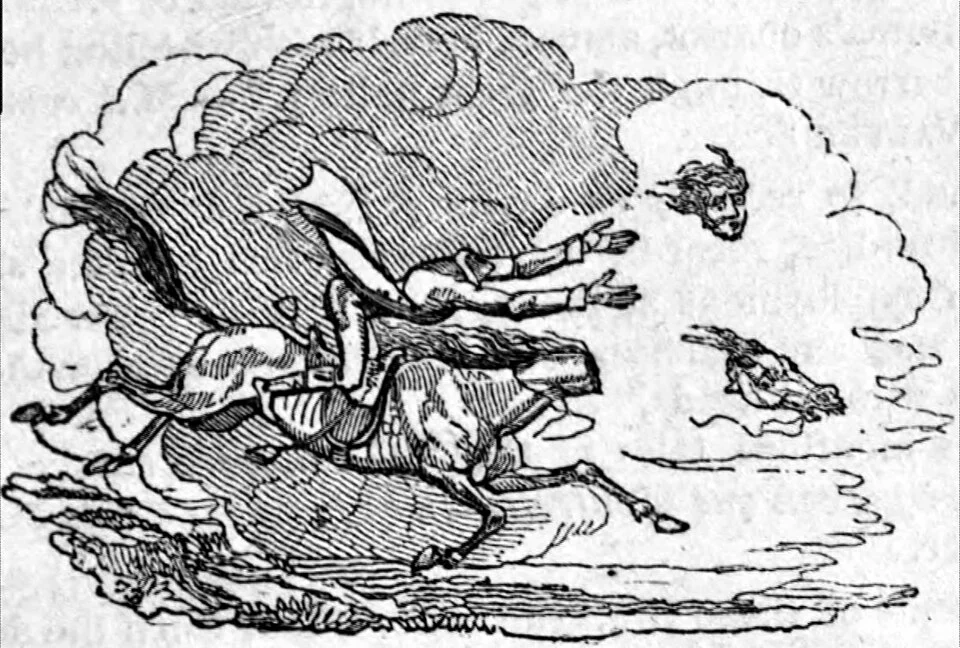
Historical illustration associated with the named tale or folklore collection; this published artistic interpretation does not establish a universal anatomy.
Overview
Charley Culnane’s wet journey beside the Blackwater follows shopping for Christmas provisions, meticulous attention to his riding equipment and drinking with a friend. He worries about a wager on his mare before noticing a detached white horse’s head moving through the air. Its corresponding body soon trots beside him, bearing a headless hunter in an old-fashioned scarlet coat. Charley’s sporting eye estimates the steed at eighteen and a half hands and its rider at least eight feet; these are the character’s measurements within the tale. A hoarse voice directs him to look beneath the rider’s right arm, where the missing head rests. The face has stretched pallid skin, great fiery moving eyes, a wide mouth and tangled black hair. The horse’s cropped-eared head remains ahead of the body while the rider manages without whip, spurs or useful stirrups.
Charley first tries remarks about the rider’s technique and coat, receiving only grunts. His praise of the horse finally draws an answer, and he then raises the possibility of riding across country. The apparition invites the trial and guarantees the mare’s safety, preserving who initiated this exchange. They jump obstacles at speed until the stranger calls a halt. He says horse and rider broke their necks a century earlier and that no previous living companion dared ride with them. Praising Charley’s courage, he promises continued support. His head is subsequently in the coat pocket, the horse’s head rises vertically, and both bodies follow out of sight. Charley’s listeners blame the whisky, yet his later wager succeeds. Croker’s separate notes discuss death-coach omens; that comparison does not turn this helpful rider into an automatic death sentence or establish unmentioned spinal whips and fear of gold.
Croker’s The Good Woman expands the Dullahan beyond a solitary mounted figure. Larry Dodd offers a silent cloaked woman a ride, then follows her into Kilnaslattery churchyard after she dismounts. Only when he catches her does he discover that she has no head. Through the ruined church window he sees headless dancers in varied clothing circling a wheel decorated with skulls. Skeletons excluded from the dance bowl their own heads at one another, while detached heads rise and speak. The scene combines a headless woman, a festive company and mobile heads rather than one uniform rider.
After Larry falls among them, one participant catches his own head, carries it under his arm and offers a cup. On drinking, Larry finds his own head dancing above his shoulders. He later wakes bruised in the church, with his head firmly attached and his recently purchased horse missing. He blames the Dullahans for its disappearance, but the narration does not show them taking it. The ending returns to his wife’s anger and his evasive explanation of following the woman. His confused recollection and intact head leave the revel as a narrated nocturnal experience, not proof of permanent decapitation.
Origins & earliest records
Croker’s 1844 selected revised edition places The Headless Horseman within its Dullahan material. The accompanying notes supply related headless apparitions and death-coach terminology, plus disputed etymology. The accident a century earlier is the character’s account, not independently dated history or the tradition’s first attestation.
Records & interpretation
The full tale witnesses detached heads, appearance, the precisely attributed invitation, accident explanation and promised aid. Its narrator also presents sceptical listeners and a successful wager. These establish literary framing, without verifying Charley’s experience, the measurements or an actual century-old death.
Selected bibliography
Documented works and useful reading. This is not a list of every appearance.
- 01
Fairy Legends and Traditions of the South of Ireland, The Headless Horseman, XXIX, pp 169–178
Inspected selected tale and section notes. Condensed/revised edition and editorial comparisons distinguished from oral origins.
- 02
Fairy Legends XXVI: The Good Woman, pp. 155–163
Complete encounter and domestic aftermath; Larry’s claim of horse theft is not an independently narrated action. Headless woman and communal dancers remain distinct from the other horseman episode.
Family & connections
A source-supported family tree or inspiration record has not yet been compiled for this profile. Related reading below indicates a connection in subject matter, not a proven lineage or creative influence.
Encyclopedia background
An additional attributed reference, separate from the editorial profile above.
Read the open encyclopedia overview
The Dullahan (Irish: Dubhlachan; dúlachán, ) is a type of legendary creature in Irish folklore. He is depicted as a headless rider on a black horse, or as a coachman, who carries his own head. Since it is not widely talked about, his origin in Irish folklore is questionable.
Text from Wikipedia contributors, “Dullahan”. CC BY-SA 4.0. Extracted introduction; formatting changed. Retrieved 5 October 2026. The source article may have changed since retrieval.
References
Sources supporting this profile. Linked pages have their own scope and editorial standards.
- Primary textCroker, Fairy Legends,1844 selected edition, The Headless Horseman, XXIX, pp 169–178Research access: 2026-10-05
- Primary edited folklore narrativeCroker, 1844: The Good WomanResearch access: 2026-10-05
Image credits
Historical illustrationDullahan
Historical illustration associated with the named tale or folklore collection; this published artistic interpretation does not establish a universal anatomy.