A sourced illustration has not yet been added. This gap is included in the coverage record.
Overview
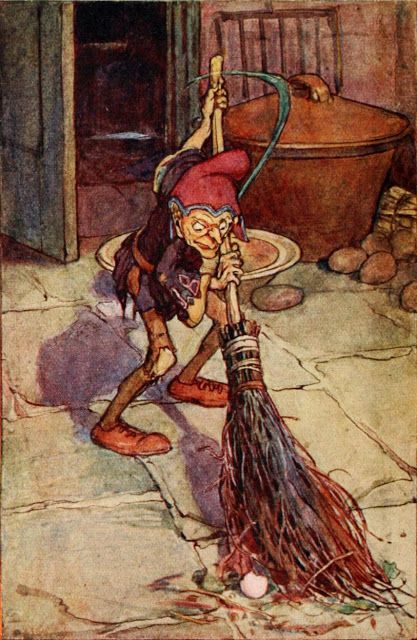
In the dairy account, a maid leaves cream beside the hearth and finds that the Bwbach has done most of the churning overnight. Sikes later calls its usual appearance brown and often hairy, but its behaviour is more prominent than its body. His Cardiganshire story places the creature in a household whose convivial customs conflict with those of a visiting Baptist preacher.
The spirit pulls a stool away during prayer, rattles the hearth implements and disturbs people and dogs. Its most alarming trick is to appear as the preacher's exact double, including his hymn-book, before he leaves the district. Another report has it join him on horseback. Sikes also discusses aerial transport attributed to household phantoms. These episodes make a single morally neat picture of the helpful goblin inadequate, and the collector acknowledges overlap between local spirit categories.
Origins & earliest records
British Goblins, printed in 1880, is the selected witness for the dairy and preacher narratives and for Sikes's description of the Bwbach's changing classifications. The collection is an English-language editorial treatment of Welsh material. Its comparisons and proposed word histories should not be taken as established proof of where the being or name first originated.
Records & interpretation
The collection preserves domestic-work motifs, an attributed preacher narrative and a descriptive comment on colour and hair. These are sources for the creature's recorded narrative roles. They are not documentary proof that invisible work was performed, nor does the similar behaviour of brownies and other household beings demonstrate that the names are universally interchangeable.
In the literature
“the Bwbach has emptied the basin of cream”
Book I, chapter II; printed p. 30
A household helper churns butter after receiving cream.
Selected bibliography
Documented works and useful reading. This is not a list of every appearance.
- 01
British Goblins: Welsh Folk-lore, Fairy Mythology, Legends and Traditions
Book I, chapter II, pp. 30–33; chapter XI, p. 133. Selected inspected witness; bibliography is not exhaustive.
- 02
British Goblins: Welsh Folk-lore, Fairy Mythology, Legends and Traditions — Book I, chapter II
London: Sampson Low, Marston, Searle & Rivington, 1880. Original English compilation by Wirt Sikes; hosted Project Gutenberg transcription retains printed page anchors. Selected reports, quoted older authorities and the compiler’s comparative theories are distinguished.
Family & connections
A source-supported family tree or inspiration record has not yet been compiled for this profile. Related reading below indicates a connection in subject matter, not a proven lineage or creative influence.
Located primary passages
Specific passages supporting details in this entry, grouped by their published witness.
British Goblins: Welsh Folk-lore, Fairy Mythology, Legends and Traditions — Book I, chapter II
London: Sampson Low, Marston, Searle & Rivington, 1880. Original English compilation by Wirt Sikes; hosted Project Gutenberg transcription retains printed page anchors. Selected reports, quoted older authorities and the compiler’s comparative theories are distinguished.
- The tidy maid leaves cream and a filled churn on the hearth; the morning account attributes the nearly finished butter to Bwbach’s nocturnal work.
- A Cardiganshire Bwbach harasses a preacher with overturned furniture, noise and a double of the man, then reportedly rides behind him as he leaves; the source links these pranks to hostility toward abstinence.
Selected complete episodes read in the hosted primary compilation. Earlier Jones, Iolo MSS., Pughe and Vale of Glamorgan citations are attributed as Sikes’s sources; their original editions have not been independently checked here. The compiler’s broad comparative etymologies are not adopted as established modern scholarship.
Encyclopedia background
An additional attributed reference, separate from the editorial profile above.
Read the open encyclopedia overview
A brownie or broonie (Scots), also known as a brùnaidh or gruagach (Scottish Gaelic), is a household spirit or hobgoblin from Scottish folklore that is said to come out at night while the owners of the house are asleep and perform various chores and farming tasks. The human owners of the house must leave a bowl of milk or cream or some other offering for the brownie, usually by the hearth. Brownies are described as easily offended and will leave their homes forever if they feel they have been insulted or in any way taken advantage of. Brownies are characteristically mischievous and are often said to punish or pull pranks on lazy servants.
Brownies originated as domestic tutelary spirits, very similar to the Lares of ancient Roman tradition. Descriptions of brownies vary regionally, but they are usually described as ugly, brown-skinned, and covered in hair. In the oldest stories, they are usually human-sized or larger. In more recent times, they have come to be seen as small and wizened. They are often capable of turning invisible, and they sometimes appear in the shapes of animals. They are always either naked or dressed in rags. If a person attempts to present a brownie with clothing or baptize it, it will leave forever.
Regional variants in England and Scotland include hobs, and ùruisgs. Variants outside England and Scotland are the Welsh Bwbach and the Manx Fenodyree. Brownies have also appeared outside of folklore, including in John Milton's poem L'Allegro. They became popular in works of children's literature in the late nineteenth century and continue to appear in works of modern fantasy. The Brownies in the Girl Guides are named after a short story by Juliana Horatia Ewing based on brownie folklore.
Text from Wikipedia contributors, “Brownie (folklore)”. CC BY-SA 4.0. Extracted introduction; formatting changed. Retrieved 5 October 2026. The source article may have changed since retrieval.
References
Sources supporting this profile. Linked pages have their own scope and editorial standards.
- Primary textSikes, British Goblins: Book I, chapter II, pp. 30–33; chapter XI, p. 133Research access: 2026-10-05
Image credits
A sourced illustration has not yet been added. This gap is included in the coverage record.