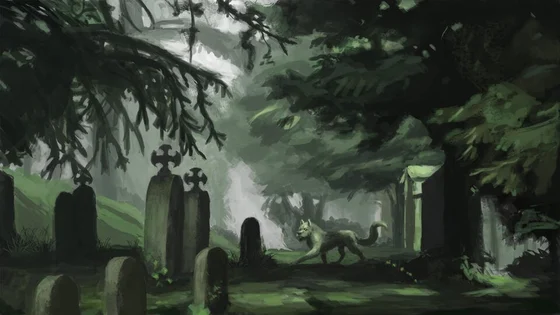
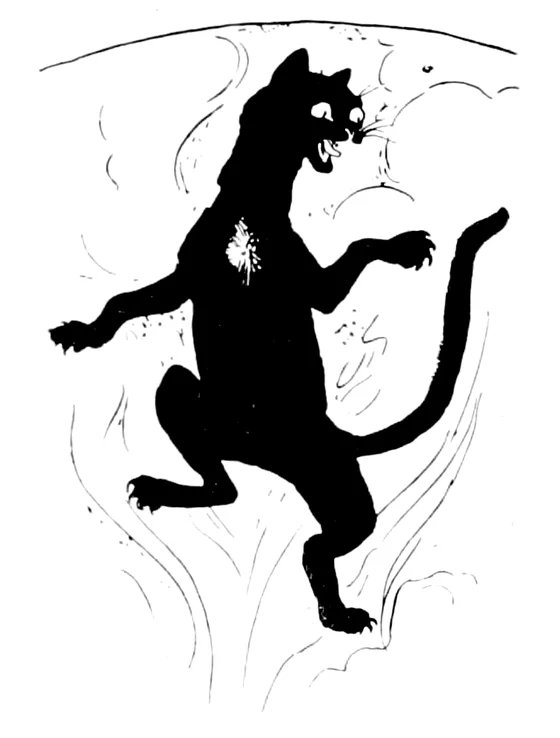
A sourced illustration has not yet been added. This gap is included in the coverage record.
Overview
Sikes describes the Gwyllgi as an enormous mastiff with burning red eyes and threatening breath. In the Lisworney lane story, a farmer's mare throws him and bolts home; the servants find both horse and rider shaken. Another narrator sees a doglike body beneath a vaguely human upper shape. His thrown hat passes through the apparition, which then disappears.
A different Pembrokeshire account makes a fighting mastiff refuse to attack the spectre at the Devil's Nags. Fire illuminates its white nose-mark, teeth and tail. These changing details belong to particular reported encounters, rather than one fixed anatomy. Sikes compares the Gwyllgi with Manx and Norfolk dogs, but explicitly separates its dangerous presence from the death-warning role of the sky-hounds.
Origins & earliest records
The selected witness is Wirt Sikes's British Goblins, published in 1880, which combines local reports with material from earlier collectors such as Edmund Jones. Its printed accounts establish a nineteenth-century record of the name and associated encounters; neither their publication dates nor the narrators' claimed experiences determine the tradition's oral beginning.
Records & interpretation
Sikes supplies named places, a horse's panic and witnesses' descriptions, including an account in which a hat passes through the dog. These are evidence for narrated belief and its presentation in a folklore collection. They are not authenticated observations of an undiscovered animal, and the collector's comparisons do not establish common biological identity.
In the literature
“the glare of its fiery eyes”
Book II, chapter III; printed p. 169
Sikes describes the terror attributed to encounters with the spectral dog.
Selected bibliography
Documented works and useful reading. This is not a list of every appearance.
- 01
British Goblins: Welsh Folk-lore, Fairy Mythology, Legends and Traditions
Book II, chapter III, pp. 169–173. Selected inspected witness; bibliography is not exhaustive.
- 02
British Goblins: Welsh Folk-lore, Fairy Mythology, Legends and Traditions — Book II, chapter III
London: Sampson Low, Marston, Searle & Rivington, 1880. Original English compilation by Wirt Sikes; hosted Project Gutenberg transcription retains printed page anchors. Selected reports, quoted older authorities and the compiler’s comparative theories are distinguished.
Family & connections
A source-supported family tree or inspiration record has not yet been compiled for this profile. Related reading below indicates a connection in subject matter, not a proven lineage or creative influence.
Located primary passages
Specific passages supporting details in this entry, grouped by their published witness.
British Goblins: Welsh Folk-lore, Fairy Mythology, Legends and Traditions — Book II, chapter III
London: Sampson Low, Marston, Searle & Rivington, 1880. Original English compilation by Wirt Sikes; hosted Project Gutenberg transcription retains printed page anchors. Selected reports, quoted older authorities and the compiler’s comparative theories are distinguished.
- Jenkin’s mare throws him in the haunted lane, while servant Anthony reports shining eyes and a partly human, partly spotted-dog shape that disappears when he throws his hat through it.
Book II, chapter III; pp. 169–170; Lisworney-Crossways reports
- In the account cited from Jones’s Apparitions, Walter returns with a mastiff after being thrown over a hedge; the dog refuses to attack the apparition, which appears within a circle of fire.
Book II, chapter III; p. 170; David Walter at the Devil’s Nags
- Rebecca passes the reputedly haunted pit, then encounters a dog whose powerful scream makes her faint; she later returns home exhausted.
Book II, chapter III; pp. 170–171; Rebecca Adams at Pant y Madog
Selected complete episodes read in the hosted primary compilation. Earlier Jones, Iolo MSS., Pughe and Vale of Glamorgan citations are attributed as Sikes’s sources; their original editions have not been independently checked here. The compiler’s broad comparative etymologies are not adopted as established modern scholarship.
Encyclopedia background
An additional attributed reference, separate from the editorial profile above.
Read the open encyclopedia overview
The gwyllgi (Welsh pronunciation: [ˈɡwɪɬɡi]; compound noun of either gwyllt "wild" or gwyll "twilight" + ci "dog") is a mythical dog from Wales that appears as a frightful apparition of a mastiff or black wolf with baleful breath and blazing red eyes. It is the Welsh incarnation of the black dog figure of English folklore.
Text from Wikipedia contributors, “Gwyllgi”. CC BY-SA 4.0. Extracted introduction; formatting changed. Retrieved 5 October 2026. The source article may have changed since retrieval.
References
Sources supporting this profile. Linked pages have their own scope and editorial standards.
- Primary textSikes, British Goblins: Book II, chapter III, pp. 169–173Research access: 2026-10-05
Image credits
A sourced illustration has not yet been added. This gap is included in the coverage record.