Cù sìth
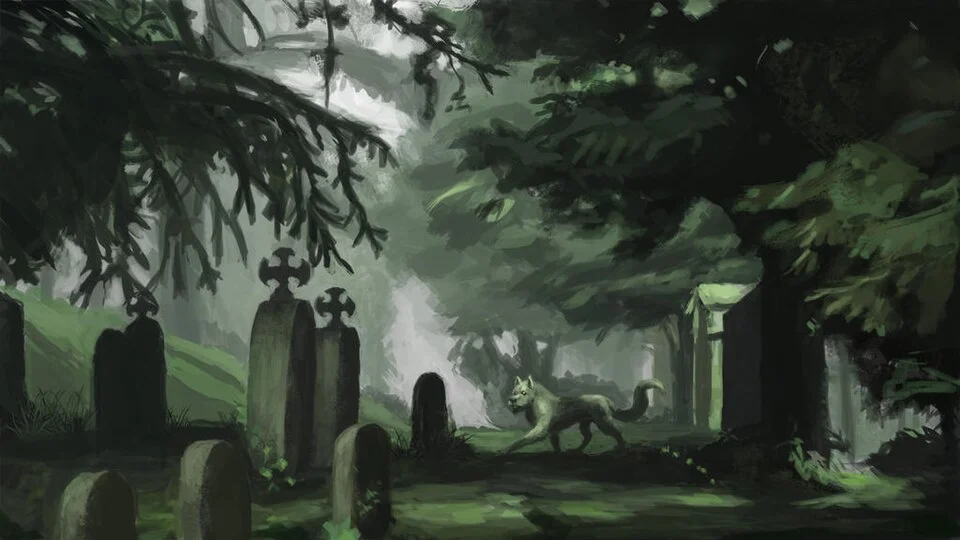
Named modern artistic interpretation of the traditional being; not a historical plate or a biological photograph. Artist and reuse license are credited separately.
Overview
The general account gives the hound an unusually large body, green colouring and a conspicuously arranged tail, though the tail’s form varies. Its movement can be silent, while its bay is far louder than an ordinary dog’s. A three-bark danger motif links the sound to the listener’s urgent need for shelter. These features belong to the collected accounts and should not be made a measurement of a natural breed.
Tiree stories place alarming black hounds and exceptionally large footprints on beaches and sandbanks. One woman’s remembered childhood encounter involves her father taking her hand and running with her into the house after a loud distant bay. A Lorn account describes green pups in a rocky lair, feared by a shepherd and his own dogs. Those episodes strengthen the physical and landscape description while retaining reported variation. The record supplies supernatural interpretation of traces and sound, not independently authenticated tracks or one universal colour for every cù sìth.
Origins & earliest records
Campbell’s1900 collection places general fairy-hound material beside named Hebridean narratives, particularly from Tiree. The selected printed witness distinguishes portrayals and reports rather than proving their oral beginnings. Black and green forms are retained as collected variation, without asserting that every district described the same hound or meaning for its bark.
Records & interpretation
The inspected sections support unusual size, colour variants, tail descriptions, bark danger and particular reported footprints or lairs. These are narrative claims and interpretations within a folklore collection. They do not identify a zoological breed, authenticate preserved tracks or prove that a supernatural animal caused the sounds described.
Selected bibliography
Documented works and useful reading. This is not a list of every appearance.
- 01
Superstitions of the Highlands and Islands of Scotland, chapterI pp31–32; chapterII pp141–144
Selected passage inspected; regional differences and collector interpretations remain attributed.
Family & connections
A source-supported family tree or inspiration record has not yet been compiled for this profile. Related reading below indicates a connection in subject matter, not a proven lineage or creative influence.
Encyclopedia background
An additional attributed reference, separate from the editorial profile above.
Read the open encyclopedia overview
The cù-sìth(e) (Scottish Gaelic pronunciation: [kʰuː ˈʃiː]), plural coin-shìth(e) (Scottish Gaelic pronunciation: [kʰɔɲ ˈhiː]) is a mythical hound found in Irish folklore and Scottish folklore. In Irish folklore it is spelled cú sídhe, and it also bears some resemblance to the Welsh Cŵn Annwn.
The cù-sìth is thought to make its home in the clefts of rocks and to roam the moors of the Highlands. It is usually described as having a shaggy, dark green coat with deeper green fur on the ears and more yellow fur towards the feet. It is said to be the size of a small cow with footprints about the width of a human hand with splayed fingers. The tail is sometimes described as long and coiled up on its back, and sometimes as flat and plaited "like the straw rug of a pack-saddle".
The Cù-Sìth was considered to be more dangerous than the similar Cat-Sith, as it was able to take the souls of the living as opposed to just those of the dead.
According to legend, the creature was capable of hunting silently, but would occasionally let out three terrifying barks, and only three, that could be heard for miles by those listening for it, even far out at sea. Those who hear the barking of the Cù-Sìth must reach safety by the third bark or be overcome with terror to the point of death. Women who were breastfeeding were considered more vulnerable to attacks of the Cù-Sìth, as it was believed that the it would kidnap the them and force them to nurse faerie children. Some sources say that it only ever traveled in a straight line while hunting. In addition to humans, it also preyed on other dogs. When Coin-shìth weren't hunting, they were used by the Fae Folk as watchdogs or as expedition companions.
Text from Wikipedia contributors, “Cù-sìth”. CC BY-SA 4.0. Extracted introduction; formatting changed. Retrieved 5 October 2026. The source article may have changed since retrieval.
References
Sources supporting this profile. Linked pages have their own scope and editorial standards.
- Primary textCampbell, Superstitions of the Highlands and Islands of Scotland, chapterI pp31–32; chapterII pp141–144Research access: 2026-10-05
Image credits
Thematic illustrationCù sìth
Named modern artistic interpretation of the traditional being; not a historical plate or a biological photograph. Artist and reuse license are credited separately.