A sourced illustration has not yet been added. This gap is included in the coverage record.
Overview
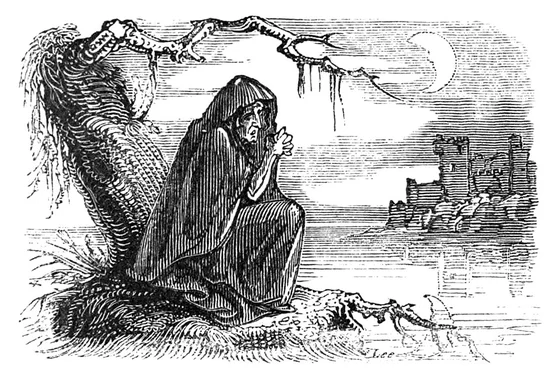
In Sikes's general account, the apparition has tangled hair, long dark teeth, wasted arms and leathery wings. It may beat against a window while calling a person's name, or appear beside water, at crossroads or through mountain mist. Although usually described as female, the cries and gender presentation are not completely uniform in his collected material.
An informant whom Sikes met near Cardiff in 1878 describes an encounter the previous November at Llandaff. This figure has red hair, a chalk-coloured face, tusklike teeth and a trailing black gown; the narrator associates its movements with an innkeeper's death. Sikes compares it with the Irish banshee but treats the Welsh naming and descriptions separately. The story presents an omen of bereavement, rather than establishing that the apparition causes the death.
Origins & earliest records
Sikes's 1880 volume is the selected printed witness, with the Llandaff narration attributed to a conversation in summer 1878. He also refers to earlier collections and literary parallels. These are successive records of interpretation and storytelling; the date of a reported encounter is not an independently verified apparition date or an origin for the tradition.
Records & interpretation
The evidence consists of a collector's descriptive synthesis and his written version of an informant's testimony. Its named location and reported death make the episode traceable as a narrative, but do not independently prove the supernatural connection. The visible, winged figure must also be distinguished from the mainly audible Cyhyraeth in the same collection.
In the literature
“long black teeth, long, lank, withered arms, leathern wings”
Book II, chapter VII; printed p. 216
The compiler’s opening description gives the apparition teeth, withered arms and wings.
Selected bibliography
Documented works and useful reading. This is not a list of every appearance.
- 01
British Goblins: Welsh Folk-lore, Fairy Mythology, Legends and Traditions
Book II, chapter VII, pp. 216–219. Selected inspected witness; bibliography is not exhaustive.
- 02
British Goblins: Welsh Folk-lore, Fairy Mythology, Legends and Traditions — Book II, chapter VII
London: Sampson Low, Marston, Searle & Rivington, 1880. Original English compilation by Wirt Sikes; hosted Project Gutenberg transcription retains printed page anchors. Selected reports, quoted older authorities and the compiler’s comparative theories are distinguished.
Family & connections
A source-supported family tree or inspiration record has not yet been compiled for this profile. Related reading below indicates a connection in subject matter, not a proven lineage or creative influence.
Located primary passages
Specific passages supporting details in this entry, grouped by their published witness.
British Goblins: Welsh Folk-lore, Fairy Mythology, Legends and Traditions — Book II, chapter VII
London: Sampson Low, Marston, Searle & Rivington, 1880. Original English compilation by Wirt Sikes; hosted Project Gutenberg transcription retains printed page anchors. Selected reports, quoted older authorities and the compiler’s comparative theories are distinguished.
- Sikes describes an ugly winged apparition that strikes windows and calls the prospective dead by name, with further variations at misty hills, crossroads and water.
Book II, chapter VII; pp. 216–217; appearance and named warning
- An unnamed farmer-class narrator tells Sikes of screeching, window shaking and an apparition entering the Cow and Snuffers Inn, followed by news of innkeeper Llewellyn’s death; this is presented as the narrator’s claim.
Book II, chapter VII; pp. 217–218; Llandaff narrator interviewed in summer 1878
Selected complete episodes read in the hosted primary compilation. Earlier Jones, Iolo MSS., Pughe and Vale of Glamorgan citations are attributed as Sikes’s sources; their original editions have not been independently checked here. The compiler’s broad comparative etymologies are not adopted as established modern scholarship.
Encyclopedia background
An additional attributed reference, separate from the editorial profile above.
Read the open encyclopedia overview
The cyhyraeth (Welsh pronunciation: [kəˈhəreθ]) is a ghostly spirit in Welsh mythology, a disembodied moaning voice that sounds before a person's death.
Legends associate the cyhyraeth with the area around the River Tywi in eastern Dyfed, as well as the coast of Glamorganshire. The noise is said to be "doleful and disagreeable", like the groans and sighs of someone deathly ill, and to sound three times (growing weaker and fainter each time) as a threefold warning before the person expires. Along the Glamorganshire coast, the cyhyraeth is said to be heard before a shipwreck, accompanied by a corpse-light.
Like the Irish banshee and the Scottish Cailleach, to which the cyhyraeth and the Gwrach y Rhibyn are closely related, the cyhyraeth also sounds for Welsh natives dying far from home.
Text from Wikipedia contributors, “Cyhyraeth”. CC BY-SA 4.0. Extracted introduction; formatting changed. Retrieved 5 October 2026. The source article may have changed since retrieval.
References
Sources supporting this profile. Linked pages have their own scope and editorial standards.
- Primary textSikes, British Goblins: Book II, chapter VII, pp. 216–219Research access: 2026-10-05
Image credits
A sourced illustration has not yet been added. This gap is included in the coverage record.