A sourced illustration has not yet been added. This gap is included in the coverage record.
Overview
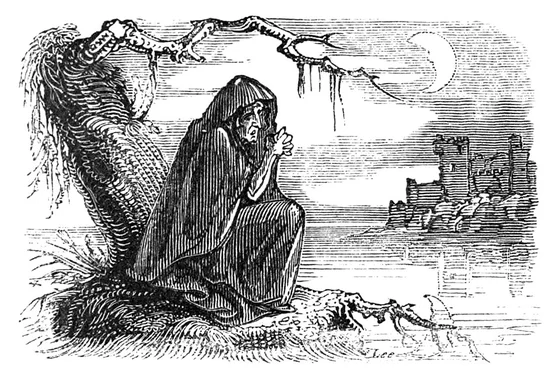
The washer appears beside lonely streams or pools, beating and folding the linen of people soon to die. This activity distinguishes her from a general wailing apparition. Campbell records different physical portrayals, including a compact child-like form in Skye and a small green-clad woman in Perthshire. Mull and Tiree stories supply another strongly bodily description. These alternatives remain located rather than becoming one composite body supposedly reported everywhere.
Encounters can lead to questions about a person’s future, but the stories differ over how the woman is approached or overcome and what she demands in return. One interpretation associates the washing with women who died before their allotted time after childbirth. That explanation belongs to the collected belief and should not be converted into a historical judgment about actual mothers. The profile retains the death-omen function while separating regional narratives and the broader banshee terminology used by the collector.
Origins & earliest records
Campbell’s1900 collection records the selected washing-woman accounts with explicit regional distinctions. The published witness documents collected narratives and interpretations, not the first appearance of the figure. His use of related fairy-woman terminology does not justify erasing the washing motif or making every Irish banshee and Scottish bean nighe interchangeable.
Records & interpretation
The inspected passage supports washing, the connection to anticipated death and regionally different descriptions or encounter conditions. Those details attest collected omen narratives. They do not establish a supernatural cause of death, a biological identity or the truth of the belief that particular deceased women were compelled to perform this labour.
Selected bibliography
Documented works and useful reading. This is not a list of every appearance.
- 01
Superstitions of the Highlands and Islands of Scotland, chapterI, pp42–44
Selected passage inspected; regional differences and collector interpretations remain attributed.
Family & connections
A source-supported family tree or inspiration record has not yet been compiled for this profile. Related reading below indicates a connection in subject matter, not a proven lineage or creative influence.
Encyclopedia background
An additional attributed reference, separate from the editorial profile above.
Read the open encyclopedia overview
The bean-nighe (Scottish Gaelic for 'washerwoman' or 'laundress'; Scottish Gaelic pronunciation: [pɛˈɲi.ə]) is a female spirit in Scottish folklore, regarded as an omen of death and a messenger from the Otherworld. She is a type of ban-sìth (Irish: bean sídhe, anglicized as "banshee") that haunts desolate streams and washes the clothing of those who are about to die. Les Lavandières is the French word under which these "night washerwomen" are perhaps best known. She is also called nigheag, 'the little washer', nigheag na h-ath, 'little washer of the ford', or nigheag bheag a bhroin, 'little washer of the sorrow'.
Text from Wikipedia contributors, “Bean-nighe”. CC BY-SA 4.0. Extracted introduction; formatting changed. Retrieved 5 October 2026. The source article may have changed since retrieval.
References
Sources supporting this profile. Linked pages have their own scope and editorial standards.
- Primary textCampbell, Superstitions of the Highlands and Islands of Scotland, chapterI, pp42–44Research access: 2026-10-05
Image credits
A sourced illustration has not yet been added. This gap is included in the coverage record.