A sourced illustration has not yet been added. This gap is included in the coverage record.
Overview
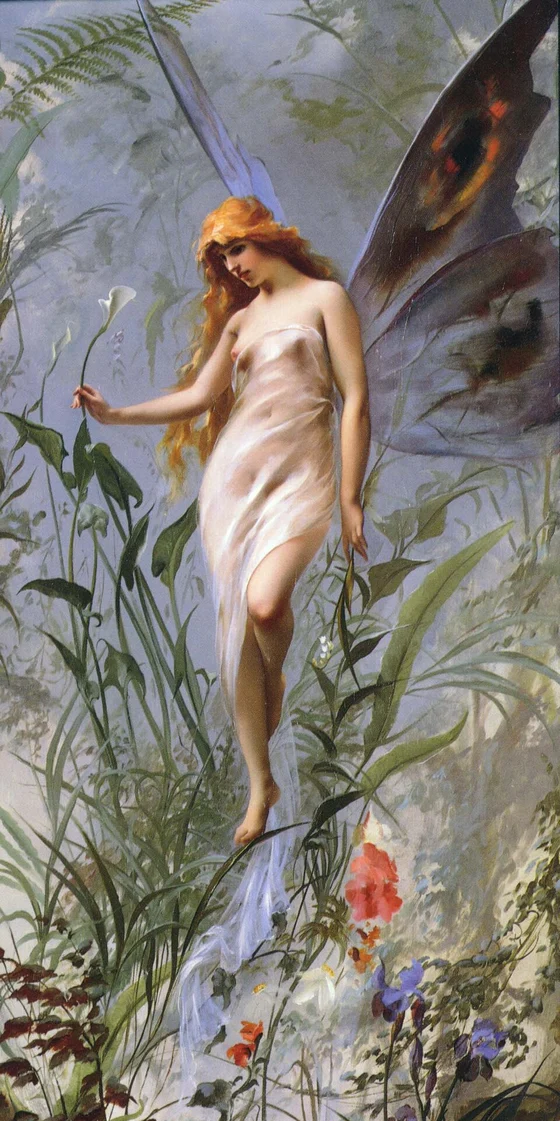
The selected collection describes a spirit whose form varies by locality. In southern Highland accounts she is a small, pale, strong woman; a Skye portrayal makes her tall and slender. Her presence can be heard in household activity even when she is unseen. Campbell gives particular importance to the site or building she haunts, distinguishing attachment to a place from permanent guardianship of one family. His opening portrait gives her long yellow hair reaching to her heels and green clothing.
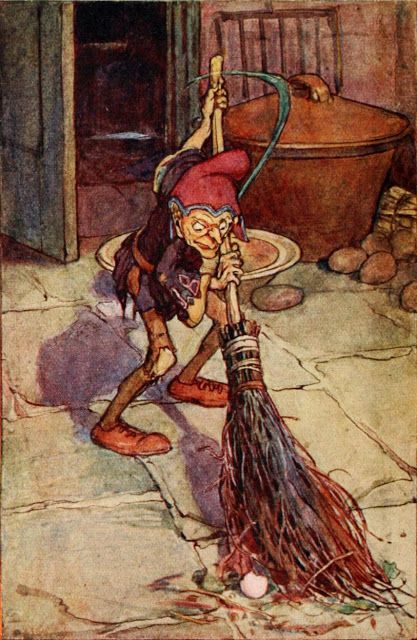
Campbell connects the household spirit with sweeping floors, moving chairs and tables, washing and spinning. Nocturnal sounds sometimes precede visitors, but the furniture can be found either tidied or disarranged in the morning. Neglected duties or disrespect provoke overturned water vessels, disturbed bedding and other pranks. Cattle-haunting accounts associate recognition of her work with a portion of milk. Her attachment to a building can survive changes of tenant, yet levelling that building brings a lament and departure. Campbell explicitly rejects the Highland Society's Dictionary definition of a goat-shaped she-devil; that disagreement remains part of his collected account.
Origins & earliest records
Campbell’s1900 collection supplies the selected Highland accounts and its explicit discussion of competing dictionary definitions. The publication establishes a collected witness, not the beginning of local belief. Reported differences between Skye and southern Highland descriptions are retained rather than combined into one supposedly fixed body shared by all narrators.
Records & interpretation
The inspected chapter supports place attachment, household and cattle duties, varying appearance and Campbell’s objection to a goat-devil definition. It documents recorded tradition and the collector’s interpretation. It does not establish a biological form, confirm unseen labour or prove that every Highland account agreed with the compiler’s preferred description.
Selected bibliography
Documented works and useful reading. This is not a list of every appearance.
- 01
Superstitions of the Highlands and Islands of Scotland, chapterIII, pp155–159
Selected passage inspected; regional differences and collector interpretations remain attributed.
Family & connections
A source-supported family tree or inspiration record has not yet been compiled for this profile. Related reading below indicates a connection in subject matter, not a proven lineage or creative influence.
Encyclopedia background
An additional attributed reference, separate from the editorial profile above.
Read the open encyclopedia overview
The glaistig is a ghost from Scottish mythology, a type of fuath. It is also known as maighdean uaine — the Green Maiden — and may appear as a woman of beauty or monstrous mien, as a half-woman and half-goat similar to a faun or satyr, or in the shape of a goat. The lower goat half of her hybrid form is usually disguised by a long, flowing green robe or dress, and the woman often appears grey with long yellow hair. This appearance may have been influenced by, or influenced, the closely related Norse folklore of "hidden-folk", Old Norse: hulder or huldra, across Scandinavia — along with the Faeroe Isles and Icelandic: Huldufólk — being beautiful women usually hiding legs and tail of an animal like a fox or a goat beneath clothing or long hair, with her named Skogsrå or Skogsfrun, the "Mistress of the Forest" in Swedish folklore.
Text from Wikipedia contributors, “Glaistig”. CC BY-SA 4.0. Extracted introduction; formatting changed. Retrieved 5 October 2026. The source article may have changed since retrieval.
References
Sources supporting this profile. Linked pages have their own scope and editorial standards.
- Primary textCampbell, Superstitions of the Highlands and Islands of Scotland, chapterIII, pp155–159Research access: 2026-10-05
Image credits
A sourced illustration has not yet been added. This gap is included in the coverage record.