A sourced illustration has not yet been added. This gap is included in the coverage record.
Overview
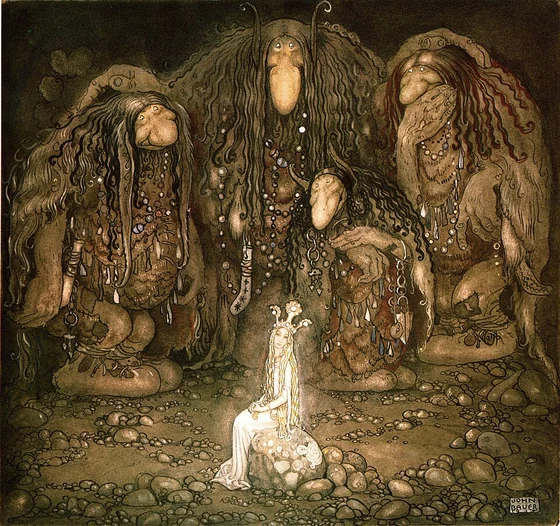
The account often presents a large grey being seen at dusk, seated on a rock or moving away from a traveller. It usually leaves passers-by alone, though some episodes give it speech or aggression. Other stories describe safe guidance for someone delayed outdoors. Campbell distinguishes its customary lonely habitat from the household setting associated with brownies, while acknowledging that narrators sometimes connect them.
In Breadalbane stories an urisk descends from high summer haunts during winter and may help with agricultural work. Named locations, including waterfalls and stones, preserve more specific associations. A milk-loving helper driven away by clothing belongs to those particular episodes. The collection itself cautions that farm assistance was not universally reported. That qualification keeps the remote landscape being from becoming a standard household servant in every version or a generic forest satyr with anatomy absent from the selected prose.
Origins & earliest records
Superstitions of the Highlands and Islands of Scotland,1900, records the selected urisk material with named local associations. The compiler reports variation in helpfulness and distribution. This is a nineteenth-century collection published posthumously, not a secure first attestation or evidence that all Scottish districts maintained the same account of the being.
Records & interpretation
The inspected chapter supports the grey solitary appearance, rocky settings, seasonal descent and selected farm-help episodes. Named stones and falls attest reported landscape associations within the collection. They do not independently verify a creature’s presence, establish physical ancestry from supernatural unions or authenticate every later satyr-like illustration.
Selected bibliography
Documented works and useful reading. This is not a list of every appearance.
- 01
Superstitions of the Highlands and Islands of Scotland, chapterIV, pp195–199
Selected passage inspected; regional differences and collector interpretations remain attributed.
Family & connections
A source-supported family tree or inspiration record has not yet been compiled for this profile. Related reading below indicates a connection in subject matter, not a proven lineage or creative influence.
Encyclopedia background
An additional attributed reference, separate from the editorial profile above.
Read the open encyclopedia overview
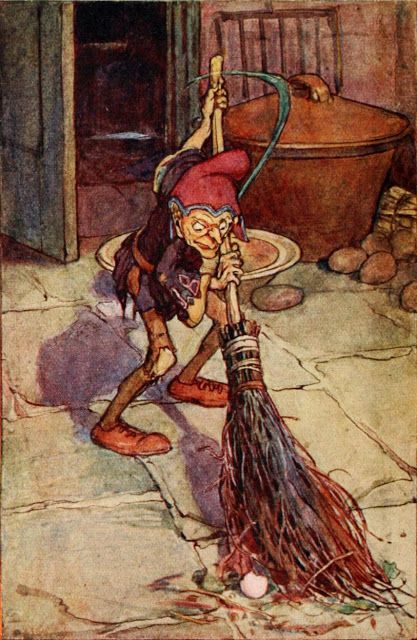
A brownie or broonie (Scots), also known as a brùnaidh or gruagach (Scottish Gaelic), is a household spirit or hobgoblin from Scottish folklore that is said to come out at night while the owners of the house are asleep and perform various chores and farming tasks. The human owners of the house must leave a bowl of milk or cream or some other offering for the brownie, usually by the hearth. Brownies are described as easily offended and will leave their homes forever if they feel they have been insulted or in any way taken advantage of. Brownies are characteristically mischievous and are often said to punish or pull pranks on lazy servants.
Brownies originated as domestic tutelary spirits, very similar to the Lares of ancient Roman tradition. Descriptions of brownies vary regionally, but they are usually described as ugly, brown-skinned, and covered in hair. In the oldest stories, they are usually human-sized or larger. In more recent times, they have come to be seen as small and wizened. They are often capable of turning invisible, and they sometimes appear in the shapes of animals. They are always either naked or dressed in rags. If a person attempts to present a brownie with clothing or baptize it, it will leave forever.
Regional variants in England and Scotland include hobs, and ùruisgs. Variants outside England and Scotland are the Welsh Bwbach and the Manx Fenodyree. Brownies have also appeared outside of folklore, including in John Milton's poem L'Allegro. They became popular in works of children's literature in the late nineteenth century and continue to appear in works of modern fantasy. The Brownies in the Girl Guides are named after a short story by Juliana Horatia Ewing based on brownie folklore.
Text from Wikipedia contributors, “Brownie (folklore)”. CC BY-SA 4.0. Extracted introduction; formatting changed. Retrieved 5 October 2026. The source article may have changed since retrieval.
References
Sources supporting this profile. Linked pages have their own scope and editorial standards.
- Primary textCampbell, Superstitions of the Highlands and Islands of Scotland, chapterIV, pp195–199Research access: 2026-10-05
Image credits
A sourced illustration has not yet been added. This gap is included in the coverage record.