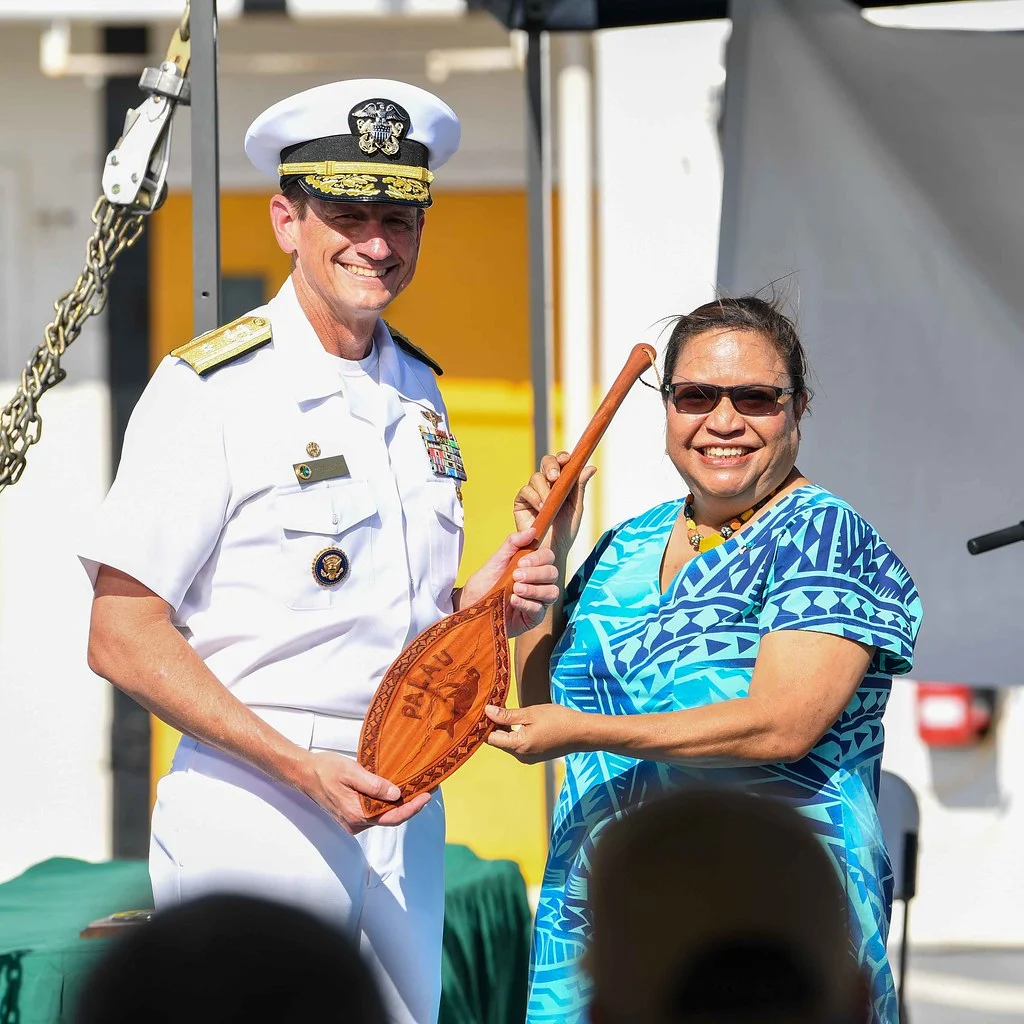
Palau Vice President Uduch Sengebau Senior and U.S. Rear Admiral Gregory Huffman holding a gift aboard USNS Mercy in December 2023
The photograph records a named diplomatic event: Palau Vice President Uduch Sengebau Senior and U.S. Rear Admiral Gregory Huffman exchanging gifts aboard USNS Mercy in December 2023. It provides context for contemporary public institutions, without treating citizenship, public office or clothing as proof of Indigenous identity.
Overview
Rechad er Belau, or Palauans, are identified in the national government’s self-description as the Indigenous people of Belau. The government account links cultural relationships with extended families, island environments and Palauans living abroad. It describes land and ocean stewardship as a responsibility toward later generations, while recognising continuing relationships shaped by contact and exchange. Independence in 1994 is a political milestone, distinct from the origins of the people or their cultural practices. This profile keeps Indigenous identity separate from residence or citizenship and uses selected public institutions and named makers to illustrate contemporary heritage work.
The Belau National Museum describes its role through collection, documentation, preservation and interpretation. Founded in 1955, it opened its new permanent home in 2005. Its objectives include education, research and collaboration with local stakeholders on tangible and intangible heritage. The institution also identifies the development of arts among its responsibilities, placing creative work alongside historical collections. These are the museum’s stated purposes, without a claim that every aspect of Palauan knowledge has been collected. The dates refer to a particular institution and building, rather than an origin point for the heritage it seeks to document.
Named canoe makers give its exhibits a more specific context. The museum identifies the Ngaramelechetech men’s club of Ngchesar State as builders of the kaeb sailing canoe and kabekel war canoe it displays. A Hatohobei fishing and transport canoe is separately credited to Lorenzo Simeon, who made it as a gift for the museum’s fiftieth anniversary. These attributions retain different makers, island settings and functions instead of treating all canoes as anonymous examples of one design. The exhibit descriptions also place household objects and photographs within a historical timeline. No construction instructions or ceremonial procedures are reproduced here.
The museum’s collection account extends this work to recordings and literature. Its media section documents the preservation of older reel tapes, including Palau String Band recordings from the 1960s and stories narrated by Ben Yobech and Daniel Ngirairikl. Jim Geselbracht is credited for voluntary restoration work on the tapes. A research library provides on-site access to historical publications, maps and field notes, while art holdings include both Palauan and non-Palauan makers whose work concerns Palau. The account includes dated 2017 and 2018 reporting, so its figures and staffing details are not treated as a current census of the archive.
The Palau Conservation Society's public account adds a contemporary organisational perspective on environmental responsibility. Founded in 1994, it identifies itself as a non-governmental, non-profit body that works to strengthen community capacity for stewardship of land and sea. Its membership elects a governing board, while its mission connects environmental care with the social and economic interests of later generations. The account also identifies local, regional and international partnerships, including BirdLife International. These statements document an organisation's structure and purposes, rather than assigning its membership to every Palauan or demonstrating conservation outcomes. They show environmental work occurring alongside the museum's documentation of cultural history.
History & identity
Living Indigenous identity; 1994 independence and museum dates concern political and institutional milestones.
Sources & representation
National self-description and scoped museum accounts; named makers and recording contributors retained, older archive data not represented as current totals.
Selected bibliography
Documented works and useful reading. This is not a list of every appearance.
- 01
Who We Are
Complete identity, family, environment and exchange passages read; political status distinct from identity.
- 02
About the Belau National Museum
Complete history, vision and objectives read; institutional dates and aims retained.
- 03
Exhibits
Complete introductory timeline and canoe sections read; club and Lorenzo Simeon maker credits retained.
- 04
Collections
Complete library, art and media sections read; dated archive reporting, without listening to recordings.
- 05
About PCS
Complete public introduction read; organisational stewardship mission, no linked projects or outcomes inspected.
Language & cultural connections
Source-supported language and cultural connections have not yet been compiled for this profile.
References
Sources supporting this profile. Linked pages have their own scope and editorial standards.
- Government self-descriptionWho We AreResearch access: 2026-10-05
- Museum self-descriptionAbout the Belau National MuseumResearch access: 2026-10-05
- Museum exhibit accountExhibitsResearch access: 2026-10-05
- Museum archive accountCollectionsResearch access: 2026-10-05
- Non-profit organisational self-accountAbout PCSResearch access: 2026-10-05
Image credits
Contextual community governance photographPalau Vice President Uduch Sengebau Senior and U.S. Rear Admiral Gregory Huffman holding a gift aboard USNS Mercy in December 2023
The photograph records a named diplomatic event: Palau Vice President Uduch Sengebau Senior and U.S. Rear Admiral Gregory Huffman exchanging gifts aboard USNS Mercy in December 2023. It provides context for contemporary public institutions, without treating citizenship, public office or clothing as proof of Indigenous identity.